

AP Syllabus focus: ‘Weight is the gravitational force on a nearby object, and near Earth the field strength is about 10 N/kg.’
Weight near Earth is a special, simplified case of gravity that shows up in almost every force problem. This page defines weight, links it to gravitational field strength, and clarifies what “near Earth” implies for calculations.
Core idea: weight is a gravitational force
When an object is close to Earth’s surface, Earth exerts an attractive gravitational force on the object. In AP Physics 1 Algebra, that force is called the object’s weight and is treated as approximately constant for typical heights.
Weight: The gravitational force exerted on an object by Earth (or another astronomical body), directed toward that body’s center.
Direction and representation
Direction: straight down toward Earth’s center (locally “downward”).
Free-body diagram: draw weight as a vector from the object’s center of mass, labelled or .
Units: newtons (N), because weight is a force.
Gravitational field strength near Earth
Near Earth’s surface, it is convenient to describe gravity using the local gravitational field strength, commonly called .
Gravitational field strength (): The gravitational force per unit mass experienced by an object at a location; near Earth it is approximately constant.
In AP Physics 1, you will often use (equivalently ) unless greater precision is specified. A more precise common value is .
= weight (N)
= mass (kg)
= gravitational field strength near Earth ( or )
This relationship encodes the syllabus statement that near Earth the field strength is about 10 N/kg: a mass has a weight of about .
What “near Earth” means (and why is treated as constant)
“Near Earth” means the object’s height above the surface is small compared with Earth’s radius, so the distance to Earth’s center is essentially unchanged. Under this condition:
The magnitude of is approximately the same from one location in the problem to another.
Therefore, weight is proportional to mass with a nearly constant proportionality factor .
This is why AP Physics 1 commonly models weight as a constant force in everyday-scale situations (labs, inclines, elevators, blocks, carts).
Mass vs weight (common AP Physics 1 confusion)
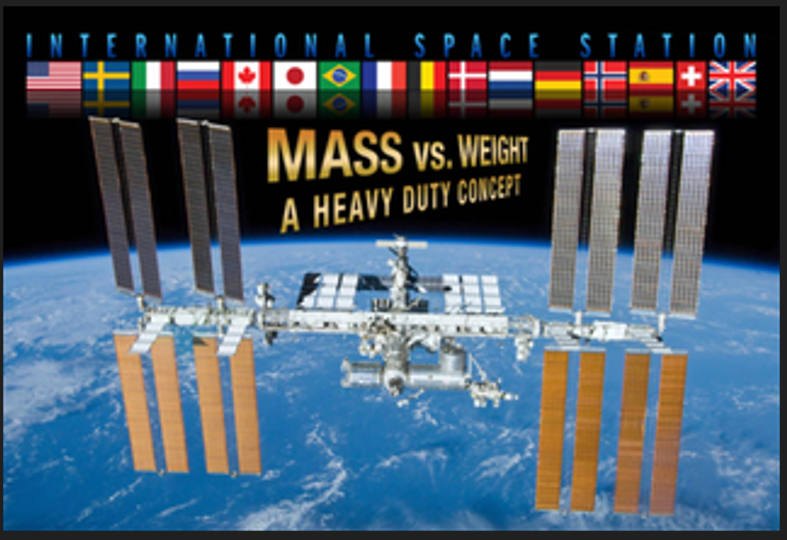
Mass is an intrinsic property of an object, while weight is the gravitational force the object experiences in a particular environment. The space-station context is a useful reminder that “microgravity” does not mean gravity is absent; rather, the situation changes how weight/scale readings and motion are interpreted. Source
Mass is a property of the object (amount of matter/inertia) and does not change when you move the object from place to place.
Weight depends on the local gravitational field; it can change if changes.
Language matters:
“The object weighs 500 N” describes a force.
“The object has a mass of 50 kg” describes an intrinsic property.
Practical notes for problem setup
Choosing
Use when the question signals an estimate, uses simple integers, or explicitly states that approximation.
Use when a more precise value is given or expected.
Sign conventions
Weight points downward; whether it is positive or negative in your equations depends on your chosen axis:
If up is positive, then the weight component is typically negative (e.g., ).
If down is positive, then weight is typically positive (e.g., ).
Practice Questions
(2 marks) A student holds a object at rest near Earth’s surface. Take . State the object’s weight and its direction.
(1)
Direction: vertically downward / towards Earth’s centre (1)
(5 marks) A crate of mass is weighed using a spring scale near Earth. The scale reads when the crate is stationary.
(a) Taking , determine . (2 marks)
(b) The same crate is taken to a location where . State the crate’s new weight. (2 marks)
(c) State one reason AP problems often approximate as . (1 mark)
(a) (2)
(b) (2)
(c) Any valid statement, e.g. simplifies arithmetic / values are close near Earth’s surface so the approximation is reasonable (1)
FAQ
They are equivalent because $1\ \text{N} = 1\ \text{kg}\cdot\text{m/s}^2$.
So $\text{N/kg} = (\text{kg}\cdot\text{m/s}^2)/\text{kg} = \text{m/s}^2$.
“Down” is a local approximation to the direction towards Earth’s centre.
On small scales (classroom/lab), the difference is negligible, so both descriptions match.
Not by itself. Weight depends on $m$ and the local $g$, not the object’s velocity.
Only a change in $g$ (location) changes $W=mg$.
$g$ varies slightly with latitude and altitude.
AP Physics 1 typically ignores these variations and uses a constant $g$ unless a problem explicitly provides a different value.
A typical scale measures a force (often the support force on you) and converts it to a mass reading by assuming a value of $g$.
If $g$ changes, the same force-based reading would correspond to a different displayed “mass” unless recalibrated.
