

AP Syllabus focus: ‘If the distance between systems changes very little, gravitational force can be treated as constant.’
When applying Newton’s laws near Earth, you often assume gravity is constant to simplify force and motion equations. This approximation is valid only when position changes are small compared with the relevant gravitational distance scale.
What “gravity is constant” means (and what it doesn’t)
Treating gravity as constant means the gravitational force magnitude on an object and the gravitational field strength at its location do not change appreciably during the motion being analysed.
Direction: near Earth’s surface, gravity is taken to point straight down (toward Earth’s centre).
Magnitude: the gravitational field strength is taken as a constant value, typically (often rounded to when appropriate).
This is an approximation, not a new law; the true gravitational force depends on separation distance.
Distance dependence of gravity
The reason the approximation can work is that gravity varies with distance by an inverse-square relationship, so small fractional changes in distance produce small fractional changes in force.
= gravitational force magnitude (N)
= mass of object 1 (kg)
= mass of object 2 (kg)
= centre-to-centre separation distance (m)
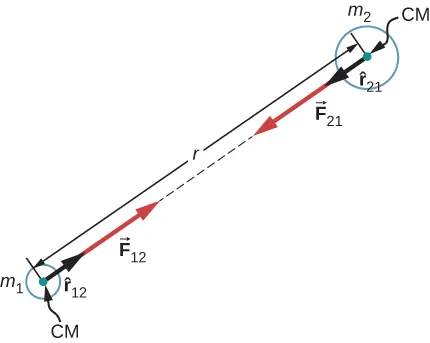
This diagram shows two masses separated by a center-to-center distance , with the gravitational forces drawn along the line connecting their centers of mass. It reinforces the meaning of in and visually connects Newton’s third-law force pair to the geometry of the interaction. Source
= universal gravitational constant ()
For near-Earth motion, one of the masses is Earth, and the object’s distance from Earth’s centre is , where is altitude above the surface.
The “small change in distance” condition
A practical way to state the syllabus idea (“distance changes very little”) is as a small fractional change in :
If the motion changes the object’s distance from Earth’s centre by a small amount compared with itself, then and change very little.
Near the surface, is very large, so everyday heights and vertical displacements often satisfy .
Because , the fractional change behaves approximately like:
for small .
So even a noticeable height change in a lab can correspond to a tiny percentage change in , making the change in gravity negligible for AP Physics 1 modelling.
Consequences for modelling forces and motion
When gravity can be treated as constant, you can use a uniform gravitational field model, which simplifies dynamics:
Uniform gravitational field: A region where the gravitational field strength is effectively constant in magnitude and direction.
In this model:
The gravitational force on an object is treated as constant: with constant .
Acceleration due to gravity is treated as constant, so kinematics with constant acceleration can be used in the vertical direction when other forces are accounted for.
In multi-step Newton’s second law problems, you do not need to update as the object moves slightly (e.g., over a ramp height, short drop, or elevator travel).
When the constant-gravity approximation can fail
You should question the approximation when the object’s distance from the attracting body changes enough that the inverse-square variation matters.
Indicators that may not be treated as constant:
The motion involves large changes in altitude compared with the planet’s radius.
The scenario involves space-scale distances where changes substantially.
The problem statement provides (or asks for) changing explicitly, suggesting you should use the inverse-square dependence rather than a constant .
In AP Physics 1 Algebra, the key skill is recognising when “distance changes very little” is a valid assumption so that gravity can be modelled as constant without significantly affecting predicted motion.
Practice Questions
(2 marks) A ball moves from height to the ground. State whether it is reasonable to treat gravitational force as constant during the motion, and briefly justify your answer.
States that it is reasonable to treat gravity as constant (1)
Justifies using “distance from Earth’s centre changes very little” / / negligible change in so negligible change in or (1)
(6 marks) A probe moves directly away from a planet from distance to from the planet’s centre. (a) By what factor does the gravitational force change? (2) (b) Explain whether gravity can be treated as constant over this motion. (2) (c) Give one modelling consequence of incorrectly treating gravity as constant here. (2)
(a) Uses (1)
(a) Calculates factor: at is of initial (or decreases by factor 9) (1)
(b) States not valid to treat as constant (1)
(b) Explains large change in separation distance so significant change in force/field strength (1)
(c) Identifies consequence: predicts wrong acceleration/trajectory/time because assumes constant (1)
(c) Links to the need to vary force with (1)
FAQ
Use a fractional-change idea: if $\Delta r/r$ is very small, then the change in gravity is very small.
A rough guide is $\Delta F/F \approx 2\Delta r/r$; if that percentage is negligible for the required precision, the constant-$g$ model is acceptable.
Because the distance to the centre is dominated by the planet’s radius.
Even if you move tens or hundreds of metres vertically, $r$ changes by a tiny fraction compared with $R_E$, so $1/r^2$ barely changes.
Only within the same approximation: if $g$ is constant and the object’s mass is constant, then the gravitational force magnitude $mg$ is constant.
If $g$ changes noticeably with altitude, then weight changes too.
Only on position (distance from the attracting body).
At a given location, different masses experience different force $F_g$, but the same field strength $g=F_g/m$.
Assuming $g=9.8\ \text{m/s}^2$ applies at any distance without checking how much $r$ changes.
If $r$ changes by a large factor, you must let gravity vary as $1/r^2$ rather than treating it as constant.
