

AP Syllabus focus: ‘Apparent weight is the magnitude of the normal force, which can differ from gravitational force when a system accelerates.’
Apparent weight can feel different from your true gravitational weight whenever you accelerate.
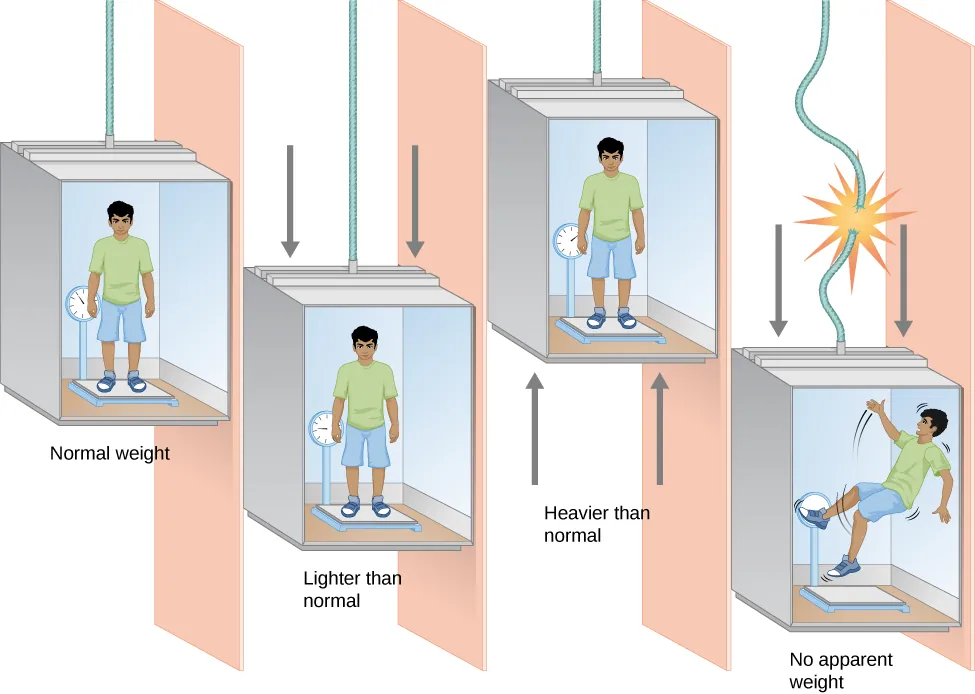
Four elevator scenarios illustrating how the scale reading (apparent weight) changes with the elevator’s acceleration. Upward acceleration corresponds to a larger normal force (heavier-than-normal), downward acceleration corresponds to a smaller normal force (lighter-than-normal), and free fall drives the normal force toward zero (no apparent weight). Source
This page focuses on the normal force as the “scale reading” and how acceleration changes it.
Core ideas: what you feel vs. what gravity does
When an object is in contact with a surface (floor, seat, scale), the surface exerts a normal force on the object. Your body interprets this contact force as “how heavy you feel,” so the apparent weight is tied to the normal force, not directly to gravity.
Apparent weight: the magnitude of the normal force exerted on an object by a supporting surface (the “scale reading”).
Even when gravity is unchanged, the normal force can change if the object–surface system accelerates. In AP Physics 1, you treat the object as a particle and apply Newton’s second law in a chosen direction (often vertical).
Normal force and why it can differ from
Gravitational force ( near Earth) is an interaction between Earth and the object.
Normal force () is a contact interaction between the surface and the object.
If the object is not accelerating vertically, forces can balance so can equal .
If the object accelerates vertically, the net force is not zero, so generally does not equal .
Apparent weight in an accelerating elevator (or any vertical acceleration)
Choose a vertical axis and stick to a sign convention (for example, up is positive). Then write Newton’s second law for the object in the vertical direction.
= Net force in the vertical direction (N)
= Mass (kg)
= Vertical acceleration (m/s)
A normal sentence between boxes: For a person standing on a scale, the main vertical forces are typically upward and downward, so (with up positive).
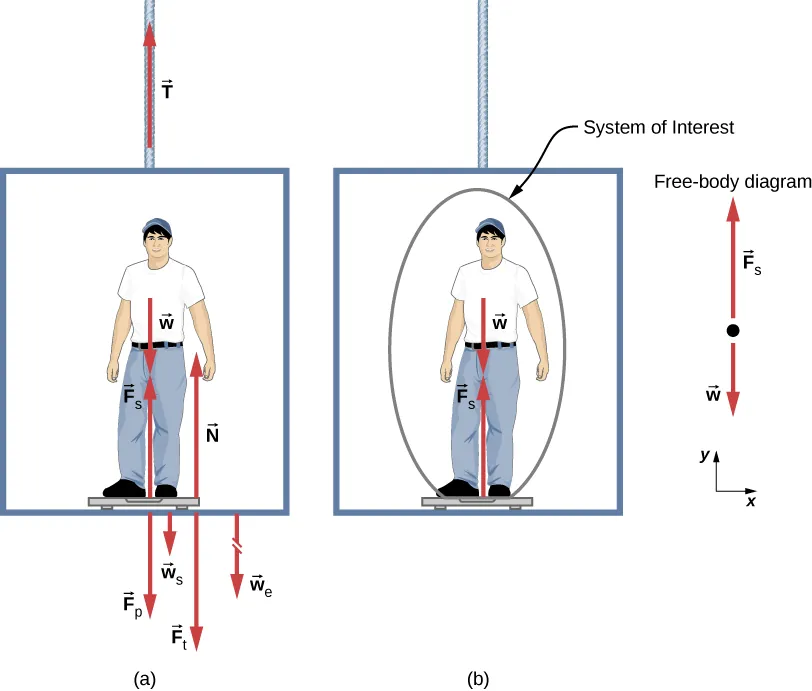
A person on a bathroom scale in an elevator, showing how the full interaction picture simplifies to the person’s free-body diagram. The only forces on the person are the upward scale force (the normal force, i.e., the scale reading) and the downward weight , which leads directly to . Source
= Normal force; apparent weight (N)
= Mass (kg)
= Gravitational field strength near Earth (m/s)
= Vertical acceleration of the object (m/s)
Interpreting the equation (direction matters)
Using :
Accelerating upward (): , so apparent weight is greater than .
Accelerating downward (): , so apparent weight is less than (because is negative).
Constant velocity (): .
In words: the normal force adjusts so that the net force produces the required acceleration.
How to reason on free-body diagrams for apparent weight
A clean approach is:
Identify the object whose apparent weight you want (often a person or a block).
Draw a free-body diagram with only external forces on that object.
Choose an axis (often vertical) and assign a positive direction.
Write in that axis and solve for .
Remember: apparent weight is the magnitude of , so report it as a positive value even if your axis is negative.
Common pitfalls to avoid
Treating as the “scale reading” during acceleration; the scale reads , not .
Mixing up signs: the acceleration sign must match your axis choice.
Forgetting that is exerted by the surface on the object (the equal-and-opposite force is the object on the surface, but that is not drawn on the object’s diagram).
Practice Questions
(2 marks) A student stands on a scale in a lift that accelerates upwards with acceleration . State what the scale reads in terms of , , and .
Uses with (1)
Gives and identifies this as the scale reading (1)
(5 marks) A person of mass stands on a scale in a lift. The lift accelerates downwards with magnitude (take up as positive).
(a) Draw/describe the vertical free-body diagram forces on the person. (2)
(b) Derive an expression for the apparent weight (scale reading) . (3)
(a) Includes upwards and downwards on the person (2)
(b) Writes or equivalent (1)
Rearranges to (1)
States is the apparent weight/scale reading (1)
FAQ
A scale compresses internally; its sensor responds to contact force. Gravity is not directly sensed—only how hard you push on the scale (equal in magnitude to $N$).
Yes, if you are accelerating momentarily (starting/stopping), $a \neq 0$ even if your velocity is zero at an instant, so $N$ can differ from $mg$.
Then the “apparent weight” depends on which surface provides the supporting contact. The relevant apparent weight is the magnitude of the normal force from that wall.
If the force fluctuates rapidly, the display may show an average or filtered value rather than instantaneous $N$, depending on the scale’s sampling rate and damping.
The net external forces still set $N$ via $\sum F = ma$, but posture can change how contact forces distribute (feet vs. handrail), altering which normal force a particular surface exerts.
