

AP Syllabus focus: ‘Centripetal acceleration can come from one force, several forces, or components of forces acting on the object.’
Circular motion is not caused by a special “circular” agent; it happens when the net force has an inward (radial) component. This page focuses on identifying which real forces supply that inward requirement.
Core idea: circular motion requires an inward net force
For an object to follow a curved path at constant radius, its velocity direction must continuously change. That directional change is produced by an inward net radial force.
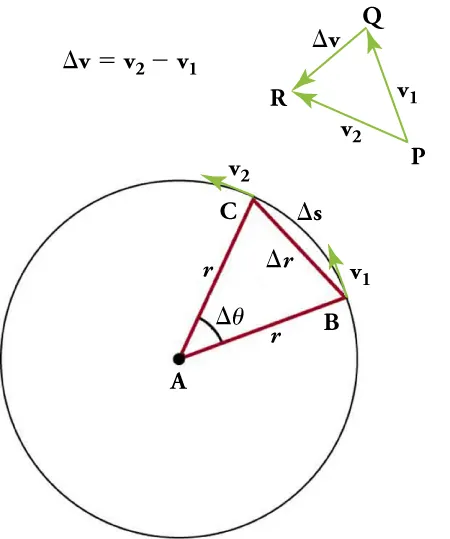
Velocity vectors drawn at two nearby points on a circular path differ in direction, and the vector difference points inward toward the center of curvature. This directly illustrates why the acceleration in uniform circular motion is centripetal (radial) even when the speed is constant. Source
Centripetal force: the name for the net inward (radial) force required for circular motion; it is not an additional force beyond the real forces in the free-body diagram.
A key AP habit is to replace “centripetal force” language with “the net force toward the center is provided by ___.”
= net force toward the center (N)
= mass (kg)
= speed along the circular path (m/s)
= radius of the circular path (m)
This equation is a Newton’s second law statement in the radial direction: whatever the forces are, their inward components must add to .
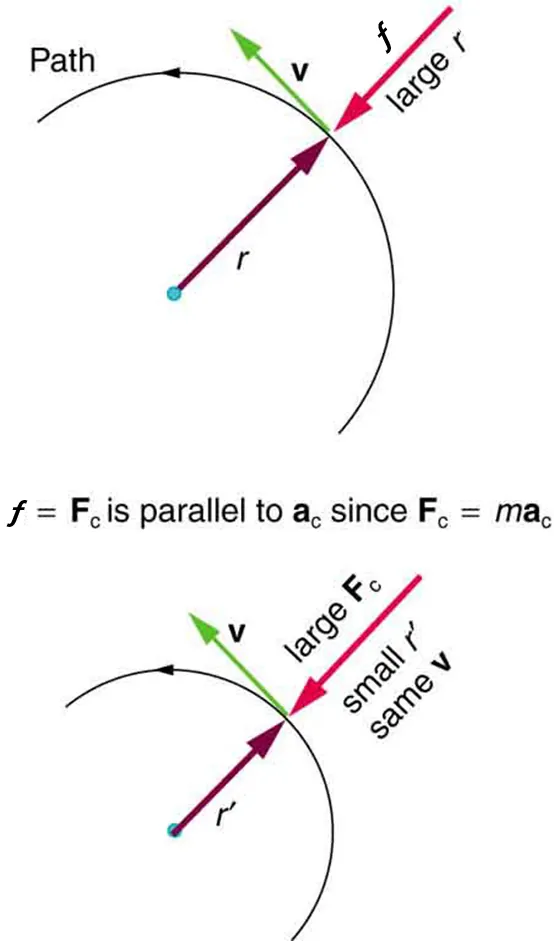
The figure depicts tangential velocity and an inward centripetal force (radial) that is perpendicular to the motion at each instant. By comparing a larger-radius path to a smaller-radius path at the same speed, it visually supports the idea that tighter curvature requires a larger inward net force (consistent with ). Source
Forces that can “cause” circular motion (supply the radial net)
The inward requirement can be satisfied in different ways, matching the syllabus statement that the radial net can come from one force, several forces, or components of forces.
Case A: one force provides all the inward net
A single real force can point directly toward the center so that it alone equals the required radial net.
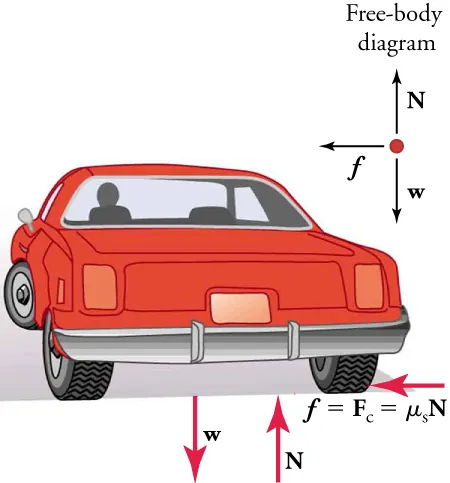
A free-body diagram for a car rounding an unbanked curve shows upward, weight downward, and static friction horizontally toward the center of the turn. The diagram makes clear that the inward net radial force is provided by an ordinary interaction force (friction), not by adding a new “centripetal force” arrow. Source
Common AP situations:
Tension in a string for a mass moving in a horizontal circle: tension points toward the center.
Normal force when a track or wall pushes an object into a circular path: the contact force can be purely radial.
Gravity in an orbital model: the gravitational force points toward the center of the attracting body.
In each case, the free-body diagram may show multiple forces, but only one is actually directed toward the center and may dominate the radial sum.
Case B: several forces combine to make the inward net
Often, more than one force has a radial component, so the inward net is the vector sum of their radial parts.
Typical examples:
A mass moving in a vertical circle: at different points, both tension and weight can contribute to (or oppose) the inward direction.
Motion along a circular path where both a contact force and friction act, with each contributing some inward component.
In these situations, it is rarely correct to set one force equal to without first checking which forces point inward at that location.
Case C: components of forces supply the inward net
Even when a force is not aimed at the center, part of it may be.
Key skills:
Choose axes with one axis radial (inward/outward) and the other tangential.
Resolve each force into components and add only the radial components to match .
Common component-based contributors:
The horizontal component of tension (e.g., when the string is angled) can be the inward contributor.
A component of the normal force can point toward the center if the surface is oriented so the normal is not purely vertical/horizontal in your chosen axes.
Static friction can be inward when it prevents slipping sideways relative to the surface.
Setting up the radial force equation correctly
A reliable setup process:
Identify the object (or system) undergoing circular motion and draw a free-body diagram with only external forces.
Mark the center of the circle and define “positive radial” (usually inward).
For each force, decide whether it is:
inward (positive radial),
outward (negative radial), or
neither (then resolve into components).
Write with consistent signs.
Language precision matters: “provides the centripetal force” means “contributes to the net radial force.” If the radial sum is zero, the object is not executing circular motion of radius at that instant.
Practice Questions
(2 marks) A ball on a string moves in a horizontal circle at constant speed. State which force provides the centripetal force and in which direction it acts.
Identifies tension as the force (1)
States it acts towards the centre / radially inward (1)
(5 marks) A 0.50 kg mass moves in a vertical circle of radius 1.2 m. At the lowest point, its speed is 6.0 m/s and the string tension is 20 N. Take .
(a) Write an expression for at the lowest point using and , taking inward as positive. (2 marks)
(b) Determine whether the given values are consistent with circular motion at that instant by comparing with . (3 marks)
(a) States inward at bottom is upward; (2: correct direction/signs)
(b) Calculates (1)
Calculates (1)
Concludes values are consistent (allowing rounding) (1)
FAQ
No. In AP Physics, you draw only real interaction forces (tension, weight, normal, friction).
“Centripetal force” is a label for the net inward result of those forces’ components.
It means that force contributes to the inward net.
Sometimes it provides all of it; other times only a component does, and other forces may help or oppose.
Pick a radial positive direction (commonly inward) and stick to it.
Then assign each force’s radial component a sign based on whether it points along or opposite that direction.
Velocity is tangent to the path, but the required acceleration is inward to change the velocity’s direction.
So the net force points inward even when the motion is not inward.
In an inertial frame (typical AP setup), there is no real outward centrifugal force.
An apparent outward force can be introduced only if you analyse from a rotating, non-inertial frame and use a pseudo-force model.
