

AP Syllabus focus: ‘Static friction and normal-force components can support circular motion on banked surfaces, and tension contributes in a conical pendulum.’
Banked turns and conical pendulums are classic cases where angled forces create the inward (centripetal) effect needed for circular motion. The key skill is resolving forces into vertical and radial components.
Core idea: circular motion needs an inward net force
In uniform circular motion, the acceleration is centripetal (toward the centre). The net force toward the centre must match this requirement.
= centripetal acceleration, m/s
= speed, m/s
= radius of circular path, m
When drawing a free-body diagram, choose axes that make components clear:
Radial axis: toward the centre of the circle
Vertical axis: up/down (often where weight acts)
Banked curves (with possible static friction)
Banked curve: a roadway tilted at an angle so that the normal force has a horizontal component that can point toward the centre of the turn.
Forces and components
For a car turning on a banked road (bank angle theta):
Weight (mg) acts straight down.
Normal force (N) is perpendicular to the road surface, tilted from vertical.
Static friction (f_s) (if present) acts along the surface, opposing the tendency to slip.
Resolve forces:
Vertical direction: must balance if there is no vertical acceleration.
Radial direction: must provide the required centripetal net force.
Frictionless “design speed” idea
If the car moves at just the right speed, no friction is needed:
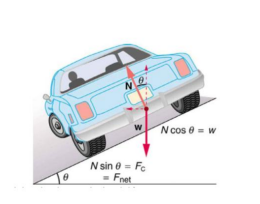
Free-body diagram for a car on a frictionless banked curve, highlighting how the normal force splits into components. The vertical component satisfies (no vertical acceleration), while the horizontal component provides the required centripetal net force, . Source
The vertical component of N balances mg.
The radial component of N supplies the centripetal requirement.
= bank angle, degrees or radians
= speed for which no friction is required, m/s
= turn radius, m
= gravitational field strength, m/s
This relation captures the syllabus idea that normal-force components can support circular motion on a banked surface.
What static friction changes (qualitative but essential)
Static friction allows a wider range of speeds than the frictionless design speed:
If the car is too slow, it tends to slide down the bank; static friction acts up the slope.
If the car is too fast, it tends to slide up the bank; static friction acts down the slope.
Because static friction adjusts its magnitude (up to a maximum), it can either:
Add to the inward (radial) component, or
Reduce the needed inward component from N, depending on the slipping tendency.
Conical pendulums (tension provides the centripetal effect)
Conical pendulum: a mass on a string moving in a horizontal circle so the string makes a constant angle with the vertical, forming a cone shape.
Forces and components
For a bob moving in a horizontal circle:
Weight (mg) acts downward.
Tension (T) acts along the string toward the pivot.
Resolve tension into components:
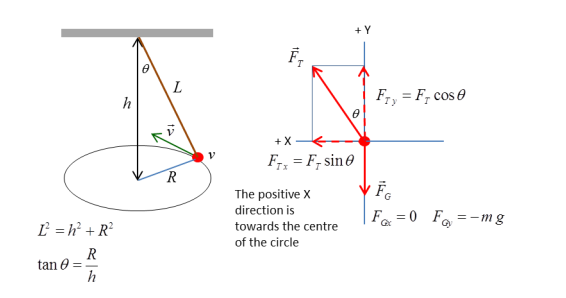
Conical pendulum force analysis showing tension along the string and weight downward. The vertical balance is , and the inward (radial) requirement is , making the centripetal cause explicit as a component of tension. Source
Vertical: balances weight (no vertical acceleration).
Radial (horizontal inward): supplies the centripetal net force.
This matches the syllabus statement that tension contributes to circular motion in a conical pendulum: the inward component of tension is the centripetal cause.
Angle/speed connection (conceptual use)
At a fixed angle:
A larger radial component of tension implies a larger required centripetal acceleration, meaning higher speed and/or smaller radius. At a fixed string length:
Changing speed changes the angle because the radial requirement changes while weight stays constant.
Practice Questions
(2 marks) A car travels around a circular banked curve at the “design speed” where no friction is required. State which force provides the centripetal acceleration and explain briefly how it does so.
Identifies that the horizontal (radial) component of the normal force provides the centripetal effect. (1)
Explains that the normal force is angled due to the banking, so part of it points toward the centre, producing the inward net force. (1)
(5 marks) A mass moves as a conical pendulum, with the string at a constant angle to the vertical. Explain, using components, how the forces determine (i) vertical equilibrium and (ii) the centripetal requirement. Write the two component equations in terms of , , , , and .
States forces: tension along string and weight downward. (1)
Resolves tension into components: vertical , radial . (1)
Vertical equilibrium equation: . (1)
Radial (centripetal) equation: . (1)
Interprets that the radial component of tension is the inward net force causing circular motion. (1)
FAQ
Banking rotates the normal force so it has an inward component even without friction.
With less required friction, the same turn can be taken more safely, especially when surfaces are wet or dusty.
Lower grip reduces the maximum available static friction, narrowing the safe speed range.
The “no-friction” speed is least sensitive to low grip, but any deviation from it demands friction that may no longer be available.
Static friction opposes impending relative motion at the contact.
Depending on speed, the car may tend to slip down the bank (friction up-slope) or up the bank (friction down-slope).
As $\theta$ increases, the string becomes more horizontal, so a larger tension is needed to keep $T\cos\theta$ equal to $mg$.
This typically corresponds to a higher speed and a larger radial demand.
Common issues include:
Measuring $\theta$ from the wrong reference (it is from the vertical)
Using an inconsistent radius (the circular path may wobble)
Neglecting that the bob’s centre traces the circle, not the knot or string line
