

AP Syllabus focus: ‘Tangential acceleration changes speed, and total acceleration is the vector sum of tangential and centripetal acceleration.’
Circular motion can involve changing direction, changing speed, or both. This page focuses on how acceleration splits into tangential and centripetal components, and how to combine them to get the net acceleration.
Acceleration components in circular motion
When an object moves along a circular path, its velocity vector can change in two independent ways:
Change in direction (even if speed stays constant)
Change in speed (speeding up or slowing down along the path)
Those correspond to two perpendicular acceleration components: centripetal acceleration and tangential acceleration.
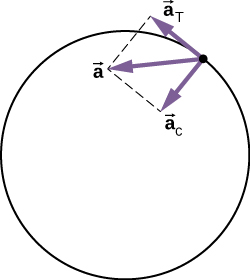
A particle on a circular path has two perpendicular acceleration components: a radial (centripetal) component pointing toward the center and a tangential component along the tangent. The diagram also shows the total acceleration vector as the vector sum of these components, making the “inward + forward/backward” direction visually explicit. Source
Tangential acceleration (changes speed)
Tangential acceleration points along the tangent to the circular path (parallel or antiparallel to the instantaneous velocity), so it changes the object’s speed.
Tangential acceleration: The component of acceleration parallel to the direction of motion that changes an object’s speed along a curved path.
Key direction ideas:
If the object speeds up, points in the same direction as .
If the object slows down, points opposite .
does not “aim at the centre”; it lies along the path.
Centripetal acceleration (changes direction)
Centripetal acceleration points radially inward toward the centre of the circle, so it changes the direction of the velocity vector.
Centripetal acceleration: The inward (radial) component of acceleration responsible for turning the velocity vector toward the centre of the circular path.
Even at constant speed, centripetal acceleration is nonzero because the velocity direction continuously changes.
= tangential acceleration (m/s)
= change in speed over the time interval (m/s)
= time interval (s)
Because this course is algebra-based, is typically used rather than calculus notation.
Net acceleration as a vector sum
The total (net) acceleration is the vector sum of centripetal and tangential accelerations. In circular motion, these components are perpendicular: centripetal is radial inward, tangential is along the tangent.
Net acceleration: The single acceleration vector found by adding all acceleration components acting at an instant.
Since and are perpendicular, the magnitude of the net acceleration comes from the Pythagorean relationship, and its direction is “inward and forward/backward” depending on the sign of .
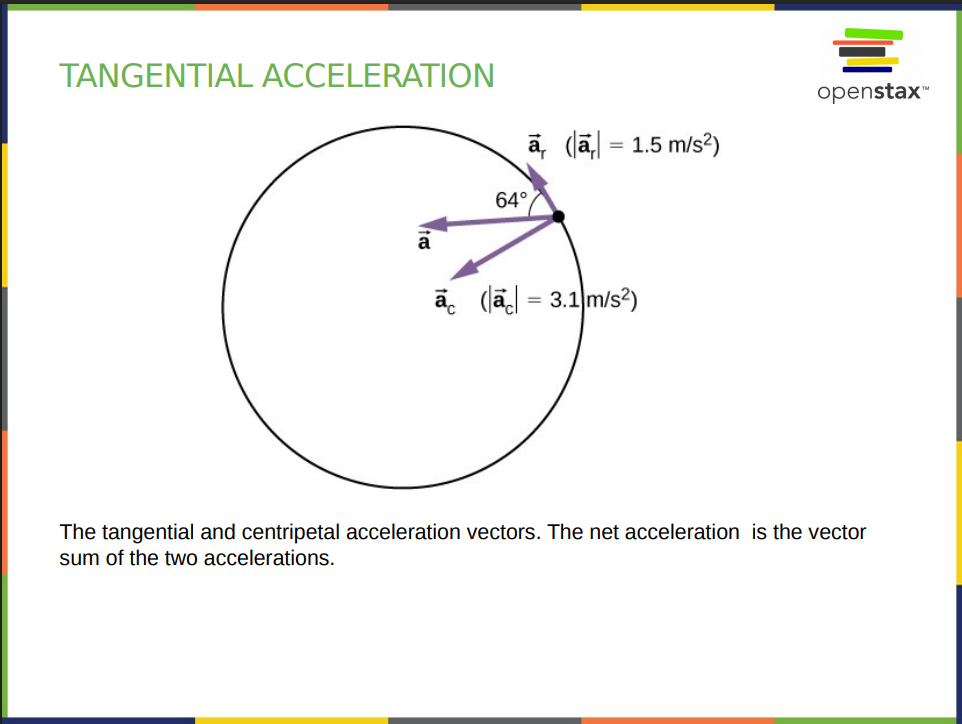
The diagram shows how the tangential and centripetal (radial) acceleration vectors combine to form the net acceleration at a point on the circle. Because the components are perpendicular, the resultant can be interpreted as the hypotenuse of a right-triangle vector addition (consistent with using a Pythagorean relationship for the magnitude). Source
= magnitude of net acceleration (m/s)
= centripetal acceleration magnitude (m/s)
= tangential acceleration magnitude (m/s)
Interpreting this physically:
If , the acceleration is purely centripetal (uniform circular motion): net acceleration points directly inward.
If , there is no turning at that instant; the object’s speed changes but its direction does not (motion is locally straight).
If both are nonzero, the net acceleration points at an angle between the inward radial direction and the tangent.
Connecting to forces without changing the focus
Acceleration components often come from force components:
A radial net force produces (turning).
A tangential net force produces (speed change).
For AP Physics 1, it is essential to keep the direction labels consistent: “centripetal” describes the direction (toward the centre), not a separate type of force.
Common sign and direction conventions
To write component equations cleanly, choose axes:
Radial axis: positive inward (often simplifies as positive)
Tangential axis: positive in the direction of motion (so slowing down gives negative )
Then:
is typically treated as a positive inward magnitude (), while the vector direction is “inward.”
can be positive or negative depending on speeding up or slowing down.
Practice Questions
(2 marks) A car moves around a circular track at constant speed. State which acceleration component is zero, and state the direction of the non-zero acceleration.
Tangential acceleration is zero / (1)
Acceleration is towards the centre / centripetal (inward radial) direction (1)
(5 marks) An object moves on a circular path. At a particular instant, its centripetal acceleration magnitude is and its tangential acceleration magnitude is . (a) Determine the magnitude of the net acceleration. (2 marks) (b) Determine the angle the net acceleration makes with the inward radial direction. (3 marks)
(a) Uses (1)
(a) (1)
(b) Recognises right-triangle geometry with components perpendicular (1)
(b) Uses where is from radial inward (1)
(b) (allow appropriate rounding) (1)
FAQ
Centripetal acceleration points along the radius, while tangential acceleration points along the tangent. A radius and a tangent are perpendicular at the point of contact on a circle.
This perpendicularity is what allows $a_{\text{net}}$ to be found using Pythagoras.
Pick a positive tangential direction first (commonly the direction of motion at that instant).
Then:
speeding up $\Rightarrow a_t>0$
slowing down $\Rightarrow a_t<0$
Be consistent with your axis choice throughout the problem.
The centripetal component still points inward. The tangential component flips to oppose the motion.
So the net acceleration points inward and “backward” along the path, making an angle to the inward radius on the trailing side.
Not for motion on a circular path at a nonzero speed, because turning requires a nonzero inward component ($a_c\neq 0$).
Net acceleration can be zero only if the object is not curving at that instant and its speed is not changing.
For a point moving in a circle of radius $r$, tangential acceleration links to angular acceleration by $a_t=\alpha r$.
This is useful when rotational variables ($\alpha$) are given, but the acceleration you need is linear (m/s$^2$).
