

AP Syllabus focus: ‘For circular orbits, gravity provides the centripetal acceleration, linking orbital period and radius to the central body’s mass.’
Circular orbits connect dynamics (forces and acceleration) to astronomy (periods and distances). By combining gravitational attraction with centripetal motion, you can derive Kepler’s third law for circular motion and interpret what orbital data reveals.
Core idea: gravity as the centripetal cause
In a circular orbit, an orbiting object continuously accelerates toward the center of its path even if its speed is constant. For circular orbits around a much more massive body (like a planet around the Sun), the gravitational force supplies exactly the required centripetal force.
What “circular orbit” means in this model
Circular orbit: motion at constant radius around a central body, idealised as a circle so the inward (centripetal) acceleration always points toward the central body’s centre.
This subsubtopic assumes:
The orbit is circular (radius is constant).
The central body’s mass is much larger than the orbiting mass (so the centre is effectively at ).
Gravity is the only significant interaction providing inward acceleration.
Linking gravity and centripetal acceleration
For a mass moving in a circle of radius at speed , the required inward acceleration is centripetal.
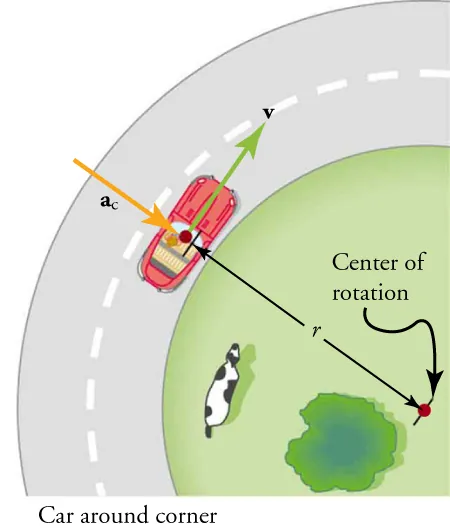
Vector diagram of uniform circular motion: the velocity vector is tangent to the path, while the centripetal acceleration vector points inward toward the center. This directly supports the relationship and the idea that acceleration can be nonzero even when speed is constant. Source
In orbit, the inward force is gravitational.
= inward acceleration, in
= gravitational constant, in
= central body mass, in
= orbiting mass, in
= orbital radius, in
= orbital speed, in
Because cancels, the orbital speed at a given radius does not depend on the orbiting object’s mass (in this ideal model). Rearranging gives as a function of and , which is the key step toward Kepler’s third law.
Orbital period and Kepler’s third law (circular form)
The orbital period is the time for one full revolution, and in uniform circular motion the distance travelled in one orbit is the circumference .
Orbital period (): the time taken for an orbiting object to complete one full revolution about the central body.
Using together with the gravity–centripetal relationship yields the standard AP Physics 1 algebraic form of Kepler’s third law for circular orbits.
= orbital speed, in
= orbital period, in
= orbital radius, in
= central body mass, in
A key proportionality to recognise is:
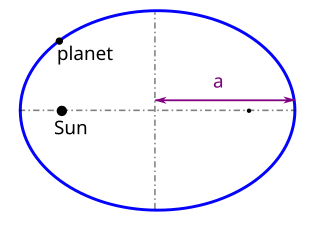
Schematic visualization of Kepler’s third law for orbits around the same central mass, emphasizing the scaling between orbital period and orbital radius. It reinforces the proportionality (equivalently, ) used in AP Physics 1 algebraic reasoning. Source
For orbits around the same central mass : .
Equivalently: .
What Kepler’s third law lets you infer
Kepler’s third law in the form links measurable orbital properties to the mass producing the gravitational field.
Practical implications (within the circular-orbit model):
If you know and for a satellite, you can determine the central mass .
If is known, increasing increases significantly because of the dependence in .
Comparing two circular orbits around the same central body eliminates and :
(useful for ratio reasoning without full calculation).
Interpreting “radius” correctly
For circular orbits, is the distance between centres of mass (centre of the planet to centre of the satellite). A common modelling step is:
(planet radius plus altitude), when altitude is given above the surface.
Because gravity depends on distance, confusing with can cause large errors in period predictions.
Limits of the model (what you should and shouldn’t assume)
To stay aligned with AP Physics 1 expectations for this subsubtopic:
Use the circular-orbit Kepler relationship only when the orbit can be treated as approximately circular.
Treat gravity as the sole provider of centripetal acceleration; adding other forces changes the dynamics and invalidates the simple form.
Assume unless explicitly told otherwise, so the orbit is about the central body’s centre.
Practice Questions
(2 marks) A satellite moves in a circular orbit of radius about a planet of mass . State the relationship between and for satellites orbiting the same planet.
1 mark: States (or equivalent wording).
1 mark: States is constant for the same central mass (or equivalent ratio form).
(5 marks) A moon orbits a planet in a circular orbit of radius with orbital period . Show how (the planet’s mass) can be written in terms of , , and constants, starting from gravity providing the centripetal force.
1 mark: Uses .
1 mark: Uses centripetal requirement (or with ).
1 mark: Sets and cancels .
1 mark: Substitutes .
1 mark: Obtains .
FAQ
Both gravity and the required centripetal force are proportional to $m$.
So when you set $\dfrac{GMm}{r^2}=\dfrac{mv^2}{r}$, the factor $m$ divides out, leaving $v$ and $T$ dependent on $M$ and $r$ only.
Measure $T$ and determine $r$ (centre-to-centre distance).
Then apply $M=\dfrac{4\pi^2 r^3}{G T^2}$. Accuracy is limited mainly by how well $r$ is known and how close the orbit is to circular.
The “central mass” is no longer effectively fixed.
A better model uses the distance between both bodies and replaces $M$ with $(M+m)$ in the circular-orbit form, reflecting two-body motion about a shared centre of mass.
Gravity depends on separation as $1/r^2$, and Kepler’s relationship uses $r^3$.
If you use $h$ instead of $r=R+h$, the error propagates strongly into predicted $T$ (because $T^2$ scales with $r^3$).
Use the ratio form:
$\dfrac{T_1^2}{r_1^3}=\dfrac{T_2^2}{r_2^3}$
Rearrange to get $T_2=T_1\left(\dfrac{r_2}{r_1}\right)^{3/2}$
This avoids substituting numerical constants and focuses on proportional reasoning.

