

AP Syllabus focus: ‘At the top of a vertical loop, an object needs a minimum speed so gravity alone can provide centripetal acceleration.’
A vertical loop is a classic circular-motion situation where contact with a track depends on speed. This page focuses on the top of the loop, where gravity can be the only inward force at the minimum speed.
Physical picture at the top of a vertical loop
At the top of the loop, the required centripetal acceleration points toward the center of the circle. For a standard object moving on the inside of a vertical loop, “toward the center” is downward at the top.
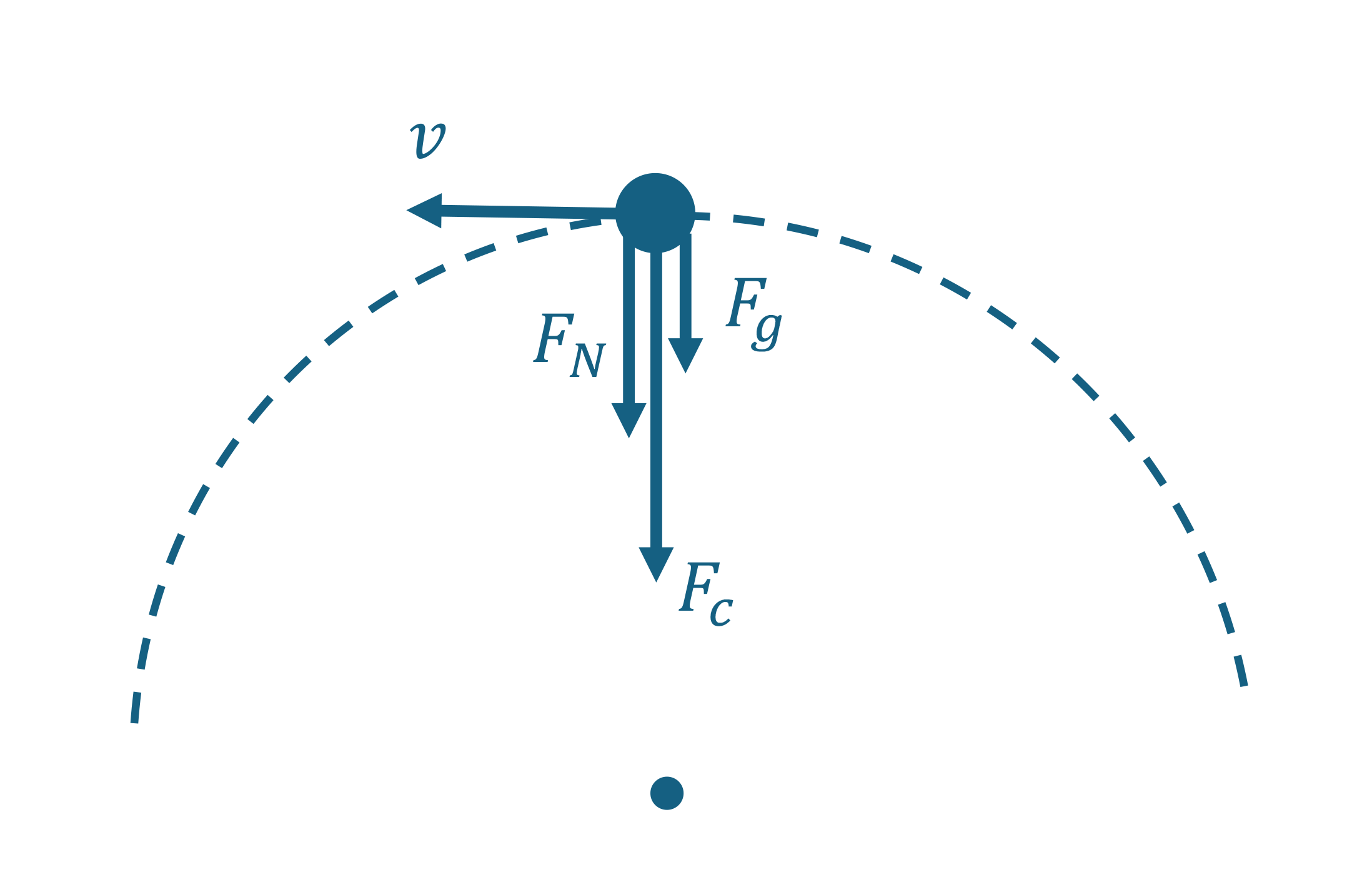
At the top of an inside-the-loop track, the inward (radial) direction is downward, so both the weight and the normal force (if contact is maintained) point toward the center. The diagram also emphasizes that “centripetal force” is not an extra force— represents the net inward force required for circular motion. Source
Forces that may act on the object at the top:
Weight , downward (always present near Earth).
Normal force , exerted by the track on the object (only if the object is still in contact), directed toward the center for an inside-the-loop track.
The key idea in the syllabus statement is that at the minimum speed, the track is just barely able to maintain contact, so gravity by itself can supply all the needed inward (centripetal) effect.
What “minimum speed” means here
Minimum speed at the top of a loop: the smallest speed at the top such that the object can follow the circular path without losing contact, with gravity alone providing the required centripetal acceleration.
At speeds below this threshold, the track cannot “pull” on the object to keep it moving in a circle (a normal force cannot be negative in this contact model), so the object loses contact and no longer follows the circular path at the top.
Force condition for circular motion at the top
Circular motion requires a net inward force that produces the needed centripetal acceleration. At the top (inside track), the inward direction is downward, so the inward forces add.
A consistent sign choice is:
Take downward as positive (inward at the top).
Then both and are positive when the object is in contact.
The minimum-speed idea corresponds to the limiting case where the object is just about to lose contact, so the normal force is zero.
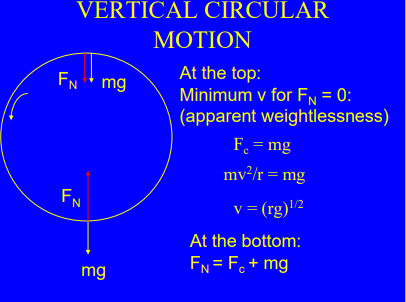
These lecture slides summarize the limiting-contact case at the top of a vertical loop: when the object is just on the verge of losing contact, the normal force is and gravity alone supplies the inward requirement. This leads directly to the minimum-speed condition and therefore . Source
Core equations (AP Physics 1 Algebra)
= mass of object (kg)
= speed at the top of the loop (m/s)
= radius of the loop (m)
In the inside-the-loop case at the top, the net inward force is the sum of forces toward the center:
If contact is maintained:
At the minimum speed (just maintaining contact): , so the net inward force is only
Minimum speed condition (gravity alone provides centripetal acceleration)
Using the limiting-contact condition at the top:
= gravitational field strength near Earth (m/s)
= minimum speed at the top to keep contact (m/s)
Important interpretation points:
The mass cancels, so does not depend on mass (in this idealised model).
The result depends only on and the loop radius .
“Gravity alone” here means the inward-force requirement is satisfied with no help from the normal force.
What happens if the speed is higher or lower?
If : the required inward force is larger than , so the track must supply the extra inward force; therefore at the top.
If : , meaning the object is on the verge of losing contact; gravity alone supplies the inward requirement.
If : the required inward force cannot be met by alone while keeping ; the object cannot follow the circular path at the very top and will lose contact (then it is no longer constrained to move in a circle).
Assumptions you are expected to use
To apply cleanly, you typically assume:
The loop is circular with constant radius .
The object behaves like a point mass (size is negligible compared with ).
Air resistance and other dissipative effects are ignored unless stated.
The object is on the inside of the loop and contact forces are push-only (normal force cannot pull).
Practice Questions
(2 marks): An object moves on the inside of a vertical loop of radius . State the condition on the normal force at the top for the object to be moving at the minimum speed, and write the resulting expression for .
at the top for minimum speed (1)
(1)
(5 marks): At the top of an inside vertical loop (radius ), an object of mass has speed . Taking downward as positive (towards the centre), derive an expression for the normal force at the top in terms of , , , and , and state the requirement for maintaining contact.
States centripetal condition: (1)
Identifies inward forces at top: (1)
Forms equation: (1)
Rearranges: (1)
Contact condition: (or equivalently ) (1)
FAQ
Yes. Replace $r$ with the local radius of curvature at the top; tighter curvature (smaller radius) increases the required minimum speed.
A contact normal force represents a push from the surface. If calculations give $N<0$, it indicates loss of contact and the constraint is no longer valid.
If it is mechanically constrained, the track can provide forces in both directions, so “minimum speed to maintain contact” no longer applies in the same way.
Drag reduces speed as the object moves, making it harder to remain above $v_{\min}$. The simple $v_{\min}=\sqrt{gr}$ condition still describes the contact threshold at the instant considered.
Slightly. Since $v_{\min}=\sqrt{gr}$, a smaller $g$ (higher altitude/other planets) lowers the required minimum top speed for the same $r$.
