

AP Syllabus focus: ‘Uniform circular motion can be described using period, frequency, and their relationship to one full revolution.’
Uniform circular motion is motion around a circle at constant speed. This page focuses on timing one full revolution and connecting that timing to frequency and speed using simple, algebra-based relationships.
Core ideas: “one full revolution”
In uniform circular motion, an object travels around a circular path while its speed (magnitude of velocity) stays constant.
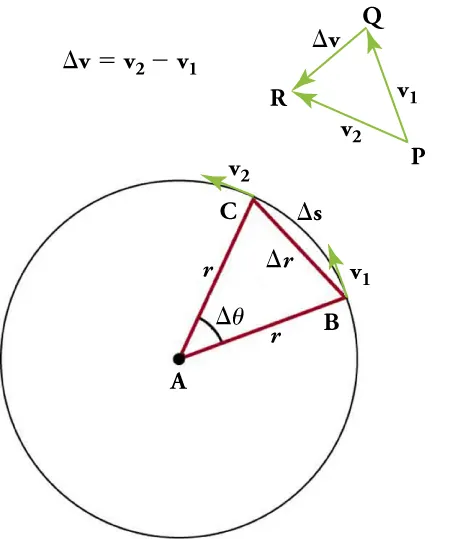
A labeled circular-motion diagram showing tangential velocity vectors at multiple points on the path, with the radius drawn from the center to the object. The figure helps distinguish the circular path from the instantaneous direction of motion (tangent), clarifying what “speed along the circular path” means. Source
A revolution means one complete trip around the circle, returning to the same position on the path.
The distance travelled in one full revolution is the circle’s circumference, , where is the radius. Time-based quantities (period and frequency) describe how quickly those revolutions happen.
Period
Period () is the time required for one complete revolution (one cycle).
Key points:
Units: seconds (s)
“Longer period” means each revolution takes more time, so the motion cycles more slowly.
In lab situations, is often found by timing multiple revolutions and dividing by the number of revolutions to reduce reaction-time error.
Frequency
Frequency () is the number of complete revolutions (cycles) per second.
Frequency describes “how many per second” rather than “how long for one.” It is commonly reported in hertz (Hz), where .
Relationship between period and frequency
Period and frequency are reciprocals: if an object completes more revolutions each second, the time for one revolution must be smaller.
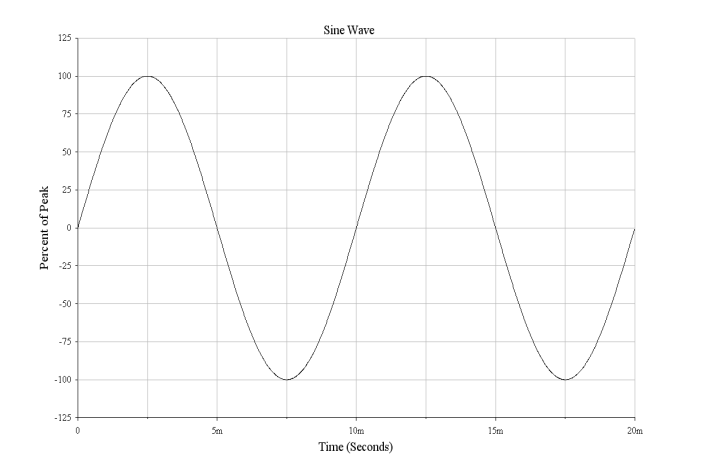
A time-domain graph showing repeated cycles, making the period identifiable as the horizontal length of one repeat. Since frequency counts cycles per second, the figure supports the reciprocal relationship as a direct reading from the cycle spacing on the time axis. Source
= frequency (Hz)
= period (s)
This relationship is only about counting cycles and time; it does not depend on the radius or the object’s mass.
Connecting period/frequency to speed in uniform circular motion
For uniform circular motion, “speed” means the constant rate of distance travelled along the circular path. In one revolution, the object travels in a time .
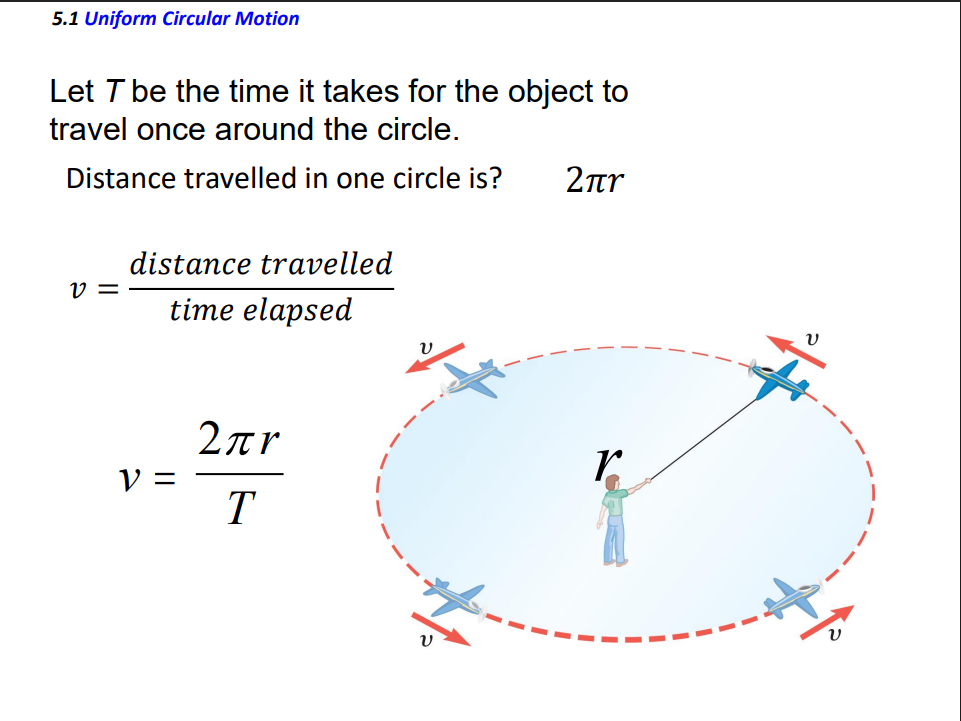
A labeled uniform-circular-motion diagram showing that one complete lap covers the circumference and takes one period . It emphasizes that speed along the path is distance-per-time for one revolution, giving . Source
= speed along the circular path (m/s)
= radius of the circle (m)
= period (s)
You can also express the same idea using frequency, since . This is useful if frequency is measured directly (for example, from a rotation sensor).
= speed along the circular path (m/s)
= radius of the circle (m)
= frequency (Hz)
Interpreting changes
If radius increases while stays the same, then speed increases (more distance per revolution in the same time).
If frequency increases while stays the same, then speed increases (more revolutions each second means more circumference covered each second).
If period doubles, the speed is cut in half (same circumference, more time per revolution).
Common unit conversions (rotation contexts)
You may see rotational rates in revolutions per minute (rpm). Converting to Hz aligns with in the equations:
Divide by 60:
Multiply by 60:
Practice Questions
(1–3 marks) A wheel completes one revolution every . State the wheel’s frequency in Hz.
Uses (1)
Substitutes (1)
(1)
(4–6 marks) A rubber stopper moves in a horizontal circle of radius with uniform circular motion. It completes 3.0 revolutions in 2.4 s.
(a) Determine the period.
(b) Determine the frequency.
(c) Determine the speed.
(a) (2: correct method, correct value)
(b) (2: reciprocal relationship, correct value)
(c) or (1)
Substitutes and finds (1)
FAQ
Time a large number of revolutions (e.g., 10–30) and divide by the number of revolutions.
This reduces percentage uncertainty from human reaction time.
Hz is the named unit for $s^{-1}$ when counting cycles: $1\ \text{Hz}=1\ \text{s}^{-1}$.
Using Hz signals you are counting repeating cycles (revolutions), not just any rate.
Both change simultaneously because they are linked by $f=\frac{1}{T}$.
As the rotation slows: $f$ decreases while $T$ increases.
When the strobe flash rate matches the object’s rotation rate (or an integer multiple), the object appears stationary or repeats positions.
That flash rate can be interpreted as the rotational frequency, with care about multiples (aliasing).
If the object looks identical after a fraction of a full turn (symmetry), you might mistakenly count that as a full cycle.
To avoid this, track a unique marker (tape mark) so each counted cycle corresponds to $2\pi$ radians (one full revolution).
