

AP Syllabus focus: 'The electric potential due to multiple point charges can be determined by scalar superposition of the electric potentials due to each point charge.'
When several point charges influence the same location, the total electric potential is found by combining their individual contributions. Because potential is scalar, the addition is algebraic rather than vector-based.
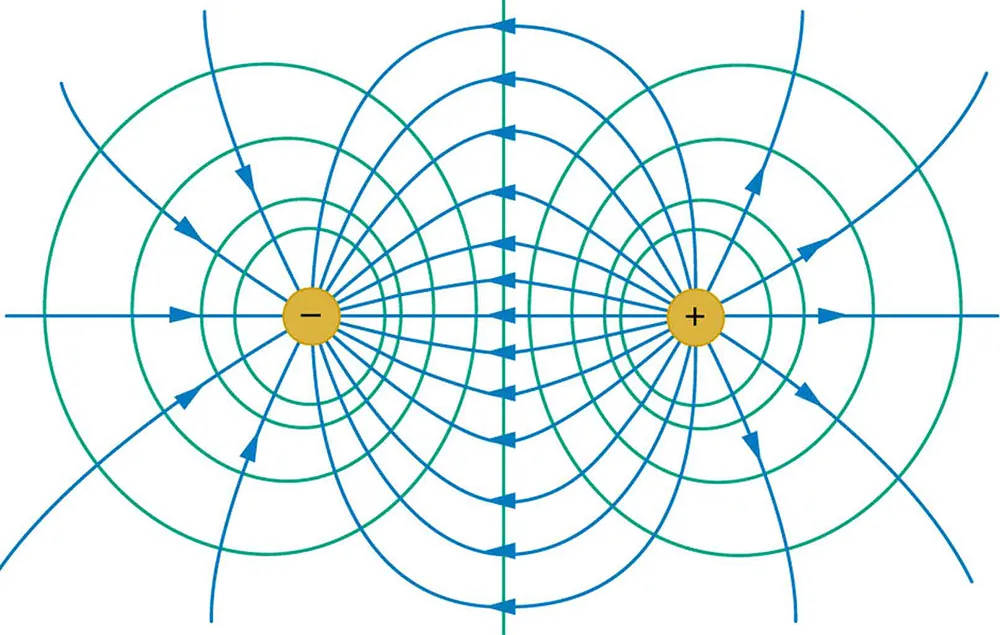
Equipotential lines (constant ) are drawn as contours around two equal and opposite point charges, with electric field lines shown perpendicular to the equipotentials. The figure emphasizes that potential varies smoothly in space and changes sign near negative versus positive source charges, consistent with adding signed terms in . Source
Meaning of scalar superposition
Each point charge creates its own electric potential at every location in space. In a system with multiple point charges, the net electric potential at a chosen point is found by adding the contribution from each charge separately. This idea is called superposition. It means one charge does not erase or replace the effect of another; instead, every charge contributes to the final value at the point of interest.
The potential is always evaluated at a specific location. You are not adding charges together directly; you are adding the potentials they create at one chosen point.
Scalar superposition: The net electric potential at a point is the algebraic sum of the electric potentials produced there by each individual point charge.
This principle is especially important because electric potential is a scalar quantity. Scalars have magnitude but no direction, so the calculation uses signed numbers rather than directional components.
= electric potential contributed by charge at the chosen point, volt
= Coulomb constant,
= source charge, coulomb
= distance from charge to the chosen point, meter
= net electric potential at the chosen point, volt
The sign of each term comes from the sign of the source charge. A positive charge contributes positive potential, and a negative charge contributes negative potential.
Why the addition is algebraic
Because the individual potentials are added as numbers, direction does not enter the sum. A charge located to the left, right, above, or below the point can still be handled with the same equation; the only geometric quantity needed is the distance from that charge to the point. This is why electric potential from several charges is often easier to combine than a vector quantity.
The word algebraic matters. If two positive charges affect the same point, their potentials add to a larger positive value. If two negative charges affect the same point, their potentials add to a more negative value. If one charge is positive and one is negative, their contributions partially cancel, and the net potential can be positive, negative, or zero depending on the relative sizes of and .
Distance also matters. A charge that is closer to the point gives a larger magnitude of potential contribution than an equal charge farther away, because changes inversely with . The nearest charge does not automatically dominate, but closeness strongly affects the result. The final answer is reported in volts, the unit of electric potential.
Problem-solving approach
When you calculate the potential from several point charges, keep the process organized.
Identify the exact point where the electric potential is needed.
Find the distance from each charge to that point.
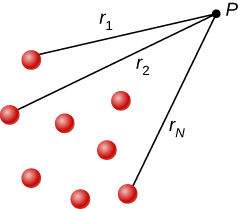
Multiple point charges are shown at different locations, with straight-line distances from each charge to the evaluation point . This diagram supports setting up by making each explicit so each charge’s contribution can be computed and then added algebraically. Source
Calculate each individual potential contribution, keeping the sign of each charge.
Add the individual values algebraically to obtain .
State the result with the correct sign and unit, usually volts.
If several charges are the same distance from the point, their terms share the same denominator, but each charge still keeps its own sign. Careful bookkeeping is essential. A common error is to use only magnitudes and ignore signs, which can completely change the final answer.
What the result tells you
A large positive net potential means positive contributions dominate at that location. A large negative net potential means negative contributions dominate. A small net potential means the signed contributions nearly cancel, not necessarily that the individual contributions are small.
The same set of point charges can produce different net potentials at different locations because each distance changes from point to point. For that reason, the geometry of the charge arrangement matters even though no vector addition is required.
Common mistakes to avoid
Adding only the magnitudes of the potentials and ignoring whether each source charge is positive or negative.
Using the distance between the charges instead of the distance from each charge to the point where the potential is being found.
Treating electric potential like a vector and trying to split it into components.
Forgetting that each charge contributes separately, even if the charges are part of one larger arrangement.
Mixing units, such as using microcoulombs and meters without converting charge to coulombs first.
In a system of many point charges, the method stays the same: compute each individual potential and add all terms. Because superposition is linear, adding another charge simply adds one more scalar term to the total.
Practice Questions
At point , three point charges create electric potentials of , , and . Determine the net electric potential at . [2 marks]
1 mark: Adds the three potential contributions algebraically.
1 mark: .
Point is from a charge of and from a charge of .
(a) Write an expression for the net electric potential at .
(b) Calculate the net electric potential at .
(c) State whether the positive or negative contributions dominate. [5 marks]
1 mark: Writes .
1 mark: Correctly substitutes values with signs.
1 mark: Finds an individual contribution correctly, such as or .
1 mark: Calculates .
1 mark: States that the positive contributions dominate because the net potential is positive.
FAQ
For isolated point charges, the potential becomes smaller in magnitude as the distance increases. Very far away, the contribution approaches zero, so infinity is a convenient reference.
A different zero level could be chosen if it were used consistently. Changing the reference shifts all potential values by the same constant, but the relationships between points remain unchanged.
Yes. The rule does not change: find the contribution from each charge at the chosen point and add all of them algebraically.
For many charges, physicists often write the result compactly as $V_{net}=\sum_i \dfrac{kq_i}{r_i}$. In AP Physics 2 Algebra, you usually apply this idea to a finite set of discrete point charges.
Electric potential is not the same physical quantity as electric force. It describes how the influence of a charge accumulates per unit charge at a location.
Because of that accumulated nature, the distance dependence becomes $V\propto 1/r$. This is why potential drops off with distance more slowly than inverse-square quantities do.
The net potential is zero wherever the positive and negative contributions have the same magnitude and opposite signs.
If the charges have equal magnitude, this happens at points that are the same distance from both charges. In many diagrams, points on the perpendicular bisector of the line joining the charges satisfy that condition.
Not always. If the observation point stays fixed and only one source charge moves, the contributions from the other charges stay the same.
You only need to update the term for the moved charge using its new distance and then recompute the algebraic sum. This makes scalar superposition efficient when comparing different arrangements.
