

AP Syllabus focus: 'When conductors are in electrical contact, electrons redistribute so that the surfaces of the conductors are at the same electric potential.'
When conductors touch or are linked by a conducting path, charge can move between them. The essential AP Physics idea is that this redistribution continues until the connected conductors share a common electric potential.
Core idea
A conductor allows electrons to move through the material. If two conductors are placed in electrical contact, they no longer behave as completely separate charge systems. Instead, electrons can pass from one conductor to the other through the contact region or through a connecting wire.
Electrical contact: A conducting connection between objects that allows electrons to move from one object to another.
If the conductors do not start at the same potential, electron transfer occurs. As electrons move, the charge distribution on each conductor changes, and the electric potential of each conductor changes as well.
Electric potential: Electric potential energy per unit charge at a location.
The specification focuses on the final condition.
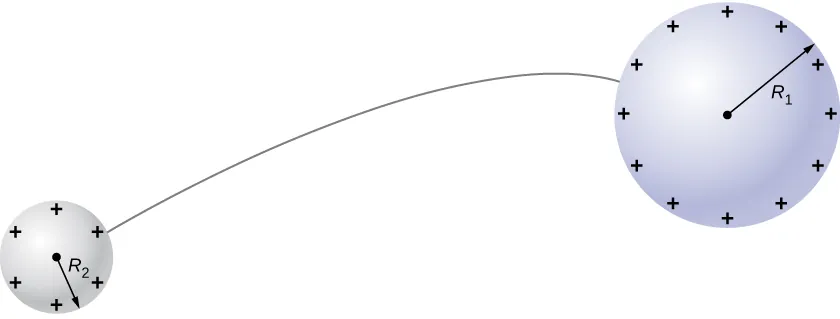
Two conducting spheres of different radii are connected by a thin wire, illustrating that the entire connected conductor system must be at a single electric potential in electrostatic equilibrium. The diagram supports the AP conclusion that “connected by a conductor and allowed to settle” guarantees equal surface potential, not necessarily equal charge. Source
After enough time has passed for the system to settle, the surfaces of the conductors are at the same electric potential. This is the result you should immediately recognize whenever a problem says conductors are touched together or connected by a conductor and allowed to reach equilibrium.
Why electrons redistribute
Initial potential differences matter
If one conductor begins at a different potential from another, the connection gives electrons a path to move. That motion is not permanent. Each transferred electron slightly changes the potentials of both conductors, so the system continuously adjusts as charge is shared.
The redistribution stops only when the potential difference between the connected conductors has been removed. At that point, there is no longer any reason for further net electron transfer between their surfaces. In AP Physics language, the conductors have reached a common electric potential.
A helpful reasoning chain is:
conductors are in contact
electrons are free to move through the contact
unequal initial potentials cause redistribution
redistribution changes the charge on each conductor
the process ends when the surface potentials are equal
Direction of electron motion
Because electrons are negatively charged, their motion is opposite to the motion of a positive test charge. In qualitative AP questions, this means electrons move from the conductor at lower electric potential toward the conductor at higher electric potential. You do not always need the exact path or amount of charge transferred; the main point is that electron motion continues only until both conductors reach the same potential.
What equal potential does and does not mean
Equal electric potential does not mean equal charge. Two conductors can share the same potential and still have different net charges. This is especially important when the conductors are different in size or shape.
Students often confuse three different ideas:
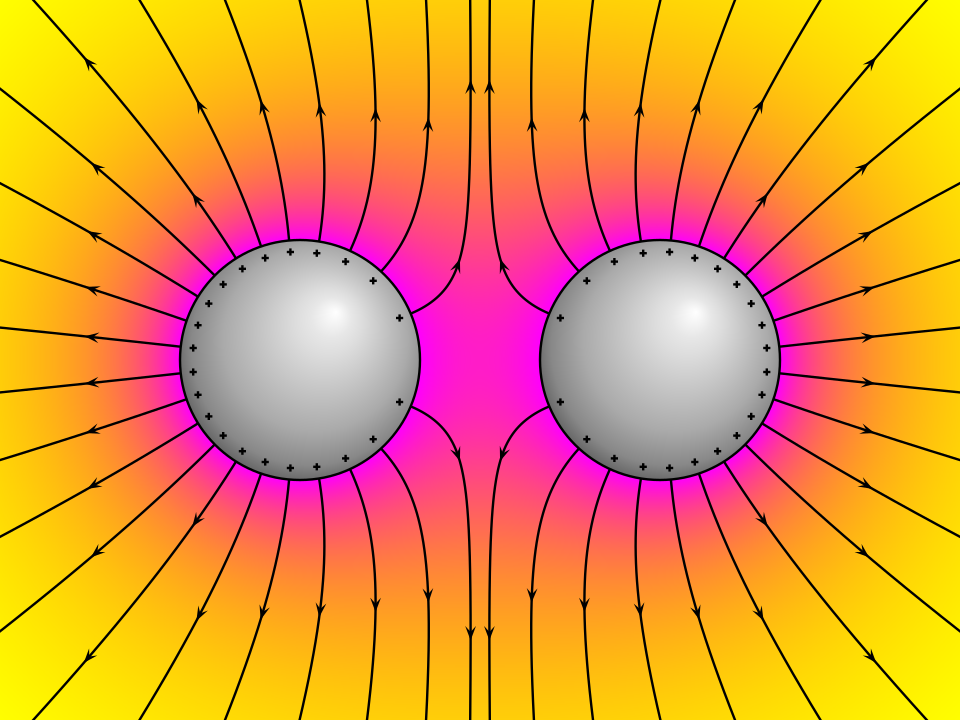
Electric potential is shown as a color background around two charged conducting spheres, with electric field lines drawn perpendicular to the metal surfaces. The figure emphasizes that conductors in electrostatic equilibrium are equipotential regions while the electric field pattern in the surrounding space can still be nonuniform. Source
same potential
same charge
same electric field
For this subtopic, only the first statement is guaranteed after electrical contact and equilibrium. The syllabus does not say that the final charges must match.
The wording about the surfaces also matters. In AP problems, the comparison is usually made between accessible points on the connected conductors after redistribution has finished. If the conductors are in contact and have settled, points on their surfaces are treated as being at the same electric potential.
Interpreting the final state
What a common potential means
When contact redistribution is complete, there is no surface point on one conductor that is at a different potential from a surface point on the other conductor. In practical terms, a measurement between the two surfaces would show zero potential difference. This does not tell you the actual common potential relative to some outside reference. It only tells you that the two conductors match each other electrically after contact.
Neutral and charged conductors
A neutral conductor can still participate in this process. If it touches a charged conductor, electrons may move into or out of the neutral conductor until the two conductors reach the same surface potential. Neutral at the start does not mean unchanged at the end.
How to analyze contact situations
Recognizing electrical contact
Electrical contact does not only mean direct touching. It also includes a metal wire or another conducting link between the objects. Problem statements often signal this with phrases such as:
"connected by a wire"
"placed in contact"
"touched together"
"allowed to reach equilibrium"
When you see these phrases, you should immediately apply the equal-potential condition.
Step-by-step AP reasoning
A reliable approach is:
identify which objects are conductors
check whether they are connected by a conducting path
infer that electrons can move between them
decide whether a potential difference initially exists
state that redistribution occurs until the final surface potentials are equal
This logic is often enough to answer short-response conceptual questions, even when no numbers are given.
If the conductors are later separated, the redistribution between them stops because the conducting path is removed. Each conductor then keeps whatever charge it has at the moment of separation, but the key contact condition was reached while they were connected: same surface potential.
Common misconceptions
"Touching makes charge disappear"
When conductors touch, charge is not destroyed. Instead, electrons are redistributed within the connected conducting system. The important change is how charge is shared, not whether charge suddenly vanishes.
"Same potential means zero potential"
Two conductors can be at the same potential without that common potential being zero. The important idea is equality, not a particular numerical value.
"The conductors must be identical"
Identical conductors are not required. Any conductors in electrical contact will redistribute electrons until their surfaces are at the same electric potential, even if one is larger, differently shaped, or initially neutral.
Practice Questions
Two metal conductors, A and B, are connected by a wire. Before connection, conductor A is at a higher electric potential than conductor B. Describe the initial direction of electron movement and state the condition that exists when electron transfer stops.
Electrons initially move from B to A. (1)
Electron transfer stops when the surfaces of A and B are at the same electric potential, so there is no potential difference between them. (1)
Two conducting spheres, X and Y, are connected by a thin metal wire and allowed to reach equilibrium. Sphere X is larger than sphere Y. A student claims that, because the spheres are connected, they must end with the same charge.
(a) State the relationship between the electric potentials of the two spheres after equilibrium.
(b) Explain why electrons move when the spheres are first connected if their initial potentials are different.
(c) Explain why the student’s claim about equal final charge is not necessarily correct.
(a)
The spheres are at the same electric potential after equilibrium. (1)
(b)
The wire provides a conducting path that allows electrons to move between the spheres. (1)
Electrons move because the initial potential difference causes redistribution, and the motion continues until the potentials become equal. (1)
(c)
Equal electric potential does not require equal charge. (1)
Conductors of different size or shape can hold different amounts of charge while still being at the same electric potential. (1)
FAQ
In ordinary metal conductors, redistribution is usually extremely fast, so classroom problems treat it as effectively instantaneous.
The actual time depends on factors such as the material, the geometry of the conductors, and the resistance of the connecting path.
Electrons can still redistribute, but the process may be much slower because the connection does not allow charge to move easily.
If charge can continue moving long enough, the conductors still approach the same electric potential. The main difference is the time required to get there.
If the potential difference is large enough, the electric effect in the gap can make the air temporarily conductive.
That brief conductive path allows electrons to jump across the gap, so charge redistribution can begin before solid-to-solid contact occurs.
Spheres are useful because their symmetry makes the redistribution behavior easier to interpret.
They reduce complications from irregular shapes, so it is easier to focus on the main idea that contact leads to a common electric potential.
Yes. If they are separated, or if an external device later drives charge onto one of them, their potentials can become different again.
The equal-potential condition applies while they are in electrical contact and have been allowed to reach equilibrium.
