

AP Syllabus focus: 'Electric potential difference between two points is the change in electric potential energy per unit charge when a test charge moves between those points.'
Electric potential difference links energy ideas to charge motion. It compares two locations in an electric situation by measuring how much energy changes for each unit of charge.
Core Idea
Electric potential difference does not describe charge stored on an object. It compares two locations by asking how much electric potential energy changes when a charge moves from one point to another. Because the energy change is divided by charge, this quantity tells how energetically different the two points are in an electric situation. That makes it a comparison of location rather than a description of the specific moving charge.
Electric potential difference: The change in electric potential energy per unit charge when a test charge moves between two points.
A positive value, a negative value, or a value of zero can all be physically meaningful.
Why “between two points” matters
Potential difference is always defined for a pair of points, such as point and point .
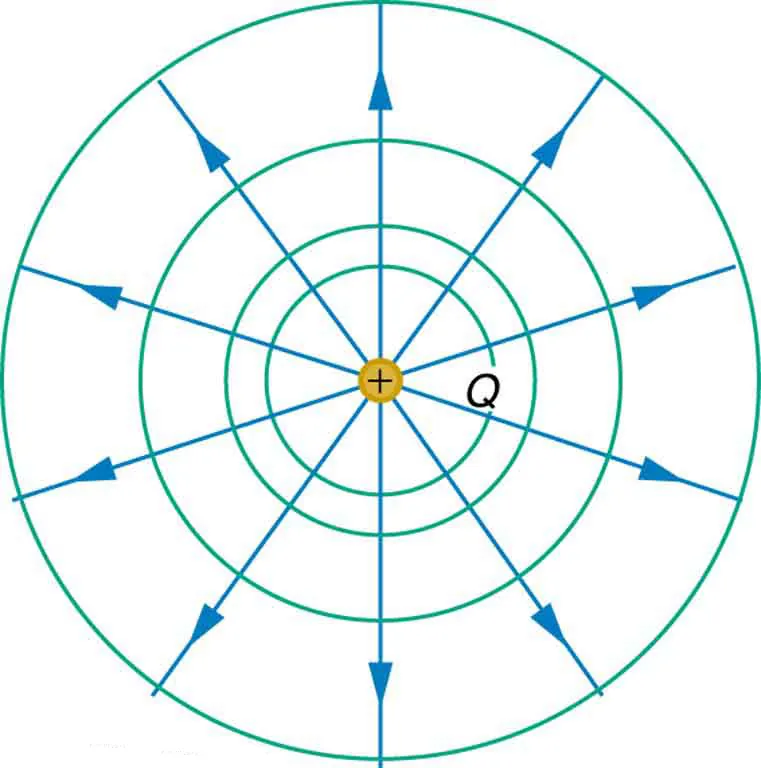
Electric field lines (direction of force on a positive test charge) are shown crossing equipotential lines at right angles. The figure emphasizes that the potential is constant along an equipotential, so potential difference arises only when moving from one equipotential to another (i.e., between different locations). Source
You must know the starting point and ending point before assigning a sign. If the final point corresponds to greater electric potential energy per unit charge than the initial point, the potential difference from initial to final is positive. If it corresponds to less, the potential difference is negative. If there is no change in electric potential energy per unit charge, the potential difference is zero.
Connecting Energy Change and Charge
The phrase per unit charge is the key idea. A larger test charge undergoes a larger change in electric potential energy when moved between the same two points, while a smaller test charge undergoes a smaller change. However, the ratio of energy change to charge is the same for any test charge moved between those points. This is why electric potential difference is treated as a property of the two locations being compared, not a property of one particular charge.
= electric potential difference, in volts,
= change in electric potential energy, in joules,
= charge of the test charge, in coulombs,
This equation also defines the unit of electric potential difference.
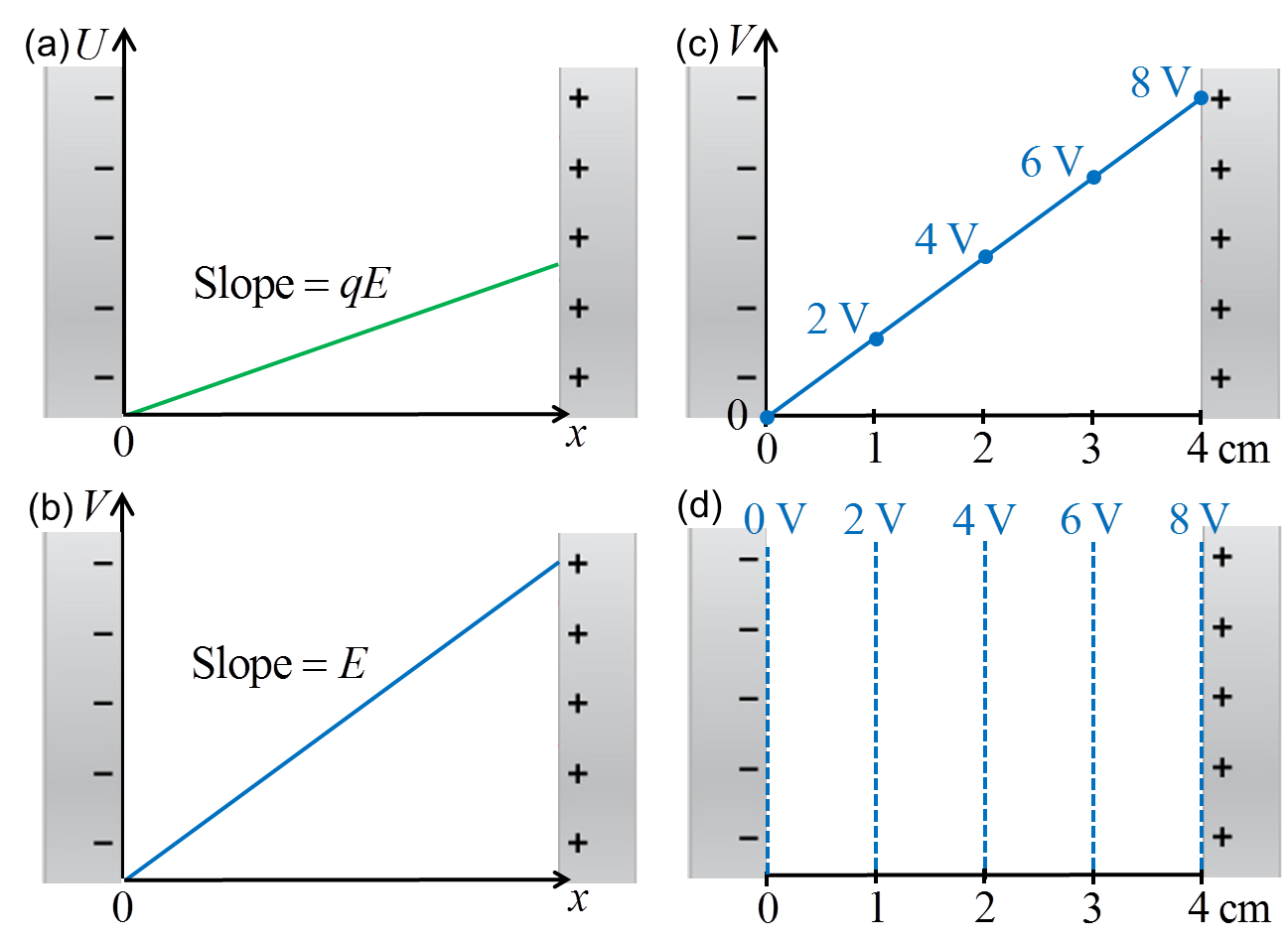
For a uniform electric field between parallel plates, the figure shows (a) electric potential energy vs. position and (b) electric potential vs. position, illustrating that removes dependence on the test charge. The contour-map/equipotential panel connects the graph to the spatial idea of voltage as a location-to-location quantity rather than something “stored in” the moving charge. Source
One volt means one joule of electric potential energy change for each coulomb of charge moved. In symbols, . This unit statement is a useful way to interpret verbal descriptions of electric situations.
The role of the test charge
In this context, a test charge is the charge imagined to move between the two points so the energy change can be described. The test charge is not what creates the situation being analyzed; it is the charge used to express how the electric environment affects energy. Choosing a positive test charge often makes sign interpretation more direct, but the definition still works for any charge value as long as the sign of is included correctly.
Interpreting the Sign
The sign of tells you how the electric potential energy of a positive test charge changes. If is positive, a positive test charge has a positive between those points. If is negative, a positive test charge has a negative . For a negative charge, the sign of the energy change reverses because the charge itself is negative. This means potential difference belongs to the two points, but the actual energy change depends on both the sign and magnitude of the moving charge.
= change in electric potential energy, in joules,
= charge of the moving object, in coulombs,
= electric potential difference between the two points, in volts,
This rearranged form is especially useful when a problem gives charge and potential difference and asks for the corresponding change in electric potential energy.
Using Electric Potential Difference Correctly
When reasoning about electric potential difference, keep these ideas in order:
Identify the initial point and the final point.
Use a consistent sign convention so that means final minus initial.
Decide whether the question asks about a difference between locations or about the energy change of a specific charge.
Remember that doubling the charge doubles , but it does not change between the same two points.
Keep units consistent: joules for , coulombs for , and volts for .
A common misunderstanding is to treat potential difference as if it were the same thing as force. It is not a force. Another mistake is to think a negative answer is somehow unphysical. A negative potential difference simply means the electric potential energy per unit charge decreases from the initial point to the final point. Finally, do not describe potential difference as belonging to only one point. It is always a comparison between two points.
Practice Questions
A charge of moves from point to point . The electric potential difference is .
Determine the change in electric potential energy of the charge.
1 mark for using
1 mark for
1 mark for stating that the electric potential energy decreases
A positive test charge of moves from point to point and its electric potential energy increases by .
(a) Calculate the electric potential difference .
(b) A charge of then moves from to . Calculate its change in electric potential energy.
(c) State whether the second charge gains or loses electric potential energy.
1 mark for using
1 mark for
1 mark for using for the second charge
1 mark for
1 mark for stating that the second charge loses electric potential energy
FAQ
Only changes in electric potential energy affect physical predictions in this context, so physics depends on differences between points rather than on an absolute zero level.
You may choose a convenient reference level for zero potential, but once that choice is made consistently, the potential difference between any two specific points is fixed.
In an electrostatic situation, no. The electric potential difference depends only on the initial and final points.
That is why a single value of potential difference can describe the energy change per unit charge between two locations, even if many possible paths connect them.
Writing $V_B-V_A$ makes the order of subtraction explicit. It tells you exactly which point is final and which point is initial.
The symbol $\Delta V$ is shorter, but it is only clear if the problem has already defined the starting and ending points.
A voltmeter reports the potential at one lead relative to the other. In standard use, it shows the potential at the red lead minus the potential at the black lead.
If you swap the leads, the sign reverses because the subtraction order reverses, even though the magnitude stays the same.
Yes. Distance alone does not determine potential difference.
What matters is how the electric environment changes between the two locations. In some situations, a strong change over a short distance can produce a larger potential difference than a weaker change over a longer distance.
