

AP Syllabus focus: 'The average electric field between two points equals the electric potential difference between the points divided by the distance between the points.'
These notes connect electric potential difference to field strength over a region, showing how a change in potential across a known distance lets you describe an average electric field with a simple algebraic relationship.
Relating potential difference to field
This subsubtopic links two ways of describing an electric situation.
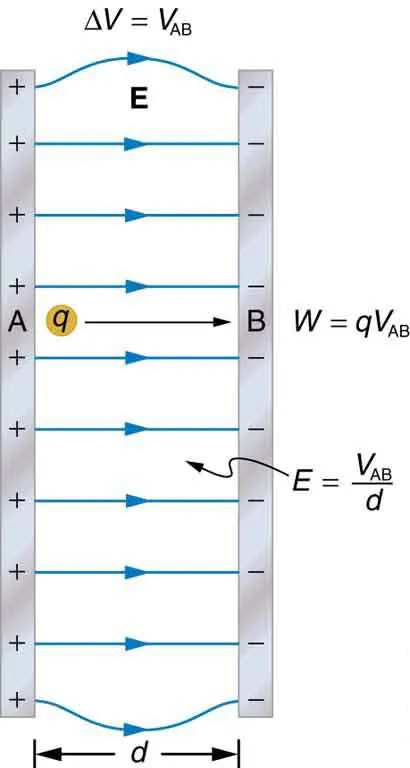
Parallel metal plates maintained at different potentials produce an approximately uniform electric field in the region between them (ignoring edge effects). This visual supports interpreting as “potential difference spread over a separation,” which is exactly the situation the equation models. Source
Electric potential difference tells you how much electric potential changes between two locations, while average electric field tells you how strong the field is across the separation between those locations.
When physicists use the word average, they mean a single value that represents the overall field behavior between two chosen points rather than every possible value at every spot in between.
Average electric field: The field value found by comparing the electric potential difference between two points with the distance separating those points.
A larger potential difference spread over the same distance corresponds to a stronger average electric field. A smaller potential difference over that same distance corresponds to a weaker average electric field. This makes the field a measure of how rapidly potential changes with position across the interval being studied.
Electric potential difference: The change in electric potential between two points in space.
Because the relationship depends on both change in potential and separation, it is not enough to know only the voltage or only the distance. Both pieces of information are required.
= average electric field magnitude between two points, in
= electric potential difference between the points, in
= distance between the points, in
You can rearrange the same relationship to find either the potential difference, , or the distance, , depending on what the problem gives you.
Interpreting the relationship
What the equation means physically
The formula says that the average electric field is the potential difference per unit distance between two points.
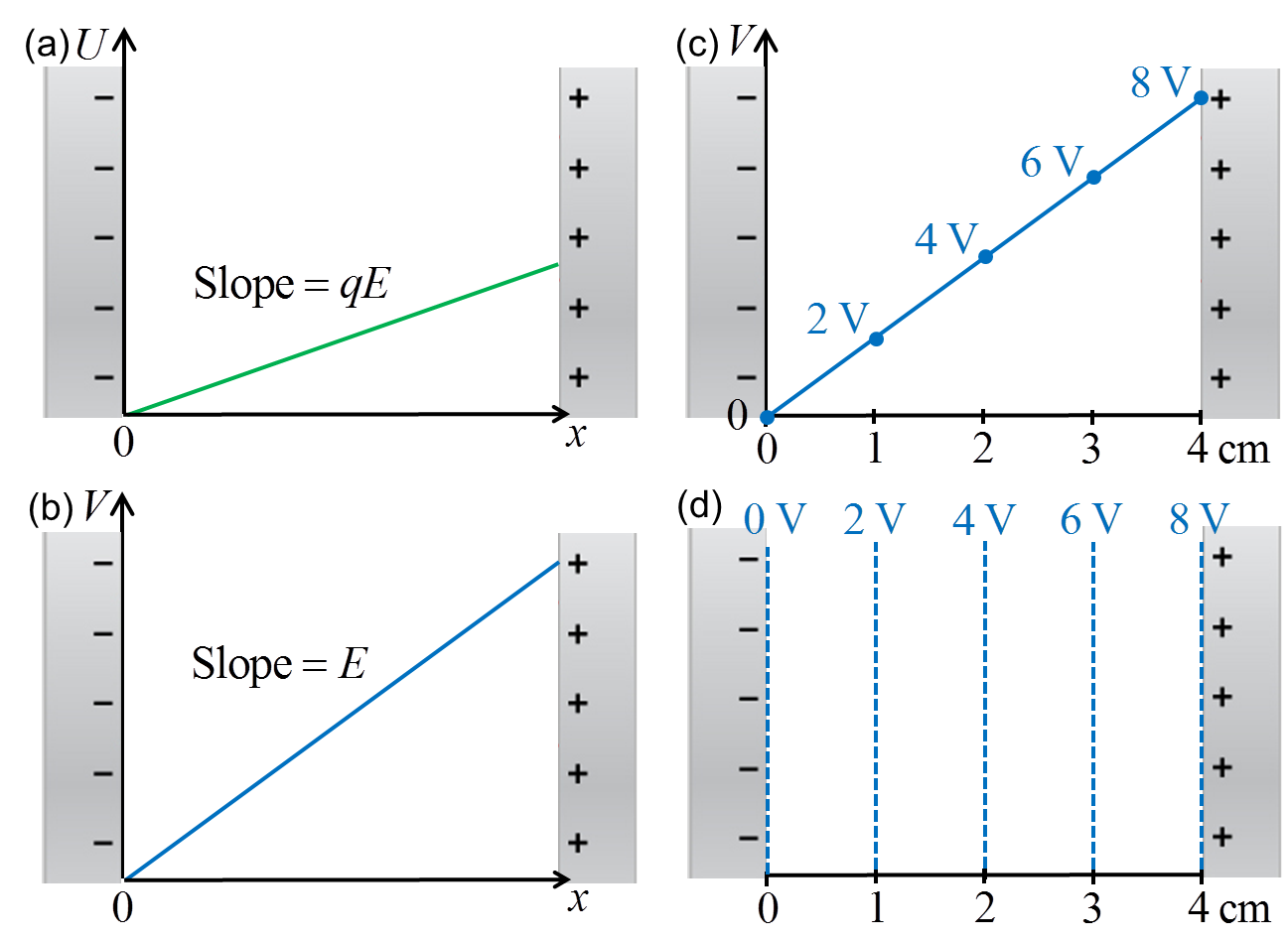
Multi-panel diagram showing a uniform electric field between plates alongside the corresponding electric potential diagram and a vs. position graph. The straight-line graph emphasizes that, in a uniform field, potential changes at a constant rate with distance, so the interval slope corresponds to the average field magnitude via . Source
If the potential changes a lot across a short distance, the average field is large. If the same potential change is spread across a much longer distance, the average field is smaller.
This idea is useful because it turns a potential-based quantity into a field-based quantity. In AP Physics 2 Algebra, that connection lets you move between two common descriptions of the same situation without calculus.
What changes the average electric field
Keep these patterns in mind:
If increases while stays the same, increases.
If increases while stays the same, decreases.
If both and change, compare their ratio, since the field depends on .
These comparisons are often more important than memorizing numbers. The equation shows a direct proportionality with potential difference and an inverse proportionality with distance.
When to use this relationship
Average value across an interval
Use this relationship when a problem asks about the field between two points and gives you a potential difference and a distance. The result is an average electric field for that interval.
That wording matters. The field could be the same everywhere between the points, or it could vary from place to place. This equation still gives one overall value for the interval. If the field truly is constant across the region, then the average value is also the field at every point in that region.
Choosing the correct distance
The distance in the equation is the separation associated with the stated potential difference. In simple AP Physics 2 Algebra problems, that is usually the distance between the two named points along the region being analyzed.
Be careful not to substitute an unrelated length from the diagram. A common mistake is using a total object length, side length, or diagonal that is not the actual separation tied to the potential difference in the problem statement.
Reading problems carefully
What a question may give you
A problem may provide the potential difference directly, or it may describe one point as being at a higher potential than another by a certain number of volts. It may then ask for the average field across the stated separation. In other cases, the field and distance are known, and you solve for the potential difference by multiplication.
Why algebraic rearrangement matters
Being comfortable with simple rearrangement helps you recognize the same idea in several forms. The relationship does not change when written as or ; only the unknown changes. This is especially useful in multi-step problems where one part asks for the average field and a later part asks for the voltage across a new distance in the same region.
Units and problem-solving habits
Potential difference is measured in volts, and distance is measured in meters, so the average electric field from this relationship is usually written in volts per meter.
Good problem-solving habits include:
Convert all distances to meters before substituting into the equation.
Decide whether the problem is using magnitudes only or a stated sign convention.
Keep track of which two points the potential difference refers to.
Report the answer with units.
A result with a larger numerical value means the potential is changing more rapidly with distance over the chosen interval.
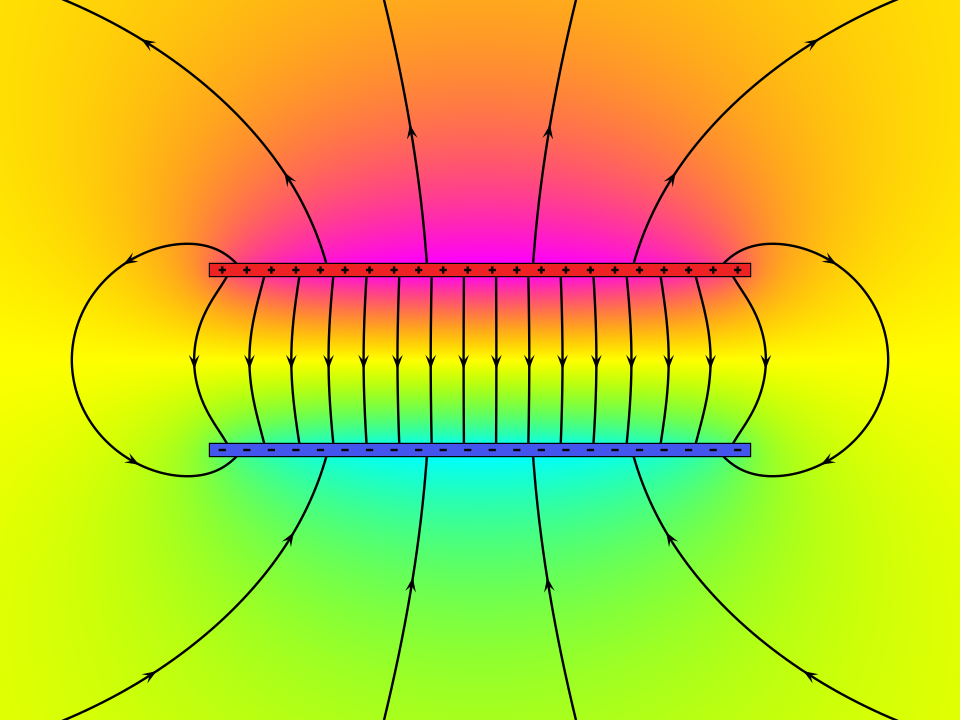
Color-mapped potential between capacitor plates, with the electric field indicated across the gap. The image visually reinforces that a bigger potential change across the same distance implies a larger average field magnitude, consistent with . Source
A smaller numerical value means the potential changes more gradually over that interval.
Common misunderstandings
Students often confuse average electric field with a field value at one exact location. This equation does not automatically tell you the field at every point unless the problem indicates the field is constant in the region.
Another common error is treating potential difference and distance as independent facts that can be interpreted separately. In this relationship, the field comes from how those two quantities are connected. The same potential difference can imply different average fields if the distances are different.
When checking answers, ask whether the value makes sense physically. A very large potential change across a tiny separation should produce a relatively large average field, while the same change across a broad separation should produce a smaller one.
Practice Questions
Two points in a region are separated by . The electric potential difference between them is . Calculate the average electric field magnitude between the points.
1 mark: Uses
1 mark: Substitutes correctly and finds
Point A and point B are separated by . The electric potential difference between them is .
(a) Calculate the average electric field magnitude between A and B.
(b) A second pair of points has the same potential difference but is separated by . State how the average electric field magnitude compares to the answer from part (a).
(c) A third interval has an average electric field magnitude of across a distance of . Determine the potential difference across that interval.
2 marks: For part (a), uses and finds
1 mark: For part (b), states the field is one-third of part (a), or
2 marks: For part (c), uses and finds
FAQ
If a problem uses a signed potential difference, reversing the order of the points can reverse the sign of $\Delta V$.
The size of the interval does not change, but the sign convention can. In many AP Physics 2 Algebra questions, you are asked for the magnitude of the average electric field, so the final value is reported as positive.
Yes. Nearby charges can still create electric fields in the region.
What matters for the average value is the net potential difference between the chosen points. If that potential difference is zero for the interval being considered, then the average electric field for that interval is zero, even though the field may not be zero at every location between the points.
Yes. Two regions can have the same ratio $\dfrac{\Delta V}{d}$ and therefore the same average electric field.
That does not mean the field behaves the same way at every point inside each region. One region might have a nearly constant field, while another might have a field that changes from place to place but still produces the same overall average across the chosen endpoints.
You would need two measurements: the electric potential difference between two points and the distance separating those points.
A common approach is to measure the voltage difference with appropriate equipment, measure the separation in meters, and then calculate $E_{avg}=\dfrac{\Delta V}{d}$. The result is only as reliable as the measurements, so careful distance measurement and clear identification of the two points are important.
A potential-versus-position graph shows how electric potential changes as position changes.
Over any chosen interval, the average electric field is related to how steeply the graph changes between the two endpoints. A larger overall change in potential over a shorter horizontal distance corresponds to a larger average field, while a gentler change corresponds to a smaller average field.
