

AP Syllabus focus: 'Electric potential difference may result from chemical processes, such as in a battery, that separate positive and negative charges.'
Batteries are important because they create a difference in electric potential by using chemistry to rearrange charge. Understanding that separation explains how a battery can drive charge motion in a complete circuit.
Batteries as sources of potential difference
A battery is not just a container of charge. Its key role is to use chemical processes to create and maintain a difference between two terminals. Inside the battery, chemical reactions rearrange charge so that one terminal becomes relatively positive and the other becomes relatively negative.
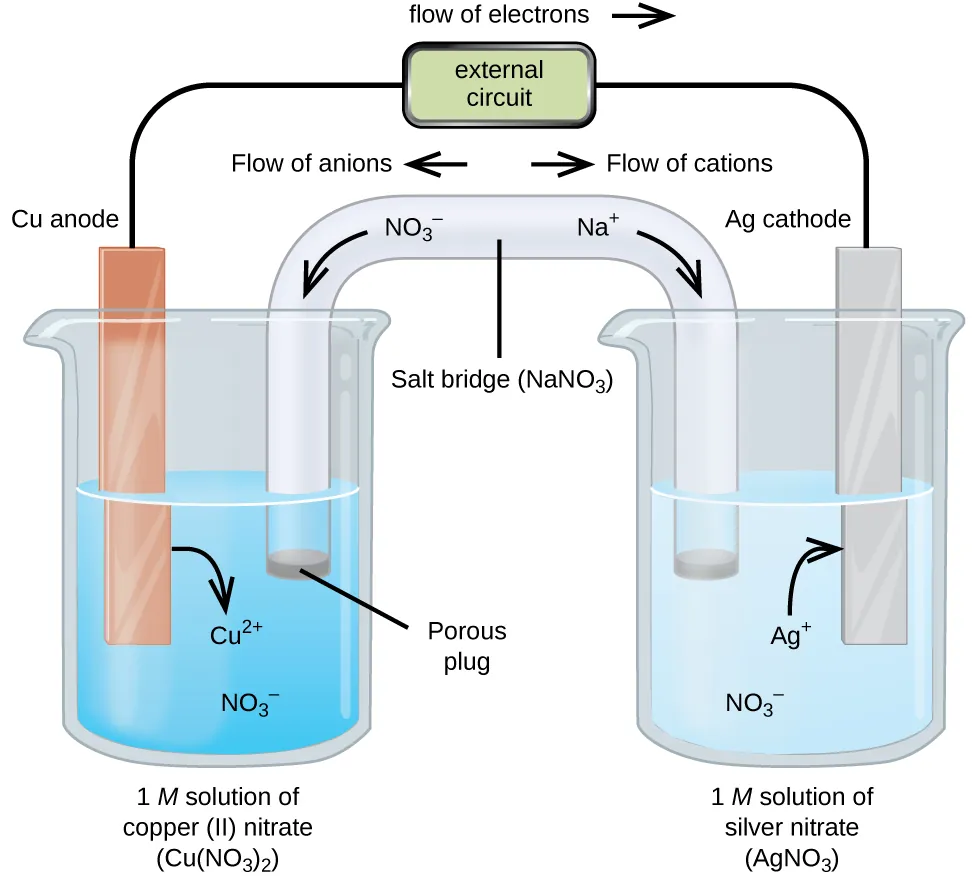
Labeled galvanic-cell schematic showing how redox reactions separate charge and establish opposite-polarity terminals. The diagram explicitly indicates electron flow through the external circuit and compensating ion motion in the salt bridge, reinforcing that the battery’s voltage comes from chemical forces maintaining separation. Source
This separation of charge is what produces an electric potential difference.
Battery: A device in which chemical processes separate charge, creating a potential difference between two terminals.
This idea is easy to miss because the battery itself may remain nearly electrically neutral overall. What matters is that charges become separated into different regions, not that the whole battery acquires only one sign of charge.
Chemical separation of charge
In a typical battery, chemical reactions inside the cell push charges in preferred directions. Those reactions are driven by differences in chemical energy between the materials in the battery. As the reactions proceed, charge builds up at the terminals. The growing electric attraction between opposite charges resists further separation, so the battery reaches a state in which chemical effects are balancing the electric tendency of charges to pull back together.
Charge separation: The redistribution of existing charges so that positive and negative charges accumulate in different regions.
At that point, there is a stable potential difference between the terminals even before the battery is connected to an external device.
What charge separation means
Charge separation does not mean charge is created. Instead, charges that already exist are moved apart. A battery transfers charge internally so that different locations end up in different electrical states. Because the terminals are no longer equivalent, a charge placed near one terminal would have different electric potential energy than near the other terminal.
Electric potential difference: The difference in electric potential between two locations, such as the two terminals of a battery.
For this subsubtopic, the crucial idea is the cause: chemical processes produce charge separation, and that separation produces the potential difference.
Role of the two terminals
The negative terminal has an excess of negative charge relative to the rest of the battery, while the positive terminal has a deficit of negative charge, making it relatively positive. This imbalance sets up the potential difference available to a circuit.
When an external conducting path is connected, the separated charges are no longer perfectly isolated.
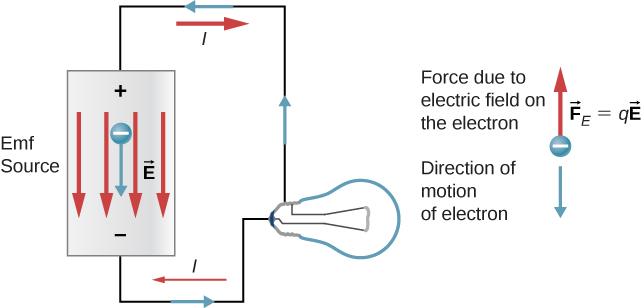
Simple circuit diagram of a battery connected to a lamp, illustrating a maintained potential difference across the battery terminals while charge moves through the external path. It’s a compact visual bridge between “battery as charge-separator” and “battery as a source element in circuit models.” Source
Charges can move through the circuit because the battery has already established a difference in electric potential between its terminals. As charges move externally, the chemical processes inside the battery continue acting to restore the separation. In this way, the battery is not merely an initial source of imbalance; it is a device that can maintain that imbalance while its reactions continue.
Open circuit and connected circuit
A useful way to think about a battery is to compare two situations. In an open circuit, there is no complete external path, so the battery can still have a potential difference even though charges are not continuously moving through a device. In a connected circuit, charges begin to move through the external path, which tends to reduce the separation at the terminals. The battery counters that reduction by continuing its internal chemical action. This is why a working battery can keep supplying a potential difference for some time instead of losing it immediately.
Why chemistry matters
Without chemical action, opposite charges would simply attract and reduce the separation. The battery's internal reactions act against that tendency, continually pulling charge apart at the microscopic level. That is why a battery can keep a potential difference across its terminals instead of letting it collapse right away.
This also explains why different batteries can provide different voltages. The amount of potential difference depends on the specific chemical reactions and materials involved. The chemistry determines how strongly charges are driven apart and how much separation can be sustained.
Common misconceptions to avoid
A battery does not manufacture charge. It redistributes charges that already exist.
A battery does not need to give the whole device a large net charge. It only needs to create separated regions of opposite charge.
Potential difference refers to a difference between two locations, not to a charge stored at one point.
The energy associated with a battery comes from chemical energy, which is used to separate charge.
Interpreting a battery in physics models
In AP Physics 2 Algebra, treat a battery as a source of chemical charge separation.
The essential physical result is a positive terminal and a negative terminal.
Those separated charges create the electric potential difference available to the rest of the system.
If the battery is operating, its internal chemistry keeps rebuilding the separation as long as the relevant reactions can continue.
Practice Questions
A battery is sitting on a lab table and is not connected to any circuit. Explain how it can still have a potential difference between its terminals.
1 mark: States that chemical processes inside the battery separate positive and negative charges.
1 mark: States that this charge separation creates a potential difference between the terminals.
A student connects a battery to a simple circuit containing wires and a lamp. Explain how the battery creates the potential difference before the circuit is completed and how it maintains that potential difference after charges begin moving.
1 mark: Identifies chemical reactions or chemical processes inside the battery.
1 mark: States that these processes separate positive and negative charges, or move charge so the terminals become oppositely charged.
1 mark: States that the separation of charge creates a potential difference between the terminals.
1 mark: States that when the circuit is completed, charges can move because the terminals are at different electric potentials.
1 mark: States that the battery maintains the potential difference by continuing to separate charge while the chemical reactions can still occur.
FAQ
Different chemical reactions release different amounts of energy per unit charge moved inside the battery.
That means different materials have different abilities to separate charge and sustain a terminal potential difference. The battery voltage is therefore tied to the specific chemistry, not just to the battery’s size.
Voltage mainly depends on the chemical reaction and, in many cases, on how many cells are placed in series.
Battery size mostly changes how much reactant is available, how long the battery can operate, and how much current it can provide without a large voltage drop. A larger battery does not automatically mean a higher voltage.
In a rechargeable battery, an external energy source can force the internal chemical reactions to run in reverse.
That reverse process restores the original chemical arrangement and re-establishes the battery’s ability to separate charge. In a nonrechargeable battery, the chemistry is not easily or safely reversed in normal use.
Low temperature slows chemical reaction rates and can also reduce the mobility of charge-carrying ions inside the battery.
As a result, the battery may have more difficulty maintaining charge separation when a device is connected. The battery can still have some voltage, but it may deliver less effectively under load.
A voltmeter usually draws very little current, so even a weak battery can sometimes maintain a small terminal potential difference during the measurement.
But when the battery is connected to a real device, the required charge separation may collapse much more quickly. That is why a battery can look acceptable on a meter yet fail in actual use.
