

AP Syllabus focus: 'Electric potential describes electric potential energy per unit charge at a point in space.'
Electric potential gives a way to describe what a location in an electric system “offers” to charge.
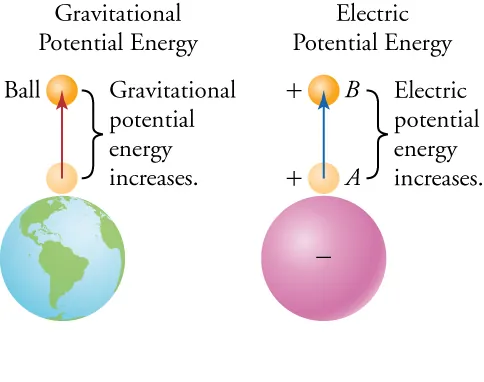
The figure contrasts gravitational and electric potential energy as position-dependent energy stored by an interacting system. The key takeaway is that “potential” ideas belong to the system and its configuration in space, which sets up the later step of defining electric potential as energy per unit charge at a location. Source
It connects energy ideas to space and separates the effect of position from the amount of charge placed there.
What electric potential means
Electric potential is about a point in space, not just about one particular charged object.
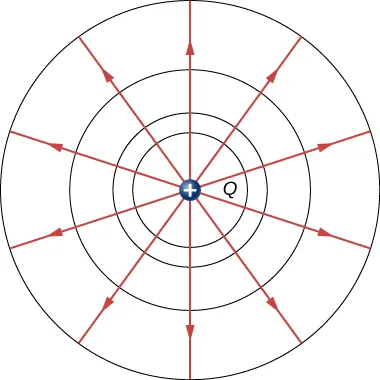
Electric field lines (red) radiate outward from a positive point charge, while equipotential lines (black) mark locations where the electric potential is constant. Because is constant along an equipotential, moving a test charge along that line does not change electric potential energy; changes in energy occur when moving between different equipotentials. Source
If a charged object were placed at that point, the object-field system would have electric potential energy. Electric potential tells how much of that energy is associated with each coulomb of charge at the location.
Electric potential: Electric potential at a point is the electric potential energy per unit charge associated with that location in space.
A useful way to think about electric potential is that it describes the energetic condition of a location. Some points are associated with greater electric potential energy per coulomb, and some with less. This lets physicists describe the electrical properties of space itself, not only the properties of individual particles.
Because it is defined per unit charge, electric potential is not tied to one specific amount of charge. That makes it more general than electric potential energy. A point can have a particular electric potential whether the object placed there later has a large charge, a small charge, or no charge at all.
Why “per unit charge” matters
Electric potential energy, , depends on two things: the electrical environment and the charge of the object being considered. If the same location is considered with different amounts of charge, the potential energy changes in direct proportion to the charge. Dividing by the charge removes that dependence and leaves a quantity that describes the location alone.
= electric potential at a point, volts
= electric potential energy, joules
= charge, coulombs
This relationship can also be rearranged to . That form is often useful for interpretation. If the value of at a point stays the same, then doubling doubles , and reversing the sign of reverses the sign of .
That idea is central: electric potential is a property of the point, while electric potential energy is a property of the object-field system. The location determines . The combination of location and charge determines .
Units and physical interpretation
The SI unit of electric potential is the volt.
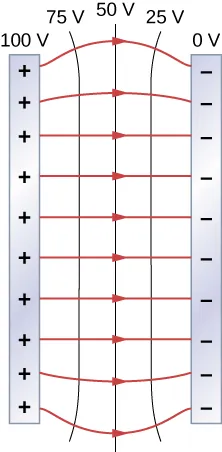
Between oppositely charged parallel plates, the electric field is approximately uniform, so equipotential lines are nearly parallel and evenly spaced. The labeled values (e.g., 100 V down to 0 V) show that electric potential is assigned to positions in space, and a charge’s potential energy change follows . Source
A volt is a compact way of expressing energy per unit charge.
Volt: One volt equals one joule of electric potential energy per coulomb of charge.
So, if a point has an electric potential of , that means each of charge at that point is associated with of electric potential energy. A larger value of potential means more energy per coulomb. A smaller value means less energy per coulomb.
The sign of electric potential also matters. A positive electric potential means a positive charge placed there would have positive electric potential energy. A negative electric potential means a positive charge placed there would have negative electric potential energy. The sign does not describe direction; it describes the sign of energy per unit charge.
Important distinctions
Electric potential is not the same as electric potential energy
Students often mix up these two terms because the names are similar. Electric potential energy is measured in joules and depends on the amount of charge involved. Electric potential is measured in volts and is the energy per coulomb at a location. They are related, but they are not interchangeable quantities.
A charge of and a charge of placed at the same point do not create two different values of electric potential at that point. They experience different electric potential energies because their charges are different, but the point itself still has one value of .
Electric potential is a scalar quantity
Electric potential is a scalar, meaning it has magnitude but no direction. At a point in space, electric potential is represented by a single number, which may be positive, negative, or zero. This is different from quantities that require both size and direction.
Because electric potential is scalar, it is especially useful for describing the energy aspect of electric interactions without having to track directions directly. In AP Physics 2, that makes it a convenient bridge between energy ideas and electric behavior.
Common mistakes to avoid
Do not treat electric potential as if it belongs to a charged particle alone. It describes a location.
Do not assume a larger test charge means a larger electric potential. A larger charge changes , not .
Do not confuse volts with joules. A volt is joules per coulomb, not energy by itself.
Do not ignore the sign of charge when using . The sign can change the electric potential energy even when the potential stays the same.
Do not interpret positive or negative electric potential as direction. The sign tells you the sign of energy per unit charge.
Practice Questions
A point in space gives a charge an electric potential energy of . What is the electric potential at that point?
1 mark for using .
1 mark for the correct answer: .
At point , the electric potential is .
(a) Explain what the value means physically. [2 marks]
(b) Determine the electric potential energy of a charge placed at . [1 mark]
(c) Determine the electric potential energy of a charge placed at . [1 mark]
(d) Explain why the electric potential at is the same for both charges even though their electric potential energies are different. [1 mark]
(a) 1 mark for stating that electric potential is electric potential energy per unit charge at a point.
(a) 1 mark for explaining that a positive charge at would have of electric potential energy.
(b) 1 mark for .
(c) 1 mark for .
(d) 1 mark for stating that electric potential is a property of the location, while electric potential energy depends on both the location and the charge placed there.
FAQ
A positive test charge sets a consistent sign convention. If the potential at a point is positive, a positive charge would have positive electric potential energy there.
The test charge is taken to be small so it does not significantly change the original charge arrangement. That keeps the measured potential tied to the location, not to the disturbance caused by the test charge.
No. In electrostatics, electric potential at a point is single-valued, so it does not depend on the path used to reach that point.
If path did matter, the same point could have multiple potential values, which would make the idea of electric potential unusable. This path independence is why potential is such a useful energy-based description.
Yes. A single potential value at one point does not uniquely identify the entire charge distribution that created it.
Different arrangements can give the same value of $V$ at a particular location, even though the surrounding space may be very different. To describe the full situation, physicists need potential information at many points, not just one.
Electric potential is a ratio that describes a location, not a claim that actual objects can carry any arbitrary fraction of charge.
Even though real charges come in multiples of the elementary charge, the quantity $V$ still works as a continuous field description of space. It tells how much electric potential energy would correspond to each coulomb, regardless of the discrete nature of actual particles.
Yes. A point can have zero electric potential because of cancellation or because of the chosen reference level.
That does not mean the region is physically unimportant. It only means the net electric potential at that point is zero on the chosen scale. Nearby charges may still influence what happens there in ways that are not captured by the single number $V=0$.
