

AP Syllabus focus: 'The energy stored in a capacitor is described by U = 1/2 QDeltaV. Adding a dielectric changes capacitance and induces an opposing electric field.'
This subsubtopic focuses on how capacitor energy is expressed and why inserting a dielectric changes the capacitor's behavior by altering the electric field between the plates.
Stored Energy in a Capacitor
A capacitor stores electric potential energy when opposite charges are separated onto its two plates. The amount of stored energy depends on both the amount of charge separated and the electric potential difference created between the plates. For AP Physics 2, the key relationship is written in terms of and .
= energy stored in the capacitor, J
= magnitude of the charge on one plate, C
= potential difference across the capacitor, V
This equation shows that stored energy increases when the capacitor holds more charge or when the potential difference across it is larger. Because the equation contains the factor , the energy is not just ; the buildup of stored energy is linked to the fact that the capacitor is charged gradually.
It is important to interpret correctly. In capacitor problems, usually means the magnitude of the charge on either plate, not the algebraic sum of the charges on both plates. The plates have equal charge magnitude and opposite signs, so the capacitor stores energy because of the separation of charge, not because the system has a large net charge.
Interpreting the Energy Relationship
The expression is useful for proportional reasoning. If increases while also increases, the stored energy increases. If either or is zero, the stored energy is zero, because there is then no separated-charge arrangement capable of storing energy in the electric field configuration of the capacitor.
The equation also reminds you that capacitor energy is a property of the capacitor system, not of a single plate by itself. The stored energy is associated with the arrangement of both plates and the electric conditions between them. For that reason, when the electric field inside the capacitor is changed, the stored energy can change as well.
Dielectrics and Their Role
Dielectric: An insulating material placed between capacitor plates that responds to the electric field and changes the capacitor's electrical behavior.
A dielectric does not act like a conductor. Charges do not flow freely through it from one plate to the other. Instead, the atoms or molecules inside the material shift slightly in response to the existing electric field. This creates a small internal separation of positive and negative charge within the material.
That internal charge separation is the reason a dielectric matters. The material is not neutralizing the plates, and it is not creating a completely independent capacitor. Instead, it is responding to the original field already present between the plates. Its response changes the electric environment in the region between the plates.
Opposing Electric Field
When a dielectric is inserted, the shifted charges inside the material create an induced electric field.
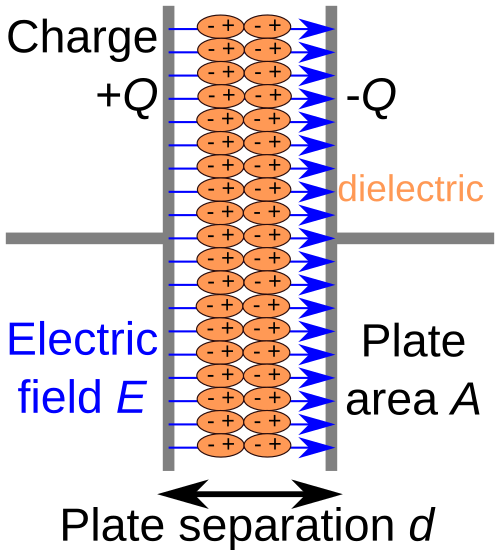
Schematic of a parallel-plate capacitor with a dielectric spacer, showing the plate separation , plate area , and the presence of charge producing an electric field . The diagram reinforces the idea that the dielectric becomes polarized and reduces the net internal electric field compared with vacuum/air, which is the mechanism behind the capacitance increase. Source
The key AP Physics idea is that this induced field points in the direction opposite the original field produced by the charged plates. Because electric fields combine by superposition, the dielectric's field partially opposes the plate field.
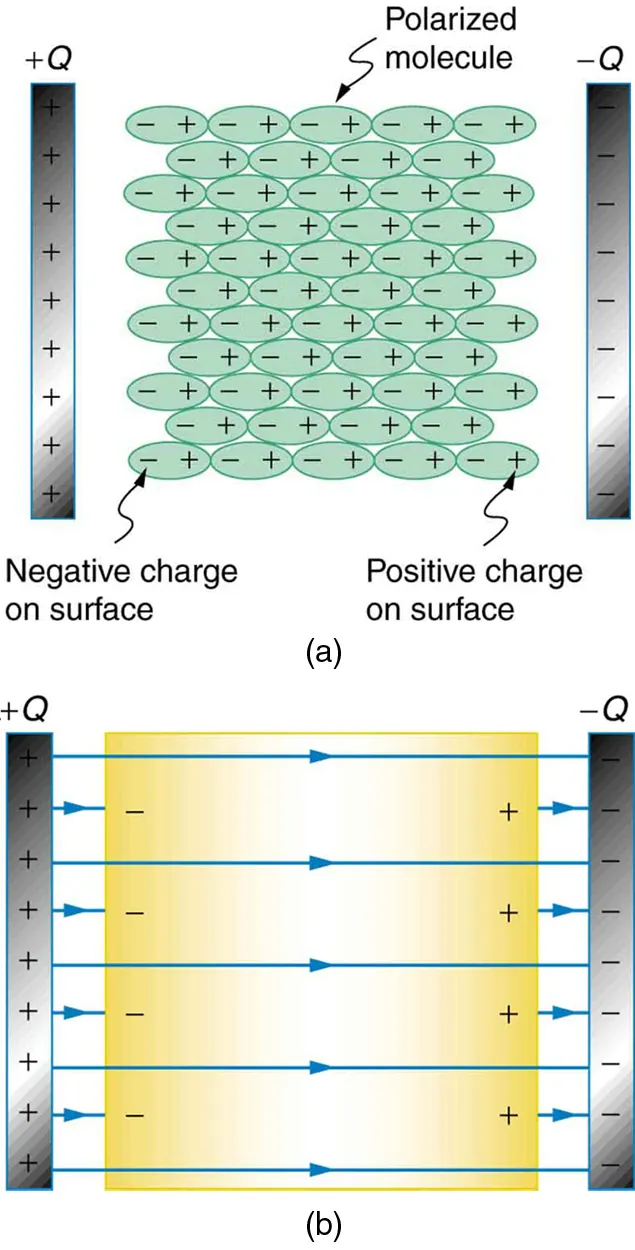
Textbook diagram showing molecular polarization inside a dielectric placed between charged capacitor plates, producing bound charges that oppose the original plate-produced field. The accompanying panel depicts fewer/shorter field lines through the dielectric region, illustrating how the net field (and thus for a given ) is reduced, which corresponds to a larger capacitance. Source
The word opposing is important. The dielectric does not usually reverse the overall field or make it disappear completely. Rather, it reduces the net field compared with the field that would exist in the same capacitor without the dielectric. This is why dielectric materials are so useful in capacitors: they change the field in a predictable way.
A common misunderstanding is to think that the dielectric "adds more charge" to the plates. That is not the central effect. The important effect is that the material responds internally, and that internal response produces the opposing field. The plate charges still set up the original field, but the dielectric modifies the final field between the plates.
Why the Capacitance Changes
Because the dielectric changes the electric field between the plates, it also changes the relationship between stored charge and potential difference. That means the capacitance changes. In physical terms, the capacitor no longer behaves exactly the same as it did when the space between the plates was empty or filled only with air.
For a given plate arrangement, an opposing induced field means the same separated charge produces a smaller net electric effect between the plates than before. As a result, the capacitor can store charge more effectively for the same general geometry. This is why inserting a dielectric is associated with a change in capacitance.
This change in capacitance connects directly back to stored energy. Since the stored energy depends on and , and a dielectric affects the electrical conditions that determine those quantities, adding a dielectric can change the amount of energy stored. The exact amount depends on the physical setup, but the underlying reason is always the same: the dielectric induces an opposing field and therefore changes the capacitor's behavior.
Precision in Language
Stored energy refers to energy associated with the capacitor system, not just one plate.
In , is the magnitude of charge on a plate.
A dielectric is an insulator, so charges do not move freely through it.
The dielectric responds to the existing field by shifting charge internally.
That internal response creates an opposing electric field.
Because the field changes, the capacitance changes as well.
Practice Questions
A capacitor stores a charge magnitude on each plate and has a potential difference across the plates. State the equation for the energy stored in the capacitor and identify what represents.
1 mark for stating
1 mark for identifying as the magnitude of the charge on one plate
A charged parallel-plate capacitor is filled with a dielectric. Explain how the dielectric produces an opposing electric field and why this changes the capacitance of the capacitor.
1 mark for stating that the dielectric becomes polarized or that charges shift slightly within the material
1 mark for stating that the dielectric is an insulator, so charge does not flow freely from one plate to the other
1 mark for explaining that the shifted charges in the dielectric create an induced electric field
1 mark for stating that the induced field is opposite the original field between the plates
1 mark for explaining that changing the field changes the relationship between charge and potential difference, so the capacitance changes
Accept “capacitance increases” as part of the final mark if supported by correct reasoning
FAQ
If the capacitor is isolated, the charge $Q$ stays constant because there is no path for charge to enter or leave the plates.
Since the dielectric increases the capacitance, the energy becomes smaller. A useful form is $U=\dfrac{Q^2}{2C}$, so increasing $C$ makes $U$ decrease.
If the battery remains connected, the potential difference $\Delta V$ stays constant because the battery fixes it.
In that case, the capacitance increases and extra charge flows onto the plates. Using $U=\dfrac{1}{2}C(\Delta V)^2$, increasing $C$ at constant $\Delta V$ makes the stored energy increase.
A dielectric works only up to a certain electric field strength. If the field becomes too large, the material can no longer remain insulating.
At breakdown:
charges begin moving through the material
the capacitor may fail
sparks, heating, or permanent damage can occur
This sets a practical limit on how much energy a capacitor can safely store.
Different materials have different abilities to polarize in an electric field. Materials whose charges shift more easily produce a stronger opposing induced field.
This is described by the dielectric constant. If a material has a larger dielectric constant $\kappa$, it generally causes a larger capacitance change, often written as $C=\kappa C_0$ for the same geometry.
Free charge is the charge placed on the capacitor plates by a battery or other charging process.
Bound charge appears inside the dielectric because the atoms or molecules polarize. Bound charge is not free to travel through the material like conduction charge. It is this bound charge arrangement that produces the opposing electric field inside the capacitor.
