AP Syllabus focus:
‘Researchers often study genetic influences on behavior and mental processes through twin, family, and adoption studies.’
Psychologists can’t randomly assign people to genes or early home environments, so they rely on comparative designs. By examining patterns of similarity among relatives with known genetic overlap, researchers estimate how heredity and environment contribute to traits.
Core idea: compare relatedness to infer influence
Researchers study individual differences (e.g., temperament, intelligence, risk for disorders) by comparing groups that differ in genetic relatedness and/or rearing environment.
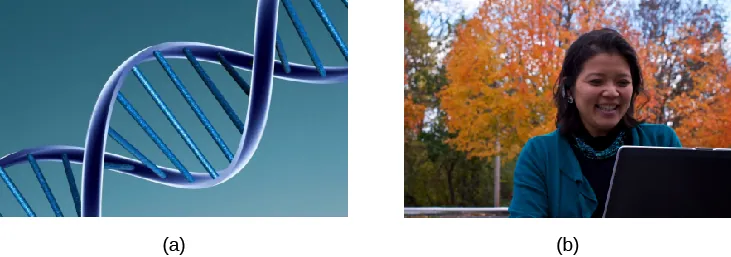
Genotype vs. phenotype (genes + environment). This figure illustrates the distinction between genotype (the DNA-based genetic makeup) and phenotype (observable characteristics). It supports the core behavioral-genetics message in AP Psych that measured traits reflect genetic variation expressed through (and often modified by) environmental context. Source
Heritability: The proportion of variation in a trait within a specific population and environment that is associated with genetic differences (ranges from 0 to 1, or 0% to 100%).
Heritability describes populations, not whether a trait in one person is “genetic,” and it can change when environments change.
Key research designs in AP Psychology
Family studies
Family studies compare biological relatives (e.g., siblings, parents and children, cousins) to see whether a trait “runs in families.”
Logic: if a trait clusters among relatives more than among unrelated people, genetic factors and/or shared environments may be involved.
Strength: practical for studying low-frequency outcomes (e.g., certain disorders).
Limitation: families share both genes and environment, so family studies alone cannot separate the two.
Twin studies
Twin studies compare monozygotic (MZ/identical) twins (about 100% shared genes) with dizygotic (DZ/fraternal) twins (about 50% shared genes, like ordinary siblings).
Logic: if MZ twins are more similar than DZ twins on a trait, that pattern suggests a genetic contribution.
Often includes twins reared together and, more rarely, twins reared apart to reduce shared-environment overlap.
Concordance rate: The percentage of twin pairs (or other paired relatives) in which both individuals show a particular trait or diagnosis.
Higher concordance in MZ than DZ twins supports genetic influence, but it does not rule out environmental effects.
Adoption studies
Adoption studies compare adoptees to:
Biological parents/siblings (shared genes, different rearing environment)
Adoptive parents/siblings (different genes, shared rearing environment)
Logic:
Similarity to biological relatives suggests genetic influence.
Similarity to adoptive relatives suggests environmental influence.
Important complications include selective placement (agencies placing children into similar homes) and prenatal environment (biological mother’s health and stress), which can make genetic and environmental pathways harder to separate.
Interpreting findings: what can and cannot be concluded
Typical inferences
MZ > DZ similarity or adoptee–biological resemblance → evidence consistent with genetic influence.
Adoptee–adoptive resemblance or strong effects of home variation → evidence consistent with environmental influence.
Common assumptions and limitations
Equal environments assumption: twin studies often assume MZ and DZ twins experience equally similar environments; violations can inflate apparent genetic effects.
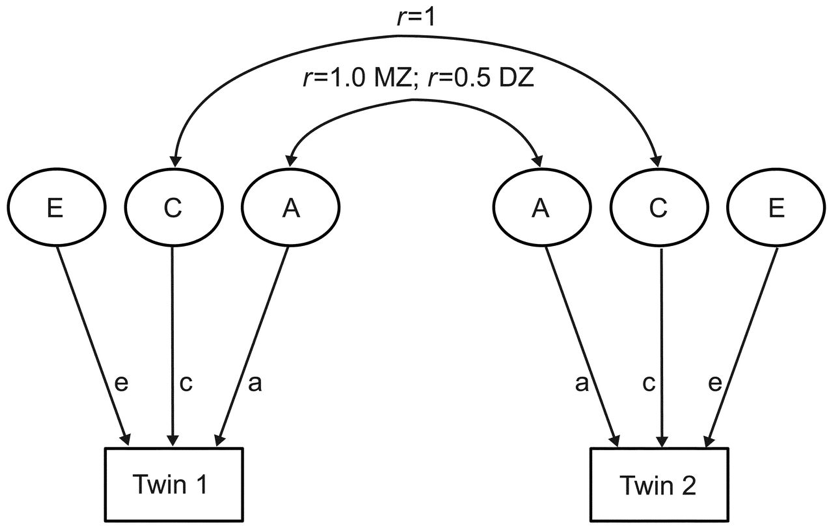
ACE model (A, C, E) for twin studies. The diagram shows how an observed trait (phenotype) is modeled as the combined influence of additive genetic effects (A), shared/common environmental effects (C), and nonshared/unique environmental effects (E). It also visually encodes the key twin-design idea that MZ twins share more genetic variance than DZ twins, while both can share the same family environment. Source
Range of environments: heritability can look larger in uniform environments and smaller in diverse environments.
Correlation, not causation: these designs estimate contributions but do not pinpoint specific genes or prove direct genetic causation.
Practice Questions
Explain one way adoption studies help psychologists distinguish genetic and environmental influences on behaviour. (2 marks)
1 mark: Identifies comparison (adoptee with biological relatives vs adoptive relatives).
1 mark: Explains inference (similarity to biological suggests genetic influence; similarity to adoptive suggests environmental influence).
Describe how twin studies and concordance rates are used to investigate genetic influences on a psychological disorder, and outline two limitations of this approach. (6 marks)
1 mark: States MZ twins share ~100% genes; DZ share ~50%.
1 mark: Describes using concordance rates for the disorder.
1 mark: Explains that higher MZ than DZ concordance suggests genetic contribution.
1 mark each (max 2): Two limitations explained (e.g., equal environments assumption; shared prenatal factors; diagnostic/measurement issues; gene–environment correlation; results are correlational not causal).
FAQ
They measure adoptive-home characteristics (e.g., SES, parenting style) and statistically control for them.
Some studies recruit from systems with more random placement policies or compare multiple adoption cohorts.
They reduce shared rearing-environment overlap, strengthening environmental separation.
They are rare due to modern adoption practices, ethical constraints, and difficulty locating and recruiting separated twins.
It occurs when genetic tendencies influence exposure to certain environments.
This can make “environmental” effects partly reflect genetic differences, complicating interpretation of family resemblance.
Concordance depends on diagnostic thresholds, interviewer reliability, and whether symptoms are assessed categorically vs dimensionally.
Broader criteria usually increase concordance, affecting comparisons across studies.
Only cautiously, because heritability depends on environmental variability.
If environments become more equal (or more unequal), the proportion of variance linked with genes can change even if genes themselves do not.