AP Syllabus focus:
‘Neurons transmit information, and glial cells provide structure, insulation, communication, and waste transport.’
The nervous system is built from specialised cells that coordinate perception, movement, and thought. Neurons carry signals, while glial cells support, protect, and fine-tune neural networks so communication remains efficient and stable.
Overview: Two Major Cell Classes
Psychologists and neuroscientists focus on how cellular structure enables function: neurons are designed for rapid signalling across distance, and glia maintain the environment that makes signalling possible.
Neuron: A nerve cell that receives, processes, and transmits information through electrochemical signals.
Neurons are “wired” for directional communication, with specialised regions that bias information flow from input to output.
Neurons: How Information Moves Through a Cell
Core parts and their jobs
Most neurons share the same basic architecture:
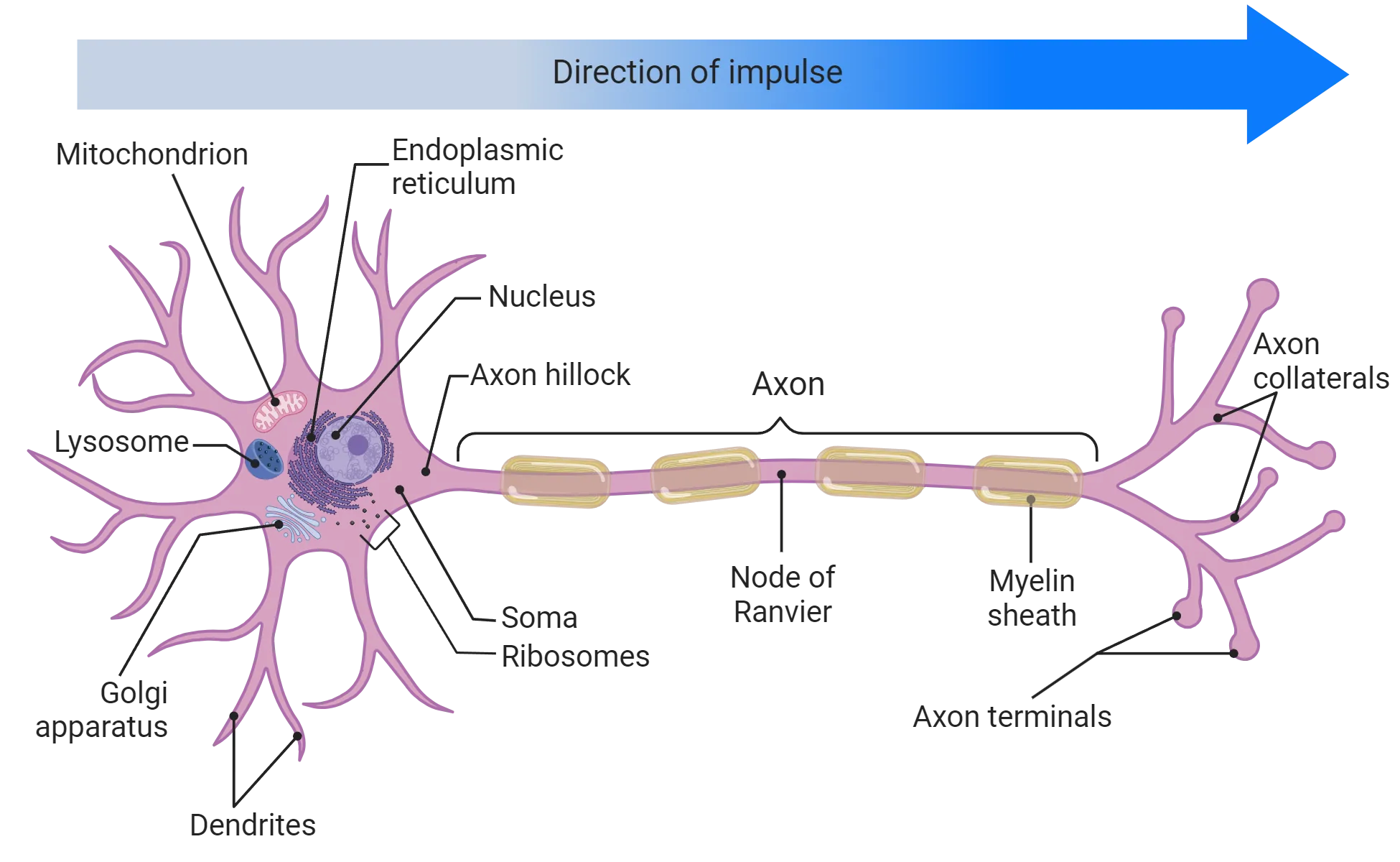
Labeled neuron diagram highlighting the major anatomical regions (dendrites, soma/cell body, axon, and axon terminals). Use it to connect each structure to its role in receiving, integrating, and transmitting signals across neural circuits. Source
Dendrites: branching input regions that receive signals from other cells.
Cell body (soma): integrates incoming information and supports metabolism.
Axon: a long fibre that carries the signal away from the soma.
Axon terminals: output endings that pass the signal to the next cell across a junction.
Signals typically travel in this sequence:
Dendrites receive input
Soma integrates input
Axon conducts the message
Terminals communicate to another neuron, muscle, or gland
What neurons transmit (without the “how” details)
At the AP level, it is essential to link structure to function: neurons transmit information using electrical activity within the neuron and chemical signalling between cells (via messenger molecules). The key idea is that neurons form networks, and behaviour emerges from patterns of activation across many connected neurons rather than from single cells acting alone.
Glial Cells: Support, Insulation, Communication, Cleanup
Neural signalling depends on a stable chemical environment, sufficient energy, and protected connections—tasks largely handled by glia.
Glial cells (glia): Non-neuronal cells that support the nervous system by providing structure, insulation, communication support, and waste transport.
Glia were once described as mere “support cells,” but they are active partners that influence how efficiently neural networks develop and operate.
Major functions emphasised in AP Psychology
Glial roles can be organised into four syllabus-aligned categories:
Structure: scaffolding that helps organise neural tissue and maintain cellular health
Insulation: creation of fatty coverings around axons that improve signal efficiency
Communication support: regulating the local environment so neurons can signal reliably
Waste transport/cleanup: removing cellular debris and helping maintain homeostasis
Myelin and insulation (glia as speed/efficiency boosters)
Some glia wrap axons in myelin, which helps messages travel more efficiently along the axon.
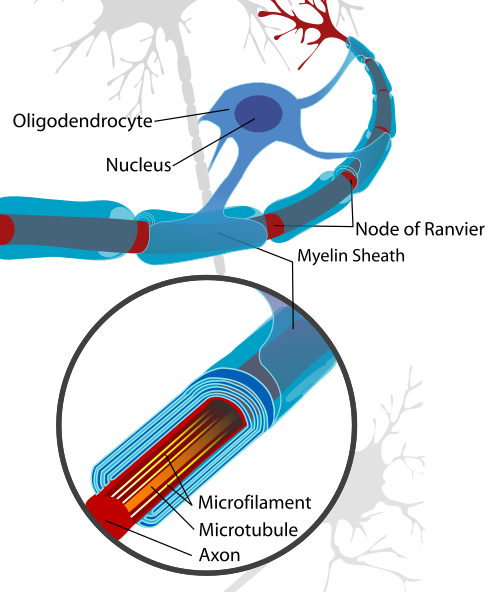
Diagram of a neuron segment with an oligodendrocyte wrapping the axon to form the myelin sheath. It visually clarifies how glial insulation is physically arranged around axons to support faster, more efficient signal conduction. Source
Myelin sheath: A fatty insulating layer around an axon (produced by glial cells) that supports faster, more efficient neural signalling.
In the brain and spinal cord, myelin is produced by glia often called oligodendrocytes; in the peripheral nervous system, similar myelinating cells are commonly called Schwann cells.
Examples of glia you may encounter
Different glial subtypes specialise in different support tasks:
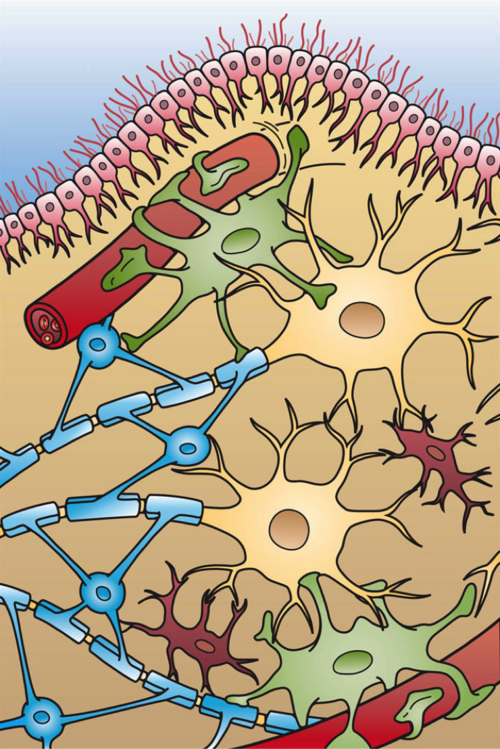
Comparative diagram of major central nervous system glial cell types—astrocytes, oligodendrocytes, microglia, and ependymal cells—distinguished by color and morphology. This supports memorizing each subtype’s “job description” (metabolic regulation, myelin production, immune cleanup, and lining fluid-filled spaces). Source
Astrocytes: help regulate chemicals around synapses and support neurons’ metabolic needs
Oligodendrocytes/Schwann cells: form myelin for insulation
Microglia: assist with cleanup and immune-like protection
Ependymal cells: help line fluid-filled spaces and support fluid-related functions
Why Neurons and Glia Matter for Behaviour
Neurons provide the signalling capacity required for sensation, movement, learning, and emotion. Glial cells make those signals possible at scale by insulating connections, stabilising the neural environment, supporting communication conditions, and transporting waste so networks can keep functioning over time.
Practice Questions
Outline two functions of glial cells. (3 marks)
1 mark: Identifies a correct function (e.g., insulation/myelin, structural support, communication support via maintaining chemical environment, waste transport/cleanup).
1 mark: Identifies a second correct function.
1 mark: Briefly links either function to supporting neuronal signalling/brain function.
Explain how the structures of a neuron and the roles of glial cells work together to support information processing in the nervous system. (6 marks)
1 mark: Accurate description of neuron parts (dendrites/soma/axon/terminals).
1 mark: Clear directional flow of information (input to output).
1 mark: Glia provide insulation (myelin) to improve efficiency.
1 mark: Glia provide structural/metabolic support to keep neurons functioning.
1 mark: Glia regulate local conditions to support communication reliability.
1 mark: Glia remove waste/assist cleanup to maintain homeostasis.
FAQ
Estimates vary by brain region and method, but many areas have roughly similar numbers of glia and neurons.
What matters more is that glia scale support (energy, insulation, cleanup) as networks grow more complex.
Astrocytes can modulate the chemical environment around synapses by taking up ions and transmitter molecules.
They also coordinate support functions across many synapses at once.
The blood–brain barrier is a selective filter that limits which substances in the bloodstream can enter brain tissue.
Astrocytes help maintain it by supporting tight regulation around brain capillaries.
Yes. Myelination can adjust across development and with practice, potentially improving efficiency in frequently used pathways.
This is one cellular way experience may shape long-term performance.
Microglia are specialised for immune-like surveillance and cleanup.
They can remove debris and help refine networks by clearing unnecessary connections during development.