AP Syllabus focus:
‘The significance level (α) is the threshold used to decide whether to reject the null hypothesis. It represents the risk one is willing to take of rejecting the null hypothesis when it is actually true.’
The significance level α is a foundational idea in statistical inference, guiding the decision to reject or not reject a null hypothesis by setting an acceptable probability of error.
Understanding the Role of the Significance Level (α)
The significance level α establishes the boundary for deciding when sample evidence is strong enough to challenge the null hypothesis. The null hypothesis is the default assumption that a population parameter, such as a proportion, equals a specific value. Because statistical decisions are made under uncertainty, α formalizes the amount of risk a researcher is willing to accept when making an evidence-based decision.
The Purpose of α in Statistical Testing
Choosing α involves balancing caution and sensitivity. A smaller α reduces the chance of making an incorrect rejection of the null hypothesis, while a larger α increases the likelihood of detecting meaningful effects. This balance underscores why α is determined before analyzing data, ensuring that decision rules remain objective and unbiased.
What α Represents in Probabilistic Terms
The value of α is the probability of committing a specific type of inferential error—rejecting the null hypothesis when it is actually true. This is known as a Type I error.
Type I Error: The error that occurs when the null hypothesis is true but is incorrectly rejected.
Researchers accept α as the maximum tolerable probability of this error. Commonly used values such as 0.05 or 0.01 reflect conventional levels of tolerance for risk across fields that use significance testing.
After α is set, the testing framework uses sample data to determine whether the observed result is sufficiently unlikely under the assumption that the null hypothesis is true. This connection makes α a pivotal component in the overall logic of hypothesis testing.
α as a Decision Threshold
When conducting a significance test, the p-value—the probability, assuming the null hypothesis is true, of observing a test statistic as extreme as or more extreme than the value calculated from the sample—is compared directly to α. This comparison forms the basis of the formal decision rule used in hypothesis testing.
p-value: The probability of obtaining a result at least as extreme as the observed sample result if the null hypothesis is true.
If the p-value is less than or equal to α, the data are considered inconsistent with the null hypothesis, and the null hypothesis is rejected.
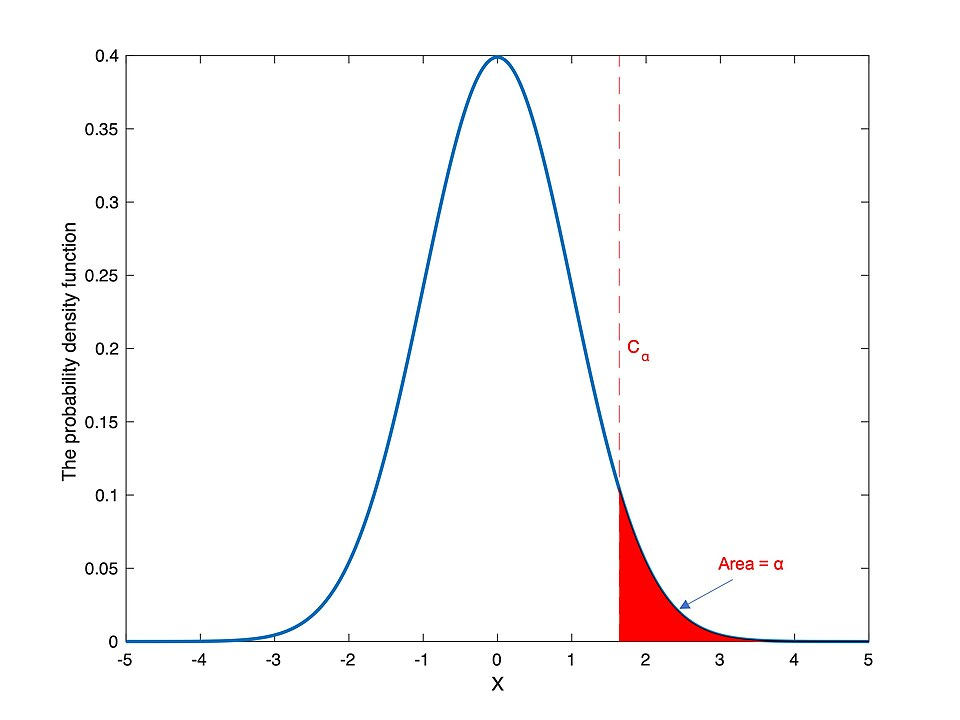
The figure shows a standard normal curve with a right-tail rejection region whose area equals α. The vertical boundary indicates the critical value used to decide whether to reject the null hypothesis. The unshaded portion represents the non-rejection region. Source.
If the p-value exceeds α, the data do not provide strong enough evidence to reject the null hypothesis. This process ensures that α consistently governs the strength of evidence required to challenge the status quo assumption.
Choosing an Appropriate Value for α
While 0.05 is commonly used, the choice of α depends on the context of the study and the consequences associated with a Type I error. Researchers must weigh the risks of an incorrect rejection carefully. Several factors influence the selection of α:
Severity of consequences
Higher stakes typically require a smaller α to minimize the probability of incorrect rejection.Field-specific standards
Disciplines with strict evidentiary requirements, such as medicine, often adopt α = 0.01 or smaller.Exploratory versus confirmatory analysis
Exploratory studies may tolerate a larger α, while confirmatory research demands stricter thresholds.
Because α reflects risk tolerance, clarity about its selection strengthens both the design and interpretation of statistical tests.
Why α Must Be Set Before Data Analysis
Fixing α in advance prevents results from influencing decisions about acceptable risk. Changing α after seeing data introduces bias and undermines the validity of statistical inference. Pre-specifying α ensures that the decision rule remains transparent and replicable, which is essential for sound scientific reasoning.
α and the Logic of Evidence in Hypothesis Testing
Significance tests rely on comparing observed outcomes to what would be expected if the null hypothesis were true. The significance level establishes how extreme an outcome must be before it is judged unlikely enough to contradict the null hypothesis. In this way, α helps transform sample evidence into a structured decision by defining the threshold for “unlikely under the null.”
Researchers use α not to measure the probability that the null hypothesis is true, but to control the long-run proportion of incorrect rejections across repeated testing. This perspective emphasizes that α applies to the procedure, not to any single decision.
The Relationship Between α and Scientific Judgment
Choosing and applying α requires interpreting statistical evidence within the research context. The significance level explicitly quantifies the risk accepted in making inferential decisions, helping researchers articulate the strength and limitations of their conclusions. As a result, α serves both a mathematical and conceptual role in guiding how evidence informs claims about population parameters.
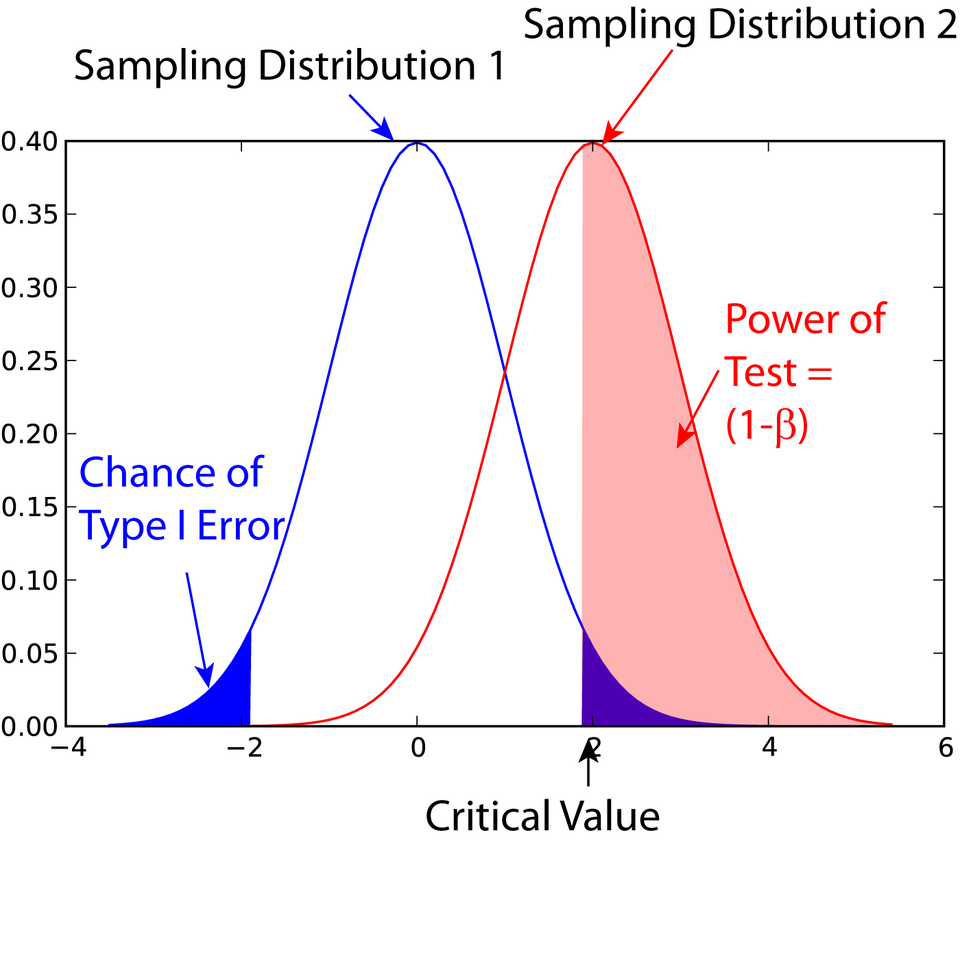
This diagram illustrates the probability of a Type I error as the small shaded tail under the null distribution. It also displays the power of the test under an alternative distribution, showing how α connects to broader inferential error structures. Some additional concepts in the image extend beyond this subsubtopic but visually reinforce the meaning of α. Source.
FAQ
When a p-value is extremely close to alpha, the decision becomes sensitive to rounding, measurement precision, and sampling variability.
A borderline p-value highlights that the evidence is neither clearly strong nor clearly weak, making contextual reasoning essential.
Researchers might report such results as “marginal” or “suggestive” rather than presenting them as definitive findings.
Using multiple alphas is generally discouraged because it increases the overall risk of Type I errors.
However, it may be acceptable if:
• The levels are pre-specified.
• Each hypothesis addresses a distinct research question.
• Appropriate adjustments (such as family-wise error control) are made.
Consistency helps maintain clarity and prevents misinterpretation.
Lower alphas minimise the probability of falsely concluding that an effect exists when it does not.
This is especially important when incorrect decisions would carry:
• Ethical implications
• Financial costs
• Risks to health or safety
A stricter threshold ensures that stronger evidence is required before taking action.
Alpha explicitly encodes the level of risk that researchers are willing to accept in their decision-making.
Although grounded in statistical theory, it is informed by practical considerations such as:
• Stakeholder expectations
• Potential consequences of decisions
• Regulatory or industry standards
Thus, alpha bridges statistical reasoning and real-world judgement.
Not necessarily. A smaller alpha reduces Type I errors but increases the chance of Type II errors.
This trade-off means that a test with a very small alpha may fail to detect true differences.
Choosing alpha involves balancing:
• The need for caution
• The desire to detect meaningful effects
• The consequences of both error types
Practice Questions
Question 1 (1–3 marks)
A researcher is testing a claim about a population proportion and sets the significance level at alpha = 0.05.
a) State what the significance level represents in the context of hypothesis testing. (1 mark)
b) Explain why the researcher must choose the significance level before examining the sample data. (1–2 marks)
Question 1
a) 1 mark
• States that the significance level is the probability of rejecting the null hypothesis when it is actually true (risk of a Type I error).
b) Up to 2 marks
• 1 mark for stating that alpha must be set beforehand to avoid bias.
• 1 mark for explaining that choosing alpha after seeing data would invalidate the test or make the decision rule inconsistent.
Question 2 (4–6 marks)
A public health department is testing whether the proportion of adults receiving a flu vaccination has changed from the previously recorded value of 0.40. They choose a significance level of alpha = 0.01.
a) Explain what a Type I error would represent in this context. (1–2 marks)
b) Describe why using alpha = 0.01 affects the likelihood of making a Type I error. (1–2 marks)
c) Discuss one reason why the department might prefer a lower significance level than the commonly used 0.05. (1–2 marks)
Question 2
a) Up to 2 marks
• 1 mark: Identifies that a Type I error means concluding that the proportion has changed when it actually has not.
• 1 mark: Provides context-specific phrasing (e.g., falsely concluding vaccination rates have shifted).
b) Up to 2 marks
• 1 mark: States that using alpha = 0.01 reduces the probability of a Type I error.
• 1 mark: Explains that the rejection threshold becomes more stringent, reducing the chance of incorrectly rejecting the null hypothesis.
c) Up to 2 marks
• 1 mark: Gives a valid reason such as serious consequences of an incorrect conclusion or the need for stronger evidence.
• 1 mark: Provides contextual explanation (e.g., policy decisions or public health messaging requiring high certainty).