AP Syllabus focus:
‘Some matters were left unresolved after ratification; debates over national vs. state power and individual rights persist today, including controversies about government surveillance and the role of government in public school education.’
Many constitutional questions were never fully settled in 1787–1788.
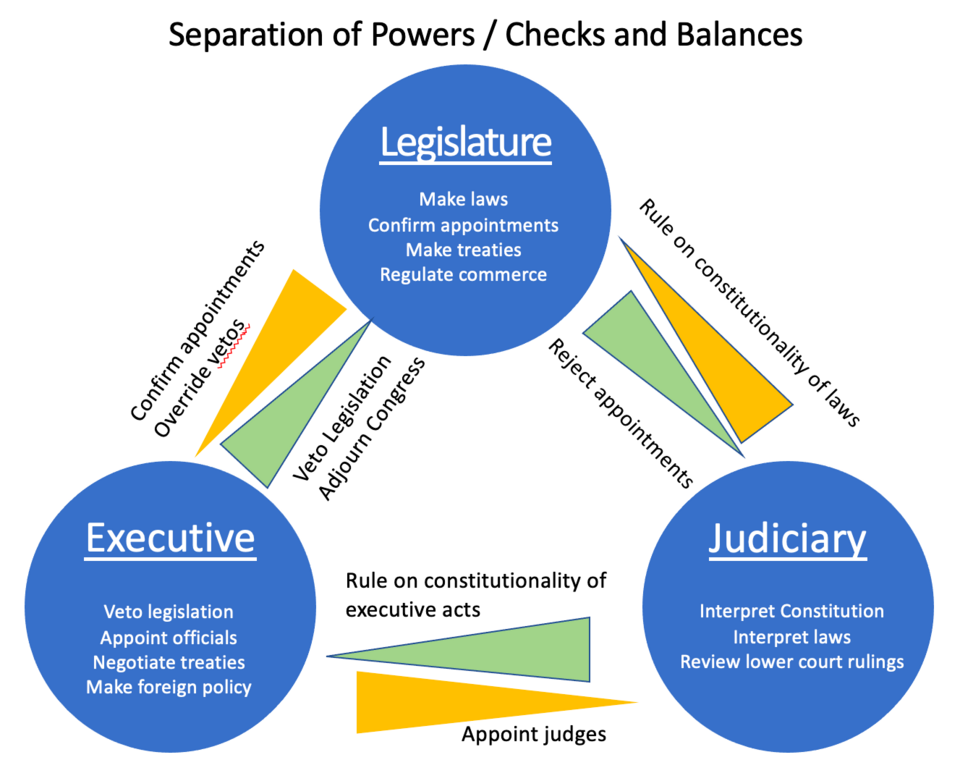
Diagram summarizing the three branches of the U.S. government and major “checks and balances” relationships among them. It helps students see how constitutional power is intentionally divided—creating frequent institutional conflict as each branch attempts to shape policy outcomes. The visual also clarifies why disputes over authority persist even when the constitutional text stays the same. Source
The Constitution’s broad language, competing values, and evolving social conditions ensure that disputes over power and rights continue in modern American politics.
Why major constitutional debates stayed unresolved
Compromise, silence, and broad language
The Constitution was designed to win agreement among states with different economies, political cultures, and fears about concentrated authority. As a result, some provisions use general phrases (for example, “necessary,” “proper,” and “liberty”) rather than precise rules. That flexibility allows adaptation, but it also invites conflict over meaning.
Competing constitutional visions
Unresolved debates persist because Americans disagree about what the Constitution is primarily for:
Effective national governance in a large republic
Protection of individual rights against government overreach
Preservation of state authority and local self-rule
Democratic accountability through elections and representation
Because these values can point in different directions, political actors routinely claim that their position is the “constitutional” one.
Unresolved constitutional debate: A recurring dispute over how the Constitution allocates power or protects rights, triggered by ambiguity in the text and changing political, technological, or social conditions.
Enduring tension: national power vs. state power
What is at stake
The Constitution creates a system where both national and state governments act as governing authorities. The unresolved question is not whether each level has power, but how far national power can reach and when state autonomy should control.
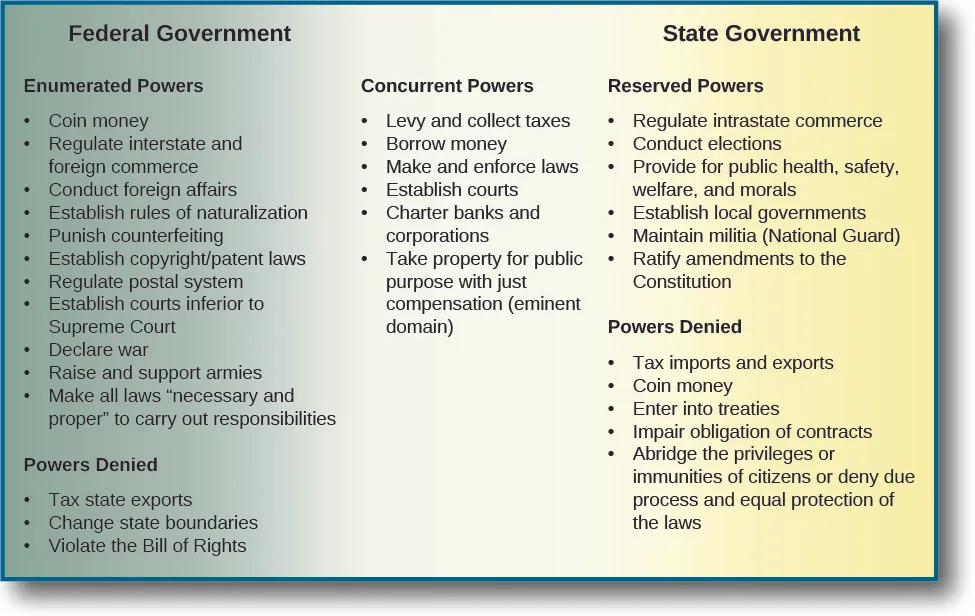
Chart comparing constitutional powers of the federal government, state governments, and their shared (concurrent) powers. By separating enumerated, reserved, denied, and concurrent authority, the figure shows why federalism disputes recur: many governing tasks sit in overlapping or contested zones. It also provides concrete examples students can use to classify real policy conflicts. Source
Why the conflict keeps returning
Disputes intensify when:
Congress or federal agencies set nationwide rules that states see as intrusive
states adopt policies that conflict with national priorities
new problems (economic crises, public health, digital technology) push demands for coordinated national action
Arguments typically split along these lines:
Pro-national power: uniform standards, equal treatment across states, ability to solve collective-action problems
Pro-state power: responsiveness to local preferences, experimentation, and a check on centralised authority
Enduring tension: individual rights vs. collective security
Government surveillance as a modern flashpoint
Controversies about government surveillance show how old constitutional principles collide with new tools. Surveillance debates commonly turn on questions like:
what counts as a “search” in a digital world
how much judicial oversight is required before monitoring
how to balance public safety against privacy and free expression
Competing claims often include:
Security rationale: surveillance can prevent threats and disrupt criminal networks; secrecy may be necessary for effectiveness
Liberty rationale: monitoring can chill speech, enable discrimination or political targeting, and expand beyond its original purpose without strong limits
Because technology changes faster than constitutional text, courts and elected officials must continually reinterpret older rights protections in new contexts.
Public school education: power and rights in everyday life
The constitutional puzzle
Public education is a central arena for unresolved debates because it involves:
state and local control of schools and curricula
federal involvement through funding conditions, civil rights enforcement, and national policy goals
individual rights of students, parents, and educators within government-run institutions
Typical points of conflict
Modern disputes often ask:
whether national standards or rules promote equality or undermine local decision-making
how student rights apply in schools (speech, religion, privacy, and disciplinary procedures)
how far government may go in shaping curriculum or regulating classroom materials
These controversies persist because public schools sit at the intersection of community values, constitutional rights, and shared governance.
How these debates play out today
Unresolved constitutional debates are fought through multiple channels:
Elections and political messaging: candidates frame disputes as protecting freedom, families, security, or local control
Litigation: interest groups and governments seek judicial rulings that set nationwide or state-specific precedents
Intergovernmental conflict: states resist, negotiate, or implement national policies differently
Public opinion and civil society: advocacy campaigns influence legislators, school boards, and administrative agencies
Because both “power” and “rights” are contested concepts, constitutional conflict is a normal feature of American government rather than a sign of constitutional failure.
Practice Questions
(2 marks) Identify two contemporary controversies that illustrate unresolved constitutional debates over (i) individual rights and (ii) national versus state power.
1 mark: Identifies a valid controversy about individual rights (e.g., government surveillance and privacy).
1 mark: Identifies a valid controversy about national vs state power (e.g., the federal role in public school education such as standards, funding conditions, or civil rights enforcement).
(6 marks) Explain how constitutional ambiguity contributes to ongoing disputes about government surveillance OR the role of government in public school education. In your answer, include two competing constitutional arguments and describe one institution that shapes the outcome.
2 marks: Explains how broad/unclear constitutional language or silence leaves room for competing interpretations.
2 marks: Develops two competing arguments (e.g., security vs privacy; national uniformity/equality vs state/local control).
1 mark: Identifies a relevant institution (e.g., Supreme Court, Congress, executive agencies, state governments).
1 mark: Explains how that institution influences outcomes (e.g., rulings, statutes, regulations, enforcement, funding conditions).
FAQ
State constitutions can provide broader protections than the federal Constitution.
This can expand student rights or limit state surveillance practices even when federal standards are less protective.
The ratification thresholds make amendments difficult.
As a result, many conflicts are resolved through statutes, court decisions, and administrative policy rather than formal textual change.
Emergencies raise political demand for rapid prevention and intelligence gathering.
They also increase the risk of long-term expansion of monitoring powers unless oversight rules, sunsets, or transparency measures restrain them.
Funding can incentivise compliance by attaching conditions to grants.
States and districts may adopt national priorities to avoid losing money, even while arguing that education should remain locally controlled.
Digital data changes what “privacy” looks like (metadata, location tracking, third-party storage).
Courts and lawmakers must decide whether older principles extend to new forms of information and monitoring tools.