AP Syllabus focus:
‘Federalism shares power between national and state governments; debates over the balance of power are shaped by the distribution of exclusive, reserved, and concurrent powers.’
Federalism is the Constitution’s core solution to governing a large, diverse republic. It creates enduring arguments about which level should lead on policy, and how power should be divided, shared, and checked.
Federalism and the Balance-of-Power Debate
What federalism is
Federalism allocates governing authority between two levels of government—the national government and state governments—so each has meaningful, constitutionally grounded power.
Federalism: A system of government in which power is divided and shared between a national government and state governments, with each deriving authority from the Constitution and the people.
Because both levels govern the same citizens, conflict is normal rather than exceptional. The balance-of-power debate asks: when should the national government set uniform rules, and when should states tailor policy to local needs?
Why the debate persists
The U.S. Constitution does not simply “pick a winner” between national and state power. Instead, it creates a dynamic structure where:
both levels can act in important policy areas,
neither level has unlimited authority,
political coalitions, crises, and policy problems can shift expectations about which level should lead.
Federalism therefore becomes both a legal structure and an ongoing political argument about legitimacy, effectiveness, and liberty.
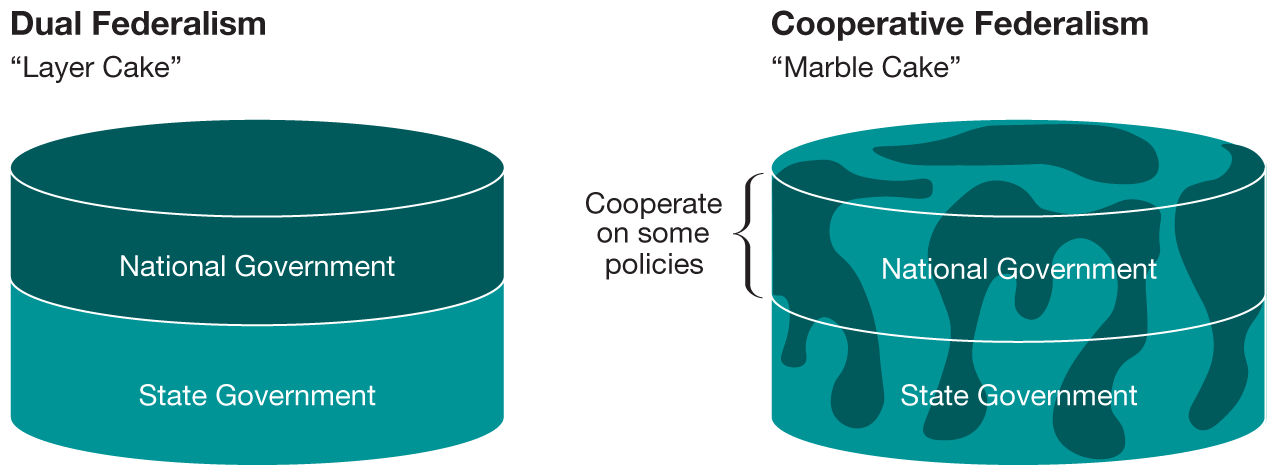
A comparative diagram using the “layer cake” versus “marble cake” metaphor to show two ways scholars describe federalism in practice. The layer cake model depicts clearer separation between national and state responsibilities, while the marble cake model emphasizes interwoven functions and cooperation across levels. This helps explain why, in many real policy areas, the debate shifts from “who may act?” to “who should take primary responsibility?” Source
The Distribution of Powers: The Framework for Debate
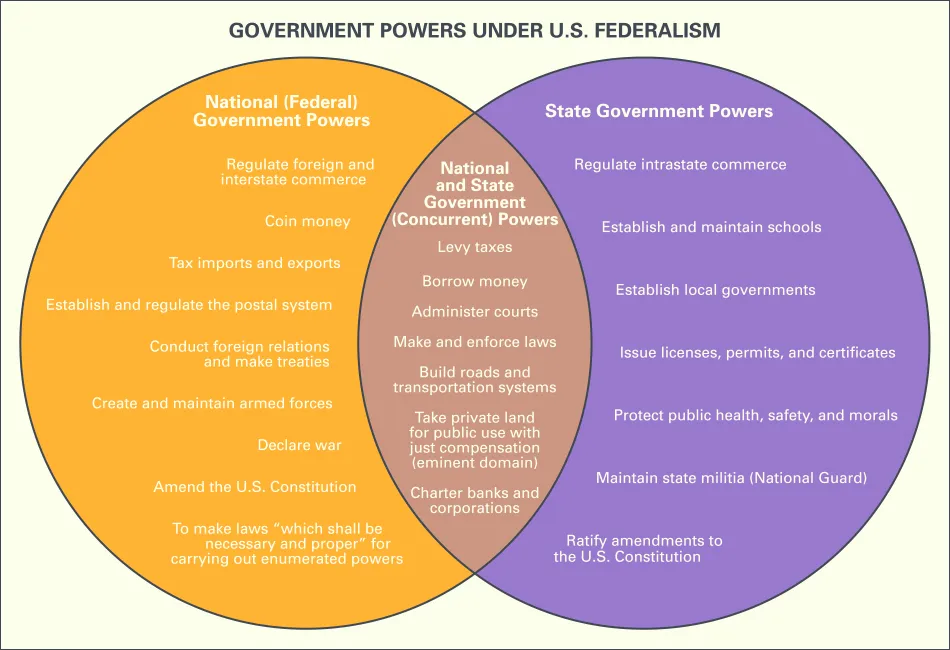
A Venn diagram summarizing the division of governing authority in U.S. federalism. The left circle lists powers primarily associated with the national government, the right circle lists state powers, and the overlap highlights concurrent (shared) powers. This visual makes the “category of power” approach concrete by pairing each category with representative policy tools (e.g., coining money vs. licensing vs. taxation). Source
Exclusive powers (one level only)
The syllabus highlights that balance-of-power debates are shaped by how authority is divided into categories. Exclusive powers belong to only one level of government (either national or state), limiting the other level’s role.
When an issue fits clearly into an exclusive category, disputes are narrower: arguments focus on whether a policy truly falls inside that “exclusive” area.
Reserved powers (states)
Reserved powers are those kept by the states rather than granted to the national government, anchoring state authority in the federal system.
Reserved powers: Powers not delegated to the national government (and not prohibited to the states), retained by the states as part of the constitutional division of authority.
A key feature of the debate is deciding whether a new policy problem is best treated as a matter of state governance (local control, variation, experimentation) or whether national involvement is necessary (uniformity, rights protection, national markets).
Concurrent powers (shared)
Concurrent powers are exercised by both the national and state governments. These shared areas create the most frequent friction because both levels can claim a legitimate role.
Concurrent powers: Powers shared by both national and state governments, allowing each level to act in the same broad policy area.
In concurrent areas, political disputes often shift from “who may act?” to “who should act more?” For example, when both levels can tax or regulate, debates arise over which level should take primary responsibility, set standards, or fund enforcement.
How Power Categories Shape Real Political Conflict
Boundary disputes and “who goes first”
Many federalism controversies are boundary disputes: advocates argue an issue belongs in a different power category than opponents claim. Typical patterns include:
Arguing an issue is national because it crosses state borders or requires uniform rules
Arguing an issue is state because it reflects local values, conditions, and accountability
Arguing an issue is shared but contesting how far one level may go before it crowds out the other
These arguments are not only constitutional; they are strategic. Political actors may prefer the level of government where they expect better electoral support, friendlier institutions, or faster action.
Policy variation vs. national uniformity
Federalism creates tension between:
State variation: states can innovate, compete, and respond to local preferences
National uniformity: national rules can reduce inequality between states and simplify compliance
This tension is central to the balance-of-power debate because each side claims democratic legitimacy:
State-focused arguments emphasise local control and responsiveness.
National-focused arguments emphasise equal treatment and collective solutions.
Accountability and “blame shifting”
When responsibilities are divided, it can be hard for voters to know which level caused a policy success or failure. This fuels debate because:
officials may claim credit when programs work and shift blame when they do not,
voters may demand clearer lines of authority, pushing power either upward (to simplify coordination) or downward (to increase local accountability).
Federalism as protection and as obstacle
Federalism is often defended as a guard against concentrated power, yet criticised when shared authority slows action. Whether it is viewed as protection or obstacle depends on:
perceived urgency of a problem,
trust in national versus state leadership,
whether uniform rules are seen as necessary or intrusive.
What to be able to do on the AP exam
A strong AP response connects the ongoing balance-of-power debate directly to the distribution of powers:
identify whether a scenario involves exclusive, reserved, or concurrent authority,
explain how that category creates conflict or cooperation between levels,
describe why different political actors would prefer national or state control in that context.
Practice Questions
(1–3 marks) Define federalism and identify one way the distribution of powers can create conflict between national and state governments.
1 mark: Correct definition of federalism (power divided/shared between national and state governments).
1 mark: Identifies a relevant power category (exclusive, reserved, or concurrent).
1 mark: Explains how that category can create conflict (e.g., overlapping authority in concurrent areas or disputes over whether a power is reserved vs national).
(4–6 marks) Explain how exclusive, reserved, and concurrent powers shape the ongoing balance-of-power debate in the United States. In your answer, compare at least two of the three power categories.
1 mark: Accurate description of exclusive powers (held by one level only).
1 mark: Accurate description of reserved powers (retained by states).
1 mark: Accurate description of concurrent powers (shared by both levels).
1 mark: Explains how exclusive powers tend to limit disputes by clarifying authority OR shows how disputes focus on classification.
1 mark: Explains how reserved powers fuel arguments for state control/local variation.
1 mark: Explains how concurrent powers increase friction due to overlapping authority and disagreements over priority/extent of action. (Maximum 6; award comparison marks when the student explicitly links categories, e.g., “unlike exclusive powers, concurrent powers…”)
FAQ
In a unitary system, regional governments typically exercise powers delegated by the central government, which can be altered unilaterally.
In the US, states have constitutionally recognised authority, so political battles often become disputes over jurisdiction rather than simply policy preference.
Parties often act strategically, preferring whichever level of government is more likely to deliver their desired policy outcome.
Factors include:
expected court rulings
partisan control of statehouses versus Congress/White House
public opinion differences across states
State constitutions can grant broader rights or structure state power differently, affecting how states govern within their reserved authority.
They can also create constraints (e.g., balanced budget requirements) that shape whether states can realistically take on policy leadership.
States can act as policy “test sites,” and successful programmes may spread through imitation, competition, or shared professional networks.
Diffusion is more likely when policies are visible, relatively low-cost, and compatible with neighbouring states’ political cultures.
Shared responsibility can blur accountability, making it unclear which level set the rules, funded implementation, or enforced compliance.
This can produce inconsistent outcomes across states and complicate comparisons, especially when data collection and standards vary by jurisdiction.