AP Syllabus focus:
‘Explain the broader context for European encounters in the Americas from 1491 to 1607.’
Understanding Period 1 requires placing European arrival within long-term global, environmental, and cultural developments that shaped motivations, encounters, and transformations across the Atlantic world from 1491 to 1607.
Broader Context for Early European Encounters
European contact with the Americas emerged from deep-rooted economic, religious, political, and technological changes occurring in the late 15th and early 16th centuries. At the same time, diverse Indigenous societies already occupied the continent, each shaped by unique environments and long-term cultural evolution. Recognizing this wider background helps students contextualize the initial encounters that defined Period 1.
Transformations in Europe Before 1492
Before voyagers crossed the Atlantic, Europe experienced sweeping developments that laid the groundwork for exploration.
Commercial expansion in the late Middle Ages increased demand for luxury goods from Asia.
The growth of a merchant class strengthened market-based economic activity and stimulated long-distance trade.
Following the Black Death, Europe underwent demographic recovery, placing new pressures on resources and encouraging overseas opportunities.
Political centralization in states such as Spain, Portugal, England, and France enabled rulers to fund maritime ventures.
The Reconquista ended in 1492, giving Spain both the unity and confidence to support bold overseas missions.
Advances in navigation, including the astrolabe, caravel, and improved maps, increased the feasibility of transoceanic exploration.
These developments produced a competitive environment in which European nations sought to expand influence, accumulate wealth, and spread religious beliefs beyond the continent.
Indigenous North America in 1491
When Europeans first arrived, the Americas were home to millions living in diverse and complex societies shaped by local environments. These cultures had developed long before contact.
Culture: The shared beliefs, practices, technologies, and social behaviors that characterize a group of people.
Native societies displayed sophisticated adaptations to varied landscapes:
Sedentary agricultural communities in Mesoamerica and the American Southwest relied heavily on maize.
Large trading networks connected regions across the continent.
Political systems, from chiefdoms to confederacies, organized social life and diplomacy.
Religious beliefs often centered on cosmology, nature, and reciprocal relationships with the environment.
Indigenous peoples were therefore not passive recipients of European influence but dynamic actors whose existing structures shaped early encounters.
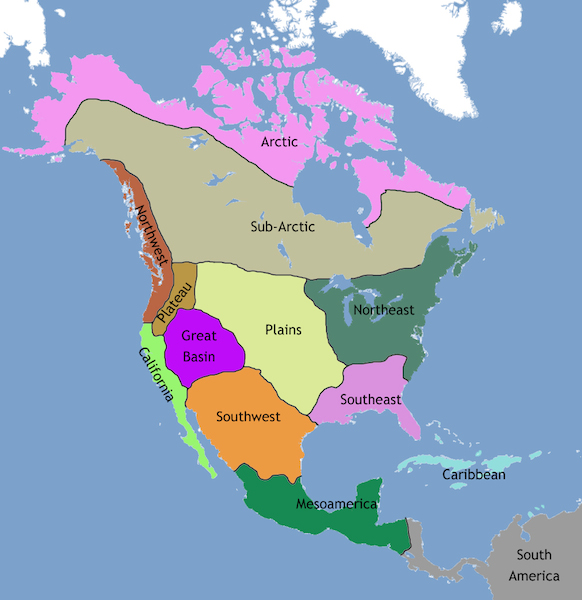
Map showing major Native American cultural regions around 1500, illustrating how diverse environments shaped social, economic, and cultural development across North America. It includes general regional labels only, adding no extra tribe-specific information. This visual supports understanding of Indigenous environmental adaptations prior to European contact. Source.
The Atlantic World and Global Interconnections
By the late 15th century, the emergence of an interconnected Atlantic World linked Africa, Europe, and the Americas through exchange, migration, and conflict. Earlier Portuguese voyages along West Africa had already established:
Trade networks exchanging gold, ivory, and enslaved people.
Coastal forts that became nodes in expanding European influence.
Maritime knowledge that later supported westward exploration.
This growing Atlantic network set the stage for interactions that reconfigured societies on multiple continents once Europeans reached the Americas.
Motivations Behind European Exploration
To contextualize the era, students must understand why Europeans sought westward expansion. These motivations are often grouped under God, Gold, and Glory, a phrase summarizing complex driving forces.
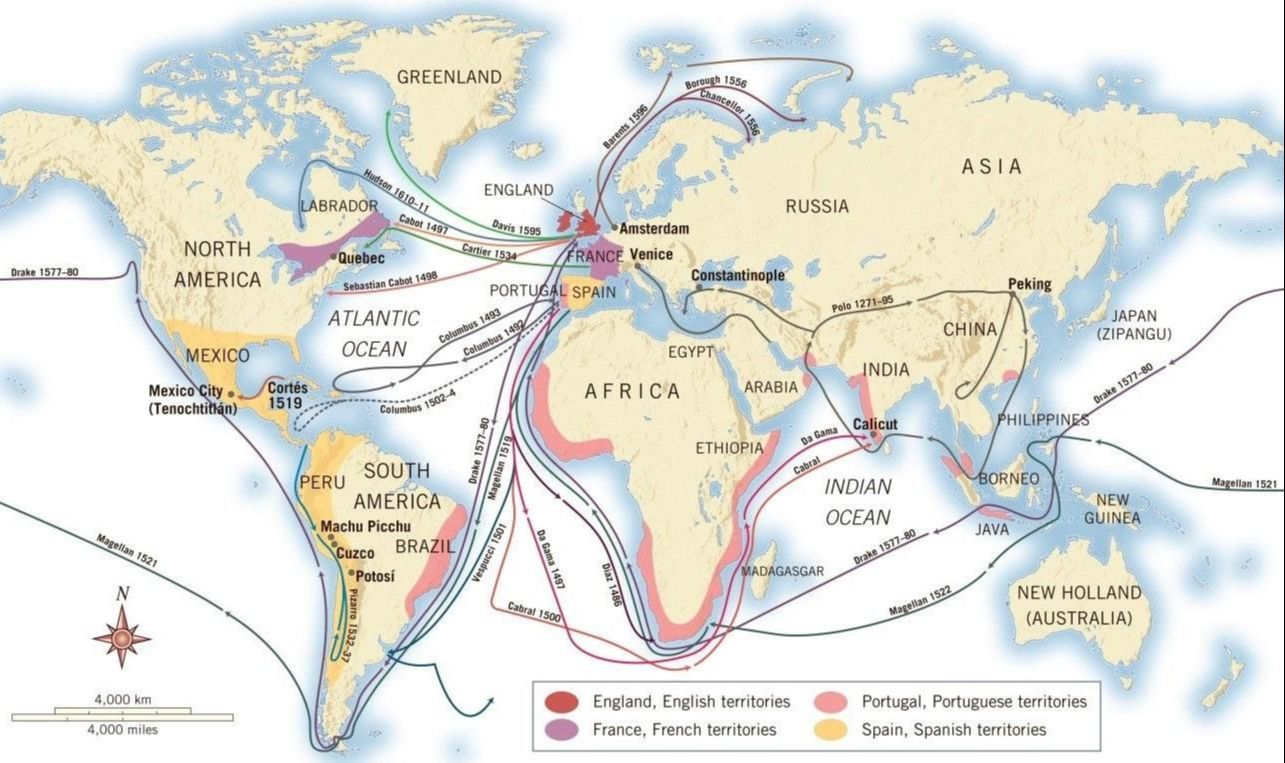
World map showing major European exploration routes from the 15th and 16th centuries, illustrating how expanding maritime networks connected Europe with Africa, the Americas, and Asia. The paths highlight geopolitical competition and technological capacity driving exploration. Some routes extend beyond the Atlantic, but these additions help contextualize how Atlantic voyages fit into broader global exploration. Source.
Motivation: A force or influence that drives a person or state to take particular actions or pursue specific goals.
Economic Competition and the Search for New Routes
European nations wanted direct access to Asian markets for spices, silks, and luxury goods. The Ottoman Empire’s control of eastern Mediterranean trade routes encouraged western kingdoms to seek alternatives.
Key economic motives included:
Breaking reliance on intermediaries by finding all-water routes.
Expanding markets for European goods.
Acquiring new sources of wealth, including precious metals and profitable crops.
Religious Goals and Missionary Impulses
Christian Europe saw expansion as a chance to spread the faith. Spain and Portugal, in particular, endorsed missionary work as part of national policy.
Important elements included:
Catholicism as a unifying cultural force.
Desire to compete with Islam after centuries of conflict.
Belief in religious duty to convert non-Christians.
These impulses shaped institutions like missions and influenced early interactions between Europeans and Native peoples.
Political Centralization and Imperial Rivalry
Strengthened monarchies sought prestige, territory, and geopolitical advantage. Early explorers claimed new lands on behalf of their sponsoring crowns, expanding European influence and fueling intense rivalry.
Environmental, Technological, and Intellectual Context
Advances in Knowledge and Navigation
Improvements in European science and technology helped make transatlantic voyages possible.
Cartographic innovations refined geographic understanding.
The caravel’s maneuverability enabled long-distance sailing.
Understanding of wind patterns, such as the trade winds, improved navigation.
Renaissance Thought and Curiosity
The Renaissance encouraged intellectual curiosity, innovation, and a revived interest in classical texts describing distant lands. This cultural environment supported exploration and the pursuit of knowledge.
Connecting Context to Early Encounters
Understanding this broader context clarifies why Europeans arrived in the Americas and how their arrival reshaped societies. It highlights:
The long-term forces driving exploration.
The complexity and diversity of Indigenous societies before contact.
The global networks linking Africa, Europe, and the Americas.
The political, religious, and economic pressures influencing European actions.
This wider lens helps students interpret the initial meetings between Europeans and Native Americans as part of larger historical patterns rather than isolated events.
FAQ
Europeans often misunderstood Indigenous practices because they interpreted them through their own agricultural and property-based systems. Groups living in mobile societies, especially in the Great Basin and Plains, were often assumed to be “less advanced,” while sedentary farming communities were more familiar to Europeans.
These misconceptions shaped early diplomacy, trade, and conflict by reinforcing European assumptions about hierarchy and land use.
Centralised monarchies could pool tax revenues, stabilise their currencies, and command unified military and naval forces.
This allowed rulers such as Ferdinand and Isabella to sponsor risky transoceanic ventures that private merchants could not fund alone.
• Stronger administration meant more efficient collection of customs duties.
• Monarchs sought prestige and influence, reinforcing exploration as a state priority.
The Black Death drastically reduced Europe’s population in the 14th century, reshaping labour systems and economic structures.
Over the following century, population recovery increased demand for food and imported goods. Rising prices and renewed commercial activity encouraged traders and monarchs to seek new markets and trade routes.
The shock also undermined feudal structures, helping promote a more flexible, mobile workforce and a growing merchant class that supported long-distance trade.
The Renaissance revived interest in classical geography and stimulated curiosity about the natural world. Scholars re-evaluated older texts, such as Ptolemy’s maps, and applied mathematical techniques to navigation.
Humanist thinking encouraged individuals to question long-held assumptions and pursue knowledge beyond traditional boundaries.
This intellectual environment made exploration seem both possible and worthwhile, reinforcing a belief that understanding the wider world could bring prestige and practical benefits.
Portugal’s ventures provided Europeans with practical experience in long-distance navigation, ship design, and mapping. Mariners learned how to use winds and currents, including the volta do mar technique, to travel efficiently across the Atlantic.
These African coastal networks familiarised Europeans with fortified trading posts, new commercial routes, and interactions with non-European societies.
Such precedents shaped expectations about trade, diplomacy, and settlement when Europeans later reached the Americas.
Practice Questions
Question 1 (1–3 marks)
Explain one broader historical development in Europe before 1492 that helps contextualise early European encounters with the Americas.
Question 1
• 1 mark: Identifies a relevant European development (e.g., political centralisation, technological advances in navigation, demographic recovery after the Black Death).
• 2 marks: Provides a brief explanation of how this development contributed to European exploration.
• 3 marks: Clearly links the development to the broader context for European encounters in the Americas, showing how it enabled or encouraged westward expansion.
Question 2 (4–6 marks)
Using your knowledge of the period 1491–1607, analyse how both European motivations and Indigenous societies’ existing structures shaped the context of the first encounters between Europeans and Native Americans.
Question 2
• 1–2 marks: Describes at least one European motivation (e.g., desire for wealth, religious conversion, geopolitical competition) and one aspect of Indigenous societies (e.g., diverse environments, established political systems).
• 3–4 marks: Explains how both factors shaped the context of early encounters, demonstrating understanding of their interaction.
• 5–6 marks: Offers a developed analysis that shows how European motivations and Indigenous structures created the conditions for complex initial interactions, making clear, historically grounded links to the broader context of Period 1.