AP Syllabus focus:
‘Contact among Europeans, Native Americans, and Africans produced the Columbian Exchange and major social, cultural, and political change across the Atlantic.’
The beginnings of the Columbian Exchange marked a turning point in world history, initiating profound biological, cultural, and political transformations as peoples across the Atlantic encountered one another for the first time.
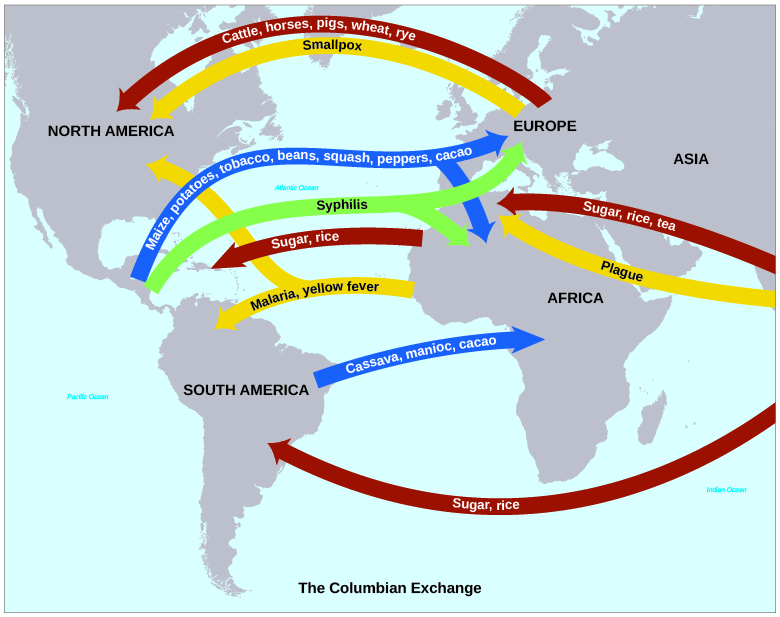
Map of the Columbian Exchange showing major flows of crops, livestock, and diseases between the Americas, Europe, and Africa after 1492. Maize, potatoes, and tobacco move eastward, while wheat, sugar, cattle, and diseases such as smallpox travel toward the Americas. The diagram also includes additional specific goods that exceed the examples listed in the notes but remain appropriate for AP-level study. Source.
Early Transatlantic Contact and Its Global Significance
European voyages after 1492 initiated sustained contact between Europeans, Native Americans, and Africans, creating new networks that reshaped every society involved. This unprecedented movement of peoples, plants, animals, and diseases set the stage for long-term exchanges that altered global demographics, economies, and power structures.
Defining the Columbian Exchange
The Columbian Exchange refers to the massive, multidirectional transfer of organisms, goods, and cultural practices between the Eastern and Western Hemispheres following Columbus’s arrival. Its earliest phase (1490s–early 1500s) began as soon as Europeans landed in the Caribbean and interacted with Indigenous communities.
Columbian Exchange: The transatlantic movement of plants, animals, pathogens, peoples, and cultural ideas that followed European contact with the Americas beginning in 1492.
This exchange rapidly expanded beyond isolated encounters, shaping environments, societies, and political structures on four continents.
Biological Exchanges: Plants, Animals, and Pathogens
The Movement of Food Crops
The earliest decades of contact initiated a circulation of staple crops that would eventually support population growth and new economic patterns.
American crops moved eastward, including:
Maize, which offered high caloric yield and adaptability.
Potatoes, especially influential in northern Europe.
Tomatoes, cacao, squash, and beans, which diversified European diets.
Eurasian crops moved westward, such as:
Wheat, which became integral to Spanish colonial agriculture.
Rice and sugarcane, both of which shaped plantation economies.
These initial transfers were small in the 1490s but laid the groundwork for expanded agricultural exchange.
The Introduction of Domesticated Animals
Europeans brought animals that were entirely new to the Americas.
Key arrivals included:
Horses, which transformed mobility and warfare for some Indigenous peoples.
Cattle, pigs, and sheep, which reshaped landscapes and food systems.
Goats, which adapted well to Caribbean environments and spread quickly.
The presence of these animals altered Indigenous agricultural practices and ecosystems, often to the detriment of native plant life.
Epidemic Disease and Demographic Collapse
The most devastating aspect of early contact involved the movement of Old World pathogens into the Americas.
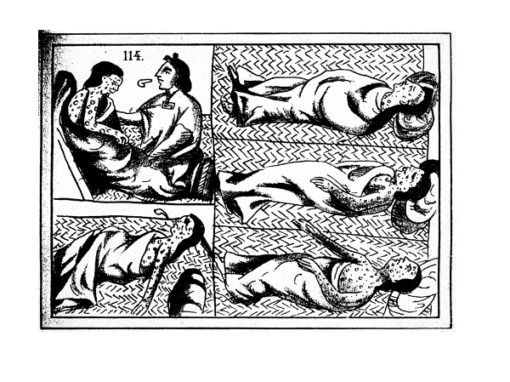
Sixteenth-century illustration from the Florentine Codex depicting Aztec victims of the 1520 smallpox epidemic lying on woven mats while covered in pustules. The scene highlights how Eurasian epidemic diseases, carried across the Atlantic with Europeans, killed large portions of Indigenous populations who lacked prior immunity. The image includes specific visual details of smallpox symptoms that extend beyond the brief textual description but remain fully aligned with the syllabus’s emphasis on demographic collapse. Source.
Diseases such as:
Smallpox
Measles
Influenza
spread rapidly through Indigenous populations lacking immunological defenses. Mortality rates reached catastrophic levels, destabilizing societies and accelerating European conquest.
Epidemic disease: A widespread outbreak of illness that spreads rapidly through a population, often causing high mortality.
The demographic shock reshaped political and social dynamics across the Americas and enabled European powers to expand influence.
Cultural Exchanges and Early Adaptation
Transformations in Material Culture
Early encounters led Europeans and Native Americans to adopt and adapt useful items from one another:
Europeans learned Indigenous agricultural methods, including intercropping and irrigation techniques, which were essential in unfamiliar environments.
Native Americans incorporated European metal tools, weapons, and certain textiles.
Religious and Intellectual Interactions
Missionaries accompanying early expeditions attempted to convert Indigenous peoples, introducing Christianity while often misunderstanding local beliefs. These interactions brought about:
Hybrid religious practices in some regions.
Conflicts where Indigenous spiritual systems clashed with Christian expectations.
Shifts in Social Relations
The first decades of contact reshaped patterns of labor, hierarchy, and identity:
Europeans asserted political dominance in newly established settlements.
The arrival of enslaved Africans in the early 1500s added a third major cultural and demographic force to the evolving Atlantic world.
Mixed populations emerged, beginning the long development of new categories of identity in colonial societies.
Environmental Change and Ecological Consequences
Transforming American Landscapes
European livestock and agricultural practices altered ecosystems:
Grazing animals disrupted Indigenous land management systems.
Wheat and sugar cultivation encouraged plantation-style labor systems.
Introduced weeds and pests outcompeted native species.
Ecological Feedback in Europe and Africa
American crops later supported nutritional diversification in Europe and parts of Africa, but the earliest phase of exchange primarily involved biological introductions that flowed westward, from Europe into the Americas.
Setting the Stage for an Atlantic World
The first decades of the Columbian Exchange laid the foundation for new economic systems, population movements, and cultural transformations. By initiating biological and social exchanges across continents, early contact created the conditions for imperial expansion, coerced labor systems, and the long-term integration of Europe, Africa, and the Americas into a connected Atlantic world.
FAQ
Indigenous societies maintained extensive trade systems across regions long before European arrival, allowing goods, crops, and cultural ideas to circulate quickly once contact began.
These networks helped spread newly introduced European items such as metal tools and livestock knowledge across communities faster than Europeans could travel.
However, these routes also inadvertently hastened the movement of epidemic diseases into interior regions, reaching populations that had never encountered Europeans directly.
Many European crops faced difficulties adapting to unfamiliar soils, rainfall patterns, and temperatures in the Caribbean and American mainland.
Over time, Europeans experimented with planting methods, irrigation, and selective site choice, eventually establishing successful wheat and sugar production.
This trial-and-error process contributed to regional specialisation, with crops thriving only where environmental conditions aligned with their original Eurasian growing requirements.
Before large-scale enslavement systems emerged, Africans arrived in small numbers through Spanish expeditions and as free or semi-free participants.
They contributed agricultural knowledge, particularly in crops such as rice, and sometimes served as intermediaries or labourers in new colonial settlements.
These early exchanges laid a foundation for later demographic and cultural influences from Africa across the Atlantic world.
Horses altered the balance of power and mobility even in regions where their spread was initially limited.
• They enhanced European exploration, military reach, and communication in the Caribbean and Mexico.
• Indigenous groups near early settlements observed and sometimes acquired horses, beginning long-term shifts in transport and hunting practices.
• The presence of horses disrupted local ecosystems, consuming native grasses and reshaping land use patterns.
Introduced animals frequently wandered freely, trampling crops and displacing Indigenous land management systems.
This created repeated conflicts that Europeans used to justify seizing land for controlled grazing or farming.
Over time, livestock-driven landscape change made Indigenous subsistence strategies less viable, facilitating European settlement patterns based on fenced grazing lands and plantation agriculture.
Practice Questions
Question 1 (1–3 marks)
Explain one way in which the early Columbian Exchange (1490s–early 1500s) altered Indigenous societies in the Americas.
Mark scheme:
• 1 mark for identifying a valid impact of the early Columbian Exchange on Indigenous societies (e.g., demographic decline due to disease, environmental disruption, cultural change).
• 1 mark for a clear explanation of how this impact occurred (e.g., Old World pathogens spread rapidly among populations lacking immunity).
• 1 mark for specific historical detail related to early contact (e.g., smallpox, measles, introduction of pigs or cattle affecting land use).
Question 2 (4–6 marks)
Evaluate the extent to which early transatlantic contact (before 1520) created significant economic and social change across both the Americas and Europe.
Mark scheme:
• 1 mark for a thesis or overall judgement addressing the extent of change.
• 1–2 marks for describing economic changes with relevant examples (e.g., introduction of new crops such as maize and potatoes into Europe; establishment of new resource extraction patterns in the Caribbean).
• 1–2 marks for describing social changes with relevant examples (e.g., demographic collapse among Indigenous populations; early cultural adaptation between Europeans and Native Americans).
• 1 mark for using specific evidence from the early phase of the Columbian Exchange (e.g., introduction of horses, initial sugar cultivation, spread of epidemic disease).