AP Syllabus focus:
‘European expansion into the Western Hemisphere grew from intense social, religious, political, and economic competition that reshaped European societies.’
Europeans looked westward between 1491 and 1607 because rising competition, religious conflict, political ambition, and economic desire encouraged exploration, conquest, and colonization across the Atlantic world.
Why Europeans Looked West: Competition, Faith, and Wealth
Intensifying Competition Among European States
By the late fifteenth century, European societies were undergoing major transformations that fostered a climate of rivalry. Monarchs sought to centralize authority, enhance international prestige, and secure greater control over long-distance trade. These goals encouraged rulers to sponsor voyages to regions previously unknown to them.
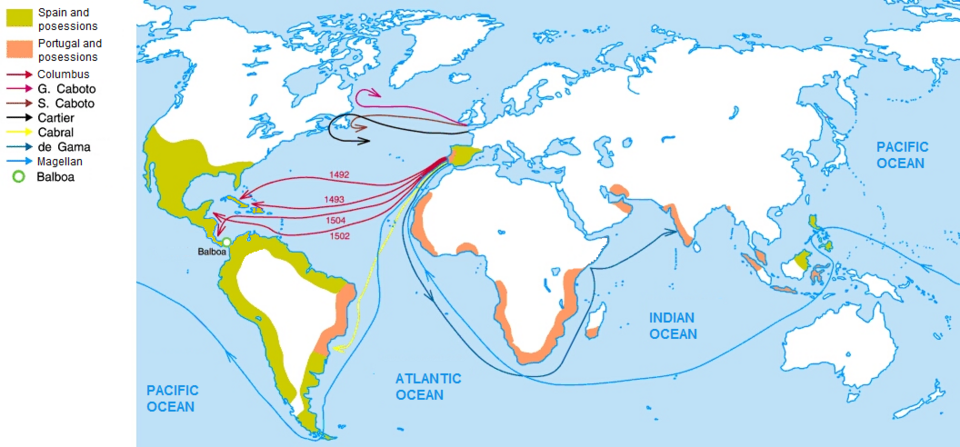
This historical map traces major European exploration routes from the fourteenth through the sixteenth centuries, illustrating how multiple powers pursued overseas expansion simultaneously. Overlapping routes highlight intense competition among states seeking trade advantages, territory, and prestige. Although the map extends slightly beyond 1607, it accurately conveys the competitive maritime context driving early Atlantic exploration. Source.
European exploration intensified as rulers competed for power, resources, and influence.
One major driver of this competition was the rise of nation-states—politically unified territories under stronger monarchs. As Spain, Portugal, England, and France consolidated power, they became increasingly eager to strengthen their economies and outmaneuver rivals. The search for direct trade routes to Asia offered opportunities to bypass intermediaries, reduce costs, and claim wealth before competing powers could do the same.
The ongoing conflict between European powers meant that control of foreign territories became not just an economic advantage but a political necessity. Possessing colonies promised increased influence, security, and access to strategic ports that were vital for maintaining dominance.
Economic Motivations: Wealth, Labor, and Global Markets
Europe’s growing appetite for wealth played a central role in driving westward expansion. States believed that global power depended on accumulating gold, silver, and other commodities. The desire for economic self-sufficiency fueled exploration of lands that might supply valuable resources.
When Europeans envisioned the Americas, they imagined fertile soils, mineral riches, and new markets for trade. These expectations pushed monarchs to invest in transatlantic voyages that could potentially return immense economic rewards.
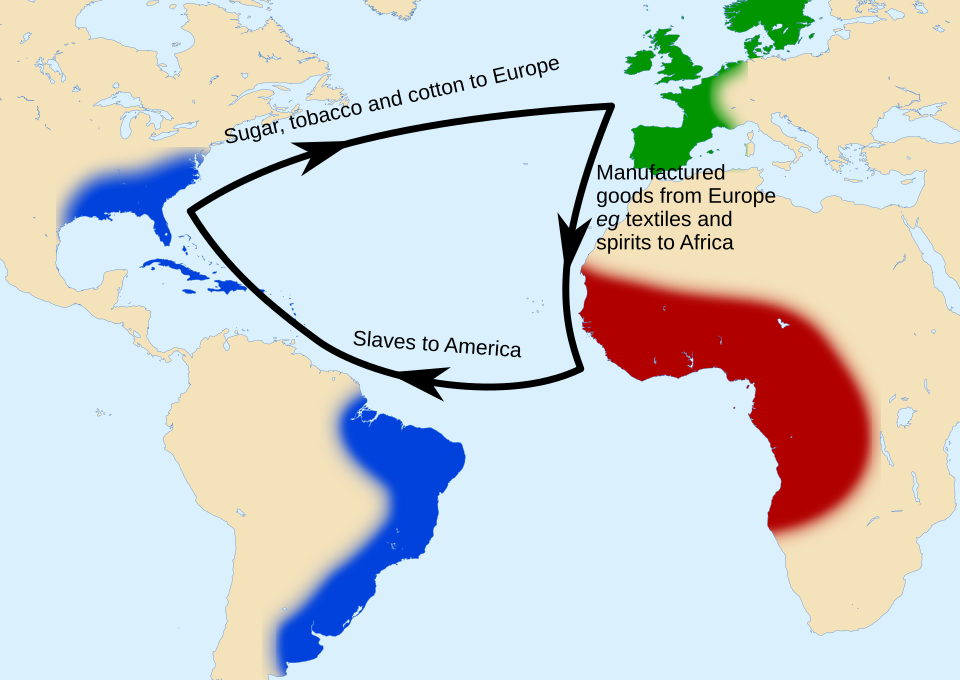
This diagram represents the triangular trade system linking Europe, Africa, and the Americas through the exchange of manufactured goods, enslaved Africans, and colonial products. It illustrates the mercantilist logic that encouraged European states to organize global trade for national profit. The full system developed more fully after 1607, so the image includes later economic patterns that grew out of earlier expansion motives. Source.
Mercantilism, a major economic philosophy of the era, shaped European thinking about empire and commerce.
Mercantilism: An economic theory asserting that national power comes from accumulating wealth—especially precious metals—through a favorable balance of trade and tight state control over the economy.
Because mercantilism emphasized competition for finite global wealth, European states viewed new territorial claims as essential to strengthening national prosperity. Colonies could supply raw materials, purchase manufactured goods from the home country, and provide labor or agricultural commodities needed for expanding global markets.
A normal sentence appears here to ensure proper spacing after the definition block.
Economic motives also included the pursuit of luxury goods such as spices, silks, and porcelain, which were in high demand among Europe’s elites. Control over the sea routes that delivered these goods promised not only wealth but also geopolitical leverage. The Ottoman Empire’s growing control over eastern Mediterranean trade routes further pushed Europeans to seek alternative western pathways to Asia.
Religious Motivations: Faith, Mission, and Cultural Authority
Religion played a powerful role in shaping European expansion. The Catholic Church, still dominant in much of Europe prior to the Protestant Reformation, encouraged missionary efforts to convert non-Christian peoples. Religious leaders framed exploration as part of a divine mission to spread Christianity and counter Islamic influence.
Spanish and Portuguese rulers, in particular, believed Christianization justified both conquest and settlement. They viewed missionary work as a moral responsibility that elevated their political ambitions. Monarchs granted explorers authority to claim land “in the name of God and the crown,” blending spiritual and political goals into a unified imperial mission.
After 1517, the Protestant Reformation intensified religious motivations further. Competition between Catholic and Protestant powers extended into the Atlantic, as each sought to spread its version of Christianity and prevent rivals from doing the same. Missions became tools of influence, reinforcing European authority while shaping colonial societies.
Social Motivations: Status, Opportunity, and Mobility
European social structures also encouraged exploration. Rigid class hierarchies limited opportunities for upward mobility, but the New World appeared to offer new paths toward wealth and status. Soldiers, younger sons of noble families, artisans, and merchants all looked west with aspirations for advancement that seemed unattainable at home.
The promise of land ownership—often inaccessible to common people in Europe—provided a powerful incentive for migration. Land symbolized independence, status, and economic security. In regions such as Spain’s growing empire, titles, privileges, and positions in colonial administration rewarded individuals who participated in conquest and settlement.
Political Motivations: Power, Prestige, and Imperial Expansion
European rulers recognized that overseas expansion could enhance state power. Establishing colonies meant establishing a global presence that increased political prestige. Leaders hoped that exploration would yield advantages such as military footholds, expanded taxation bases, and increased diplomatic leverage.
Monarchs also understood that empire-building enabled them to project their authority far beyond Europe. Colonies could serve as strategic bases for naval operations, enabling states to control shipping lanes and protect commercial interests. The race to secure these advantages intensified rivalries, particularly between Spain and Portugal in the fifteenth and sixteenth centuries.
Interconnected Motivations and the Reshaping of European Societies
These motivations—competition, faith, and wealth—did not function independently. Each interacted with and reinforced the others. Economic ambition supported political expansion; religious leaders lent moral legitimacy to conquest; social pressures made colonization appealing to ordinary people. Collectively, these forces reshaped European societies by redirecting their political energies, economic priorities, and cultural values toward the Atlantic world.
As a result, European expansion into the Western Hemisphere transformed not only the Americas but Europe itself, setting the stage for global empires, intensified rivalries, and far-reaching cultural change.
FAQ
Exploration was expensive and risky, often requiring multiple ships, crews, and long periods without profit.
European rulers increasingly partnered with wealthy merchants and banking families to spread financial risk. This allowed voyages to continue even after failures.
Royal charters and licences also protected investors by granting exclusive trading rights, making exploration more attractive despite uncertainty.
The Ottoman Empire controlled key land routes and eastern Mediterranean ports used for Asian trade.
As a result:
European merchants faced higher taxes and limited access to spices and luxury goods
Western rulers sought alternative routes to Asia that bypassed Ottoman territory
This geopolitical pressure made Atlantic exploration a strategic response to existing power structures rather than a purely adventurous choice.
Successful overseas expansion enhanced royal authority by increasing wealth and prestige.
Monarchs used exploration to:
Reward loyal nobles and military leaders with titles or colonial offices
Expand taxation through overseas trade
Present themselves as divinely favoured rulers supporting Christian missions
These outcomes helped rulers reduce the power of competing elites within Europe.
Early explorers generally prioritised trade routes, wealth extraction, and strategic claims rather than large-scale settlement.
Permanent settlement expanded later when:
Expected riches were not immediately found
Control over territory became necessary to block rival powers
Agricultural production proved profitable
This gradual shift shows that colonisation evolved from exploration rather than being its original primary goal.
Late medieval Europe increasingly celebrated risk-taking in commerce and warfare.
Cultural values began to favour:
Exploration as a path to honour and reputation
Military-style conquest as a legitimate source of wealth
Individual ambition supported by royal authority
These attitudes encouraged participation in dangerous voyages and reinforced expansion as an acceptable and admired pursuit.
Practice Questions
Question 1 (2 marks)
Identify and briefly explain two motivations that led Europeans to explore westward during the period 1491–1607.
Question 1
Award 1 mark for each correctly identified and briefly explained motivation.
1 mark for identifying an economic motivation, such as the search for wealth, precious metals, or new trade routes, with a brief explanation linking it to European exploration.
1 mark for identifying a religious or political motivation, such as spreading Christianity, increasing royal power, or competing with rival European states, with a brief explanation.
Full marks require two distinct motivations with clear explanations. Do not award marks for vague or undeveloped statements.
Question 2 (5 marks)
Assess the extent to which economic competition was the primary reason for European expansion into the Western Hemisphere between 1491 and 1607. In your answer, consider at least one additional factor that influenced European exploration.
Question 2 Mark Scheme (5 marks)
1 mark for a clear and historically defensible argument addressing the question (e.g. stating that economic competition was a major or primary factor, or that it was one of several equally important factors).
2 marks for accurate and relevant evidence explaining how economic competition encouraged exploration, such as mercantilist ideas, the search for gold and silver, or rivalry over trade routes and colonies.
1 mark for identifying and explaining at least one additional factor, such as religious motives, political prestige, or social opportunity, that influenced European expansion.
1 mark for analysis that explains how economic motives interacted with or were limited by other factors, showing a balanced assessment rather than a simple description.
To receive full marks, the response must remain focused on the period 1491–1607 and demonstrate clear understanding of multiple motivations behind European expansion.