AP Syllabus focus:
‘New sources of American mineral wealth fueled European economies and helped accelerate a shift from feudalism toward capitalism.’
European acquisition of American mineral wealth reshaped global economies, expanding trade, transforming social structures, and accelerating Europe’s transition from medieval feudalism toward dynamic capitalist systems.
The Centrality of American Mineral Wealth
Spanish contact with the Americas rapidly revealed vast deposits of silver and gold, particularly in regions such as Mexico and Peru. The extraction of these minerals was not incidental; it became the defining engine of early European empire-building. Because the early modern European economy relied heavily on precious metals to stabilize currency and finance state power, the sudden influx of American bullion fundamentally transformed European commercial life. Most importantly, it contributed directly to shifting Europe away from a rigid feudal order—based on land, fixed social hierarchies, and limited markets—toward a more dynamic capitalist structure of international trade and private investment.
Capitalism: An economic system based on private ownership, market exchange, and the pursuit of profit.
This shift did not happen instantaneously; rather, mineral wealth created pressures and incentives that altered how Europeans conducted trade, governed their societies, and imagined economic possibility.
Spanish Colonial Mining Systems
Spain developed an organized and hierarchical apparatus for extracting American minerals. The most famous example was the Potosí silver mine in the Andes, one of the world’s largest and most productive mining centers.
Major Features of Spanish Mining
Forced labor systems, including the encomienda and later the mita, enabled Spain to mobilize Indigenous labor on a massive scale.
Technological innovations, such as mercury amalgamation, dramatically increased silver yields.
Colonial administration coordinated extraction, taxation, and shipping of precious metals.
Transatlantic fleets carried bullion through fortified shipping routes, integrating the Americas into global commerce.
These systems showed how mineral wealth did more than enrich Spain; it reorganized entire colonial societies around extraction, labor control, and imperial priorities.
European Economic Transformation
The arrival of American silver intensified existing European economic changes and accelerated new ones. The influx of bullion increased the money supply, enabling greater commercial activity and state taxation.
The Price Revolution
Economists often use the term Price Revolution to describe the sustained inflation that occurred in Europe between the 1500s and 1600s. Rising prices had profound effects:
Real wages declined, weakening the economic position of peasants.
Long-distance trade became more profitable.
Monarchs found new financial resources to wage wars and expand bureaucracies.
Banking families, such as the Fuggers and Medicis, increased their influence.
The broader effect was a loosening of feudal economic relationships. As money and commerce replaced land as primary sources of wealth, European societies increasingly incentivized investment, innovation, and trade.
From Feudalism to Capitalism
Feudalism, based on lord-vassal obligations and localized exchange, could not withstand the commercial boom fueled by mineral wealth. Silver provided the liquidity that allowed merchants, states, and investors to experiment with new forms of economic organization.
Feudalism: A medieval European social and economic system structured around land ownership, hereditary status, and reciprocal obligations between lords and peasants.
Mineral wealth helped break the rigidity of that system by empowering new economic actors and making markets central to daily life. Capitalism’s foundations—private investment, wage labor, competitive markets, and expanding global trade—emerged more clearly as silver circulated through European port cities, merchant networks, and financial institutions.
Between these developments, mineral wealth did not just supplement European economies; it reshaped them, encouraging new forms of enterprise and weakening medieval hierarchies.
Global Trade Networks and Finance
American silver quickly spread across the Atlantic and eventually across the globe. Through Spanish trade routes, silver passed from Europe into the Mediterranean and across the Indian Ocean to China, where it became a key medium of exchange in the Ming economy. The global flow of bullion marked one of the earliest truly interconnected commercial systems.
From there, bullion moved along expanding Atlantic and Pacific trading networks, paying for Asian textiles, Chinese porcelain, and spices that Europeans consumed in growing quantities.
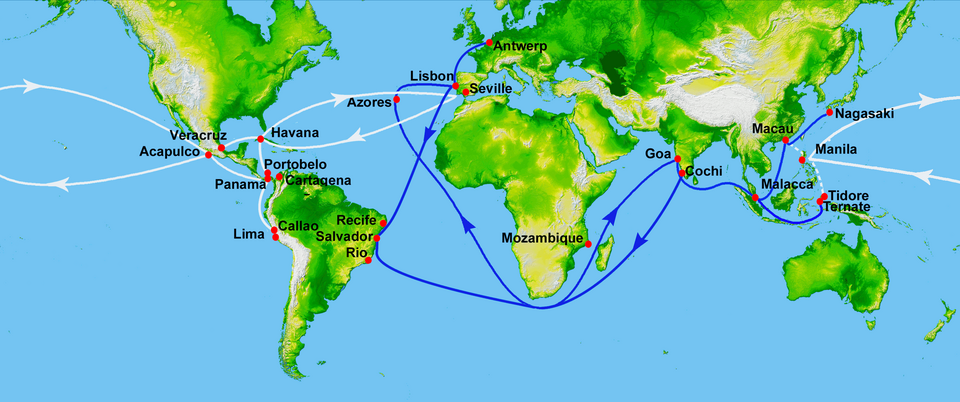
This world map highlights major 16th-century Spanish (white) and Portuguese (blue) oceanic routes, including the Manila–Acapulco galleon pathway that transported much of the Americas’ silver into global markets. It illustrates how mineral wealth flowed through interconnected trade circuits that supported European commercial expansion. The map also shows Portuguese spice routes beyond the scope of this specific AP U.S. History subtopic. Source.
Social and Political Effects in Europe
Mineral wealth strengthened European monarchies by offering unprecedented revenue streams. Stronger states could centralize power, expand standing armies, and assert influence over global trade. Meanwhile, the merchant class gained economic clout, further weakening feudal aristocracies.
The Andean city of Potosí became one of the largest cities in the world, its population and wealth built directly on forced labor in the surrounding silver mines.
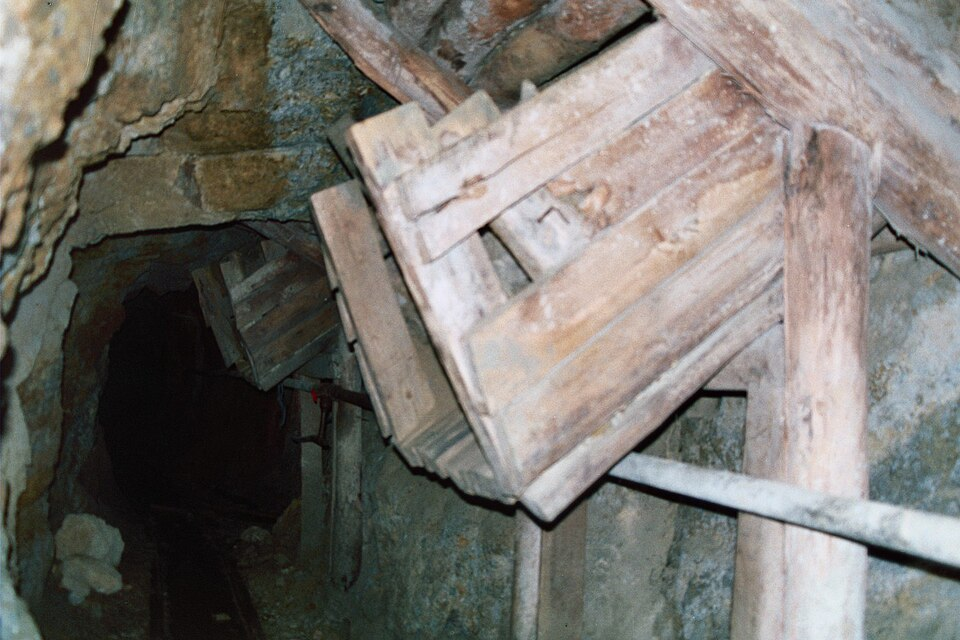
This photograph depicts the slopes of Cerro Rico at Potosí, scarred by centuries of intensive silver extraction that financed Spanish imperial ambitions. It provides a visual example of the mining landscapes that powered Europe’s economic transformation. Modern structures in the image extend beyond the early modern time frame but help illustrate the site’s long mining history. Source.
State centralization increased as rulers relied on bullion to fund administration and warfare.
Merchants and financiers became vital political actors.
Social mobility expanded modestly as commerce offered new avenues for wealth accumulation.
Together, these forces contributed to the long-term emergence of capitalist norms, marking one of the most significant transformations in early modern European history.
FAQ
Spain imposed strict bureaucratic controls through the Casa de Contratación in Seville, which oversaw shipping schedules, licensing, and taxation.
To minimise illicit trade, Spain required all silver to be transported in armed fleets and registered in official ledgers.
Officials also used convoy systems, port inspections, and bonded warehouses to ensure that bullion reached the Crown’s treasury rather than private merchants’ pockets.
The introduction of mercury amalgamation allowed miners to extract silver from lower-grade ore that previously yielded little return.
This process drastically increased output, especially in regions where high-quality ore was depleted.
Its use tied mining centres to global trade because mercury itself had to be imported, particularly from Spanish-controlled mines in Almadén.
Chinese tax reforms under the Ming dynasty increasingly demanded payment in silver, creating enormous demand for the metal.
This turned American silver into a global commodity, flowing through European and Asian merchants.
The high value of silver in China encouraged further extraction in the Americas and deepened Europe’s participation in Asian trade networks.
Peasants’ wages and rents were largely fixed, meaning rising food and commodity prices eroded their purchasing power.
Urban merchants, by contrast, could raise prices, diversify income sources, and benefit from increased trade.
Inflation therefore widened socioeconomic divides and contributed to the weakening of feudal structures based on rigid obligations.
Access to New World silver allowed Spain to fund prolonged military campaigns, strengthening its claim to great-power status.
Other European states, such as England and the Dutch Republic, sought to undermine Spanish dominance by targeting its fleets and colonies.
These rivalries stimulated naval innovation, privateering, and colonial expansion, reshaping the political landscape of early modern Europe.
Practice Questions
Explain one way in which the influx of American silver contributed to economic change in Europe between 1500 and 1650. (1–3 marks)
Question 1 (1–3 marks)
• 1 mark for identifying a valid economic change, such as increased inflation, expanded trade, or strengthened state finances.
• 1 mark for explaining how the influx of American silver contributed to this change.
• 1 mark for using a specific example or detail (e.g., the Price Revolution, Potosí silver production, or the growth of merchant banking).
Evaluate the extent to which mineral wealth from the Americas accelerated Europe’s shift from feudalism to capitalism in the sixteenth and seventeenth centuries. (4–6 marks)
Question 2 (4–6 marks)
• 1 mark for establishing a clear argument about the extent of change (e.g., significant acceleration, limited impact, or mixed effects).
• 1–2 marks for describing how American mineral wealth contributed to the decline of feudal structures (e.g., monetisation of the economy, weakening of land-based aristocracy, growth of markets).
• 1–2 marks for explaining how silver supported early capitalist development (e.g., increased liquidity, expansion of long-distance trade, rise of financial institutions).
• 1 mark for use of at least one specific example, such as Potosí, the Price Revolution, the Spanish treasure fleets, or European banking families.