AP Syllabus focus:
‘Improvements in maritime technology helped Europeans travel farther and expand international trade in the Atlantic world.’
Advances in navigation, ship design, and sailing techniques enabled Europeans to explore the Atlantic more safely and efficiently, stimulating unprecedented long-distance travel, commerce, and imperial expansion.
The Foundations of Maritime Innovation
European Atlantic expansion between 1491 and 1607 depended heavily on maritime technology, defined as the set of tools, vessels, and navigational systems that allowed sailors to plan, guide, and sustain long-distance voyages. These innovations were not inventions of a single moment but cumulative developments shaped by earlier Mediterranean, Islamic, and Asian knowledge that Europeans adapted for their Atlantic purposes.
The Role of Ship Design in Atlantic Travel
The most influential vessel of the early modern era was the caravel, a small, maneuverable ship capable of sailing close to the wind.
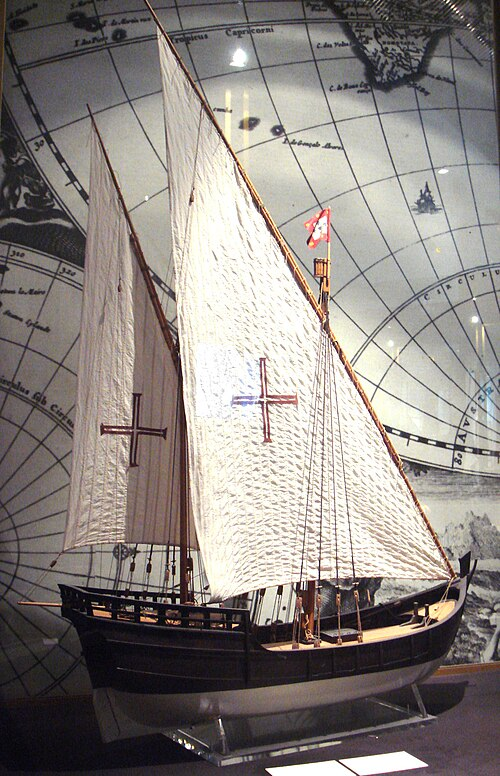
Model of a Portuguese caravel showing the compact hull, high forecastle and sterncastle, and mixed sail types that made it stable and maneuverable in Atlantic waters. The combination of square and lateen sails illustrates its ability to sail effectively in shifting winds. The image includes structural details such as rigging and deck configuration that extend beyond the information required in the notes. Source.
Caravel: A light, highly maneuverable sailing ship developed by the Portuguese, featuring lateen sails that allowed efficient tacking against the wind.
Caravels enabled expeditions along the African coast and across the Atlantic where wind patterns were unpredictable. These ships offered several advantages:
Shallower drafts, allowing closer coastal exploration.
Improved maneuverability, critical for mapping unfamiliar waters.
Capacity for longer voyages, supporting early exploration before heavier ships such as carracks became more widespread.
Between these advancements, sailors could better navigate ocean currents and return home reliably, which was essential for sustaining exploration.
Navigating the Seas: Instruments and Techniques
As Europeans looked westward, precise navigation became vital. Innovations in navigational instruments allowed mariners to determine their position with greater accuracy, reducing the risks of transoceanic travel. The astrolabe, originally developed in the Islamic world, gained new importance for Atlantic sailors.
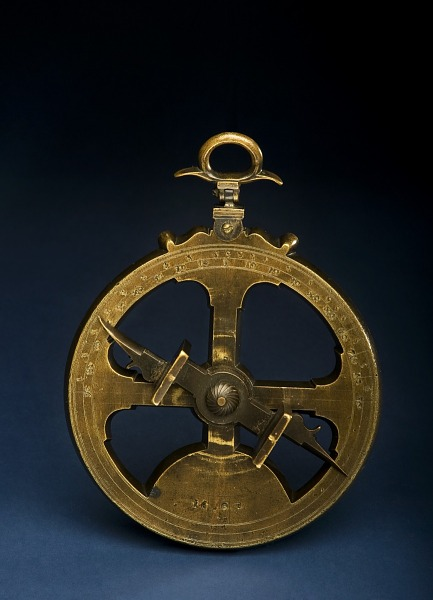
A brass mariner’s astrolabe from the early 1600s used by navigators to measure the altitude of celestial bodies to estimate latitude. Its heavy frame and open design reveal how it was stabilized and aligned aboard ships in rough seas. The inscription and detailed scale markings exceed syllabus requirements but help students appreciate how such instruments functioned in practice. Source.
Astrolabe: A navigational instrument used to determine latitude by measuring the angle of celestial bodies above the horizon.
The increasing availability of magnetic compasses, which indicated direction regardless of weather, further revolutionized navigation. Combined with charts and celestial observations, these tools helped standardize ocean travel. Mariners also relied on:
Portolan charts, which mapped coastlines and harbors with directional lines radiating from compass points.
Dead reckoning, a technique estimating position by calculating distance traveled over time.
Celestial navigation, using stars such as Polaris to approximate latitude during open-ocean crossings.
These techniques did not eliminate danger, but they significantly reduced uncertainty and made repeated transatlantic travel feasible.
Linking Technology to Atlantic Expansion
Maritime innovation did not occur in isolation—it directly supported Europe’s expanding networks of trade, conquest, and colonization. As ships traveled farther with greater predictability, the Atlantic became a dynamic arena of commercial and political competition.
Expanding Trade Networks Through Improved Travel
Long-distance sailing opened access to new markets, both for imported goods and for commodities extracted from the Americas. Ships capable of carrying more cargo, staying at sea longer, and surviving harsher conditions allowed Europe’s emerging empires to build consistent trade routes. These routes connected:
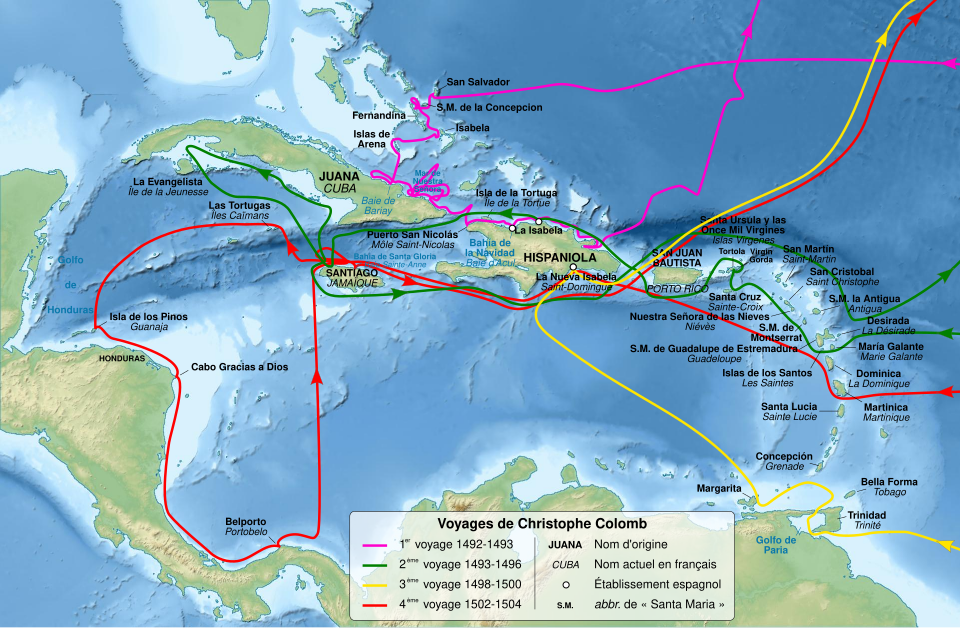
Map showing the four Atlantic voyages of Christopher Columbus from 1492 to 1504, illustrating the sailing routes made possible by improved maritime technology. The multiple tracks highlight the growing regularity of transatlantic crossings. The map includes additional geographic detail and labeling not discussed in the notes but helpful for visualizing the scope of early Atlantic travel. Source.
Europe, as a center of manufactured goods.
Africa, which supplied enslaved labor under expanding slave-trading systems.
The Americas, which offered agricultural and mineral products desired in European markets.
Improved maritime technology thus facilitated the early foundations of the Atlantic World, a system of exchange that transformed economies on multiple continents.
Supporting Empire-Building and Overseas Exploration
As navigation became more reliable, European monarchs gained confidence in funding expeditions. Portugal and Spain were early leaders, though other powers soon joined the competition. Technological improvements enabled:
More ambitious voyages, such as Columbus’s 1492 expedition across the Atlantic.
Regular transatlantic crossings, allowing sustained colonial administration.
Rapid communication and resource extraction, both essential to imperial consolidation.
The ability to travel farther also intensified European rivalry. Nations sought not only wealth but also geopolitical advantage, using maritime power to claim territories and defend trade routes. Thus, maritime innovations were intertwined with political strategy.
Transforming European and American Worlds
The spread of advanced maritime technology had profound consequences that shaped the early modern Atlantic. It supported the movement of people, goods, and ideas in ways that dramatically altered societies.
Creating New Patterns of Contact and Exchange
Advanced ships allowed Europeans to establish lasting contact with the Americas. This, in turn, accelerated the Columbian Exchange, which introduced new crops, diseases, and animals across hemispheres. The flow of ideas and technologies also expanded, as Europeans adapted Indigenous knowledge and incorporated it into navigation practices and exploration strategies.
Enabling Large-Scale Migration and Labor Systems
Improved transatlantic travel made it possible for Europeans to transport settlers, soldiers, and enslaved Africans across vast distances. The mobility created by maritime technology underpinned:
Plantation economies, demanding coerced labor.
Mining enterprises, vital to European wealth accumulation.
Cultural interactions, sometimes violent and often transformative.
As European presence intensified, maritime systems became essential infrastructure for emerging colonial societies.
Technology as a Driver of Change
Maritime innovations were fundamental to Europe’s ability to project power across the Atlantic. Whether through improved ships, refined navigation, or expanded trade networks, these tools enabled the sustained contact that defined the early modern Atlantic world. They supported economic, political, and cultural transformations that would continue shaping global history well beyond 1607.
FAQ
European sailors had to navigate the predictable yet challenging system of trade winds and westerlies across the Atlantic. These wind patterns encouraged the development of ships capable of tacking efficiently, such as caravels.
The need to sail diagonally against the wind also increased reliance on tools that could help maintain accurate course, leading to greater use of the compass and more detailed navigational charts.
Europeans did not create their navigational toolkit in isolation. They borrowed heavily from the Islamic world, especially in astronomical instruments and mathematical techniques used for navigation.
Asian influences contributed to improvements in hull construction, sail design, and early compass technology, which were later adapted for Atlantic exploration.
The potential rewards of exploration—access to trade routes, wealth, and strategic power—encouraged risk-taking.
Rulers provided patronage for voyages and supported experimentation with new ship types and navigational methods, making technological innovation a state-backed venture rather than an individual gamble.
Improved instruments reduced the guesswork involved in determining position, making voyages less hazardous and disorienting.
Better ship design:
Provided slightly more space and stability
Allowed safer storage of food and water
Reduced travel time on some routes
Such developments helped increase morale and made repeated crossings more feasible.
More accurate navigation meant sailors could record coastlines, currents, and distances with greater precision, gradually replacing medieval mapmaking traditions.
As voyages became repeatable, Europeans began to view the Atlantic not as a barrier but as a navigable space connecting regions and economies, reshaping geographical understanding across Europe.
Practice Questions
Question 1 (1–3 marks)
Which development in maritime technology most directly enabled European explorers to navigate more effectively against prevailing Atlantic winds during the late fifteenth and early sixteenth centuries?
Mark scheme
1 mark for identifying a relevant innovation such as the caravel.
1 additional mark for explaining its manoeuvrability or ability to sail closer to the wind.
1 additional mark for linking this advantage to European Atlantic exploration or extended voyages.
Question 2 (4–6 marks)
Explain how improvements in maritime technology contributed to the expansion of European trade networks in the Atlantic world between 1491 and 1607.
Mark scheme
1 mark for identifying at least one key technological improvement (e.g., caravels, improved navigational instruments, portolan charts).
1 mark for describing how the identified technology functioned or what advantage it provided.
1 mark for linking technological improvements to longer, safer, or more predictable oceanic voyages.
1 mark for explaining how these voyages enabled the creation or strengthening of transatlantic trade routes.
1 mark for connecting technological change to increased exchange between Europe, Africa, and the Americas.
1 mark for demonstrating accurate historical context or using a specific example of expanded trade (e.g., the movement of goods, people, or resources across the Atlantic).