AP Syllabus focus:
‘Over time, Europeans and Native Americans adopted useful aspects of each other’s cultures during extended contact.’
Cultural Exchange: Adaptation and Syncretism
European and Native American contact fostered ongoing cultural blending as each group selectively adopted practices, technologies, and ideas that improved survival, communication, and influence in a rapidly changing Atlantic world.
Understanding Cultural Exchange in Period 1
Extended contact between Europeans and Native Americans produced mutual adaptation, meaning each side incorporated elements from the other when useful for economic, political, or cultural purposes. This process created syncretism, the blending of distinct cultural traditions into new forms.
Syncretism: The process through which different cultural traditions merge to create new, hybrid practices or beliefs.
During the sixteenth century, such exchanges were not uniform; instead, they shifted with geography, available resources, and local power dynamics. Interactions ranged from cooperative exchange to conflict-ridden negotiation, and cultural blending emerged even in contexts of violence and coercion.
Adoption of European Material Goods by Native Peoples
Many Native American groups adopted European goods not because they sought cultural assimilation, but because these items enhanced established systems of trade, warfare, and diplomacy.
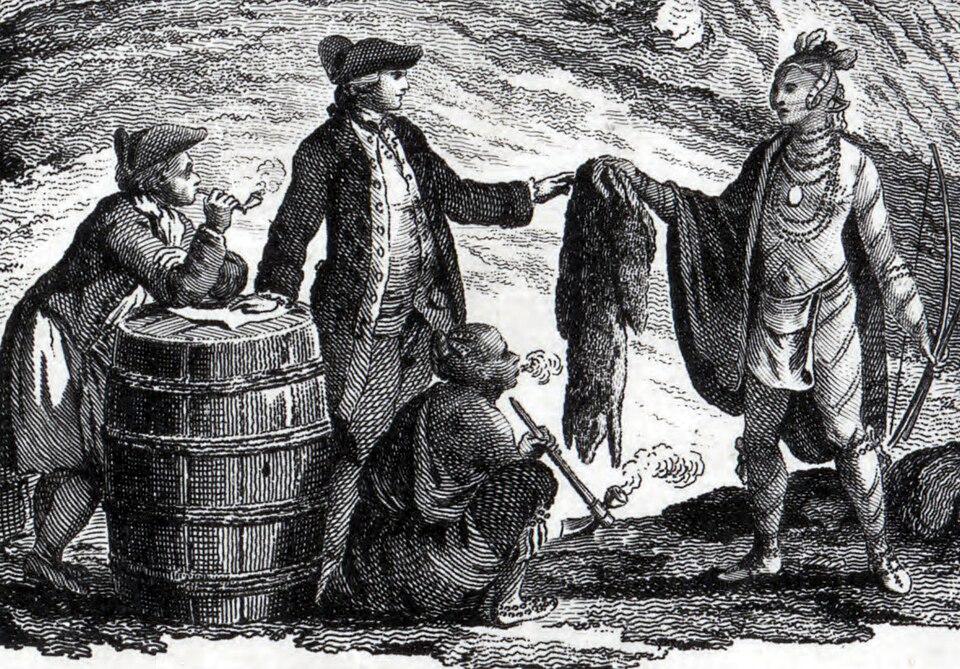
This 1777 engraving depicts Native Americans trading furs for European tools and goods, illustrating how Indigenous communities selectively adopted foreign materials within existing trade systems. The landscape and clothing details exceed syllabus requirements but help contextualize early exchange relationships. Source.
Metal Tools, Weapons, and Domestic Items
Native communities incorporated items such as iron tools, metal knives, and brass kettles, which often replaced stone or ceramic equivalents.
Iron axes improved woodworking for building longhouses and canoes.
Metal fishing hooks increased efficiency in coastal and riverine economies.
Kettles became prized trade items that circulated widely beyond the point of initial contact.
These objects strengthened existing cultural practices rather than fundamentally altering them, showing how adaptation could coexist with cultural continuity.
Firearms and Shifting Political Relationships
Firearms reshaped intertribal relations as groups that obtained guns earlier could enhance military standing.
Competitions for access to European weapons intensified long-standing rivalries.
Groups such as the Iroquois and Huron strategically negotiated alliances to secure reliable firearm trade routes.
The redistribution of power revealed that cultural exchange was deeply tied to political strategy rather than simple assimilation.
Indigenous Influence on European Practices
Europeans similarly relied on Native knowledge to survive and navigate unfamiliar environments. This influence shaped settlement strategies, land use, diet, and diplomacy.
Agricultural and Environmental Knowledge
European settlers adopted Native crops and cultivation methods that were essential to survival.
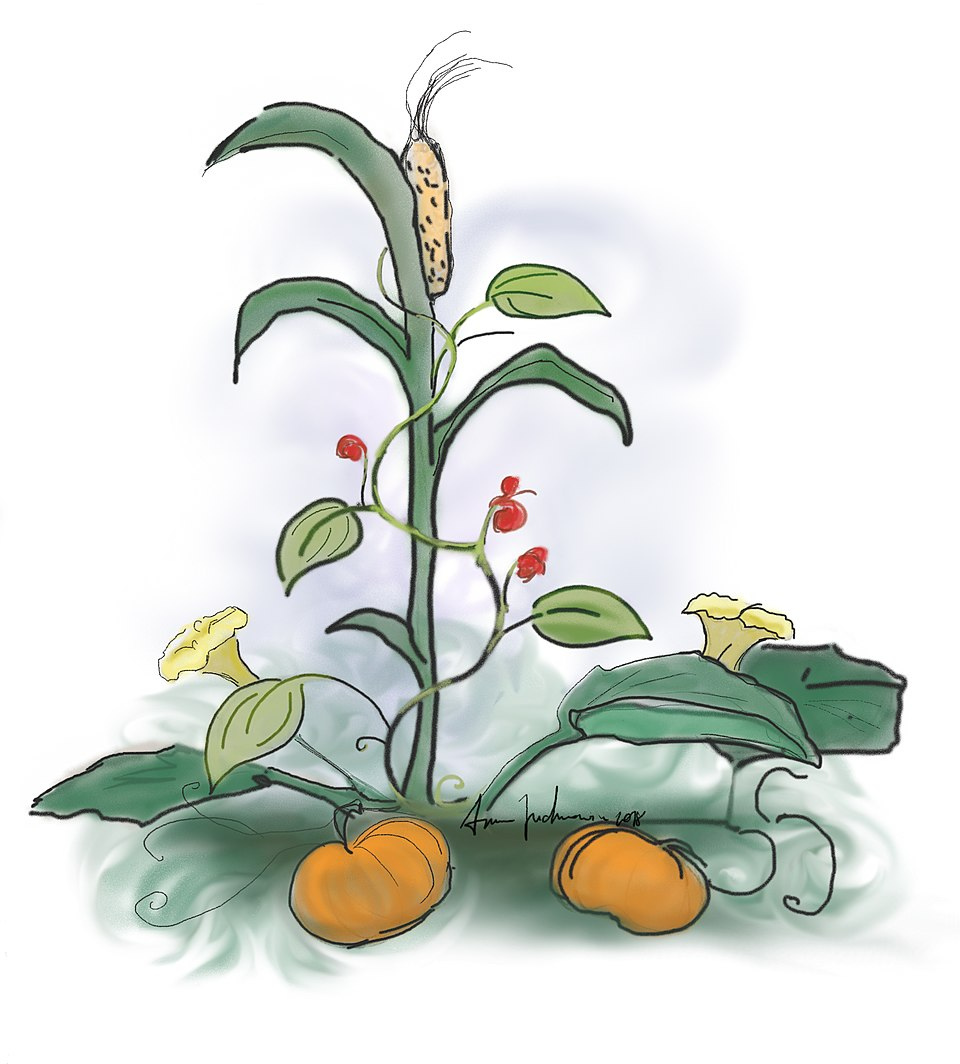
This diagram shows the Three Sisters—corn, beans, and squash—growing together in the complementary Indigenous planting system adopted by many Europeans. Its labeling offers more detail than required by the AP syllabus but clearly demonstrates how each crop supports the others, reinforcing the ecological sophistication of Native agriculture. Source.
The Three Sisters: A complementary planting system of corn, beans, and squash developed by Native peoples to maximize soil health and crop yield.
Colonists incorporated Indigenous planting techniques to adapt to New World soils and growing conditions.
Knowledge of local medicinal plants, such as willow bark for pain relief, informed early colonial healing practices.
Environmental strategies—like controlled burns used by tribes in the Northeast and Southeast—helped Europeans manage forests and hunting grounds.
These adaptations demonstrated that Europeans were not simply cultural exporters; they were also learners who depended on Indigenous expertise.
Foodways and Daily Life
European diets changed significantly due to the introduction of American staples. Foods such as corn and potatoes later transformed European agriculture, but settlers also adopted Native methods of preparation.
Methods for drying and storing corn ensured winter survival.
Indigenous techniques for smoking fish and meat influenced colonial food preservation.
Canoe designs and snowshoes were incorporated into frontier life, aiding exploration and travel.
Religious and Cultural Syncretism
Despite European efforts to impose Christianity, many Native communities blended Christian practices with existing spiritual systems rather than abandoning longstanding beliefs.
Hybrid Religious Practices
Missionary influence varied across regions, but syncretic belief systems emerged widely.
Some Indigenous converts blended Christian saints with traditional spirit beings.
Rituals such as baptism were incorporated alongside Native ceremonies.
The persistence of Indigenous cosmologies shows that spiritual adaptation often strengthened cultural identity rather than weakening it.
European observers sometimes misunderstood this syncretism as incomplete conversion, revealing their limited grasp of Native worldviews.
Language and Communication
Linguistic blending also emerged as a practical necessity.
Pidgin languages developed in regions with sustained trade, enabling basic communication between groups.
Interpreters—often individuals of mixed ancestry or those raised in multilingual households—were central to diplomacy and commerce.
Borrowed vocabulary circulated widely; for example, Europeans adopted Indigenous terms for unfamiliar animals and geographic features.
Social and Cultural Blending Through Intermarriage
Intermarriage was another site of cultural fusion, especially in French and Spanish borderlands.
Kinship Networks and Alliances
French traders frequently married into Native communities to secure long-term trading relationships.
Such marriages strengthened diplomatic ties and provided access to Indigenous trade routes.
Children of mixed ancestry often played key roles as cultural intermediaries.
Kinship connections reinforced cross-cultural understanding and helped maintain peace in contested regions.
Material Culture and Daily Practices
European settlers adopted aspects of Indigenous dress—such as moccasins or animal-skin clothing—suited to local climates.
Native decorative traditions influenced colonial material culture, including beadwork and patterns used in trade goods.
Clothing, housing styles, and even gendered labor roles shifted in some communities, reflecting continuous negotiation and adaptation.
Economic Exchange as a Driver of Cultural Blending
Trade was the catalyst for much of the cultural exchange in Period 1, shaping both material and ideological adaptations.
Trade Networks and Shared Economic Spaces
Indigenous trade networks predated European arrival but expanded and transformed due to new goods entering circulation.
Europeans adapted to Native systems of gift exchange, which carried diplomatic meaning beyond material value.
Native groups integrated European items into long-distance networks stretching across the continent.
These exchanges fostered blended economic systems that reshaped social relations, diplomacy, and cultural practice.
The intertwined nature of exchange—material, intellectual, and spiritual—illustrates how both Europeans and Native Americans navigated early contact through ongoing adaptation and syncretism.
FAQ
Patterns of exchange varied widely because Indigenous societies had diverse economies, political structures, and environmental conditions.
In the Northeast, trade centred on furs and metal goods, leading to sustained diplomatic alliances.
In the Southeast, agricultural societies exchanged knowledge of crops and land management.
In the Southwest, Pueblo communities interacted with Spanish settlers through labour systems and religious instruction, producing distinct forms of cultural blending.
Regional diversity shaped the pace, depth, and character of syncretism.
Indigenous communities adopted items that improved efficiency, strengthened security, or enhanced trade networks.
Key factors included:
• durability and usefulness compared to traditional equivalents
• compatibility with existing hunting, farming, or warfare practices
• value in diplomatic gift-giving and intertribal trade
• ability to reinforce, rather than disrupt, core cultural traditions
Goods that failed to meet these criteria were often rejected or only selectively used.
Some groups limited or rejected aspects of cultural exchange to maintain autonomy or protect sacred practices.
Resistance took several forms:
• refusing missionary instruction or selectively interpreting Christian teachings
• restricting access to certain ceremonies or knowledge
• controlling trade to prevent dependency on European goods
• maintaining traditional gendered labour roles despite European pressure
Such resistance shows that cultural exchange was negotiated rather than inevitable.
Intermarriage created households where languages, customs, and technologies blended in ways not always visible in formal diplomacy.
Children of mixed ancestry often served as cultural mediators, transmitting traditions from both sides.
Household spaces became sites for shared cooking practices, dress styles, and religious observances.
In some regions, these families helped stabilise frontier communities by promoting communication and reducing misunderstandings.
The influence of these blended households extended across generations.
Indigenous environmental expertise shaped European settlement patterns, resource use, and survival strategies.
Examples include:
• guidance on locating fresh water, fertile soil, and seasonal food sources
• instruction in sustainable hunting, fishing, and controlled burning
• knowledge of medicinal plants and remedies
• teaching of seasonal mobility practices in harsh climates
This environmental knowledge allowed Europeans to adapt their lifestyles to unfamiliar landscapes, deepening cultural exchange over time.
Practice Questions
(1–3 marks)
Describe one way in which cultural exchange between Europeans and Native Americans resulted in adaptation by Indigenous peoples during the period 1491–1607.
Question 1 (1–3 marks)
1 mark for identifying a valid example of Indigenous adaptation.
(e.g., adoption of metal tools, firearms, or European textiles)2 marks for describing how the adopted item or practice was used.
(e.g., metal axes used to improve woodworking, firearms altering intertribal warfare)3 marks for explaining why Indigenous peoples incorporated the item or practice while maintaining core cultural traditions.
(e.g., goods enhanced existing trade networks or military strategies rather than replacing Indigenous cultural identities)
(4–6 marks)
Explain how extended contact between Europeans and Native Americans led to the development of syncretic cultural practices in the period 1491–1607. In your answer, refer to both European and Indigenous adaptations.
Question 2 (4–6 marks)
4 marks for explaining at least one example of European adaptation and one example of Indigenous adaptation.
(e.g., Europeans adopting the Three Sisters agricultural system; Indigenous peoples blending Christian rites with traditional ceremonies)5 marks for demonstrating how these examples illustrate syncretism.
(e.g., the merging of belief systems or the creation of hybrid practices)6 marks for providing a well-developed explanation that links adaptations to the broader context of extended contact, diplomacy, trade, and survival needs.
Responses earning full marks should show clear understanding that syncretism emerged through selective, purposeful blending on both sides rather than simple cultural replacement.