AP Syllabus focus:
‘As Europeans demanded land and labor, Native peoples defended sovereignty, prosperity, religious beliefs, and gender relations through diplomacy and military resistance.’
European encroachment during early colonization provoked significant Indigenous resistance as Native societies worked to defend land, culture, sovereignty, and social order through diverse diplomatic and military strategies.
Encroachment, Sovereignty, and the Struggle for Control
European settlement patterns in the sixteenth and early seventeenth centuries increasingly disrupted Indigenous homelands. As foreign populations expanded, encroachment—the gradual seizure of land, resources, and labor—forced Native peoples to respond to threats against political autonomy and cultural continuity. The push to protect sovereignty (the right of a community to govern itself) shaped nearly every Indigenous strategy in this period.
The Nature of Encroachment
European encroachment varied across regions, but its core pressures were consistent. Colonizers sought territory for agriculture, labor for emerging colonial economies, and influence over trade networks. These demands often collided with Indigenous land tenure systems, which many Europeans misunderstood or dismissed.
Land seizure: European claims relied on written deeds, while many Native societies emphasized communal use and stewardship.
Labor exploitation: Early colonial systems, including Spanish coerced labor practices, attempted to redirect Indigenous labor toward European goals.
Cultural intrusion: Missionary activities sought to restructure Native religious and social systems, intensifying conflict over autonomy.
As foreign populations expanded, encroachment on Native lands took many forms, from permanent settlements to forts, missions, and trading posts.
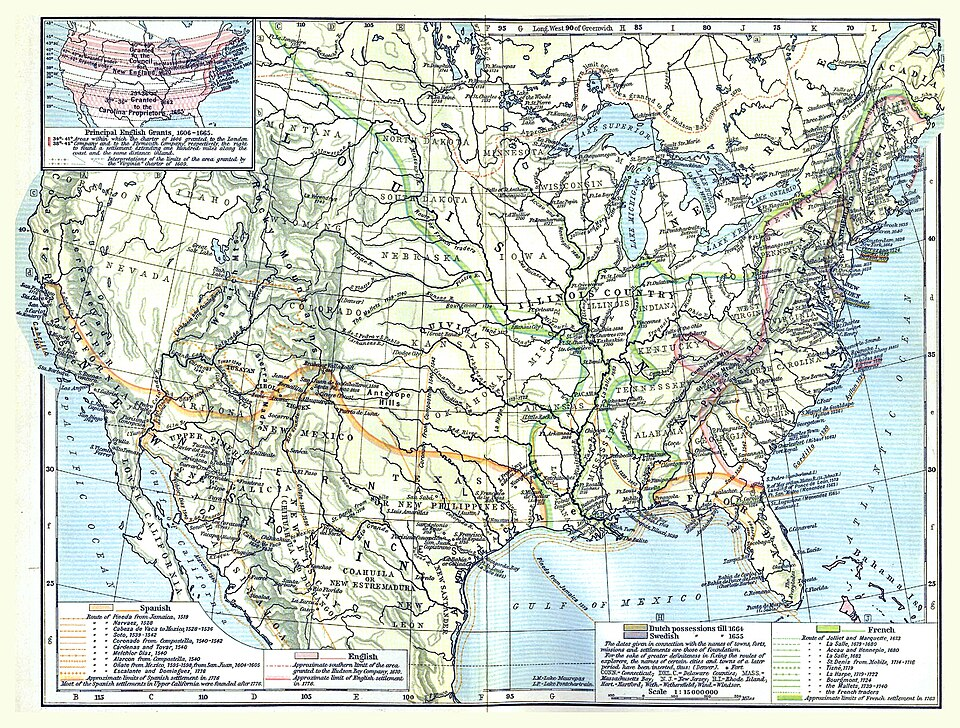
Map of European settlements in North America from 1513 to 1776, with major imperial regions clearly labeled. The shaded areas show how European coastal footholds expanded inland over time, gradually pressing against Indigenous territories. Although some territorial boundaries extend past 1607, the image illustrates the long-term pattern of encroachment introduced during Period 1. Source.
Indigenous Defense of Prosperity and Land
Indigenous communities responded to escalating pressures through diplomatic negotiation, strategic alliances, and, when necessary, coordinated armed defense. The preservation of prosperity—including food security, trade access, and political stability—was central to these efforts.
Diplomatic Resistance and Negotiation
Diplomacy was a primary tool of early Indigenous resistance. Native leaders sought to manage European presence without forfeiting control over their homelands.
Forming alliances with rival European powers to balance influence
Negotiating treaties to restrict settlement or safeguard trade relations
Leveraging knowledge of local environments to maintain bargaining strength
These strategies reflect Indigenous agency rather than passive reaction. Native diplomats used European rivalries to their advantage, attempting to shield communities from the worst effects of colonization.
Native leaders used treaties, gift exchanges, and formal alliance networks to try to restrain European settlement and protect their people.
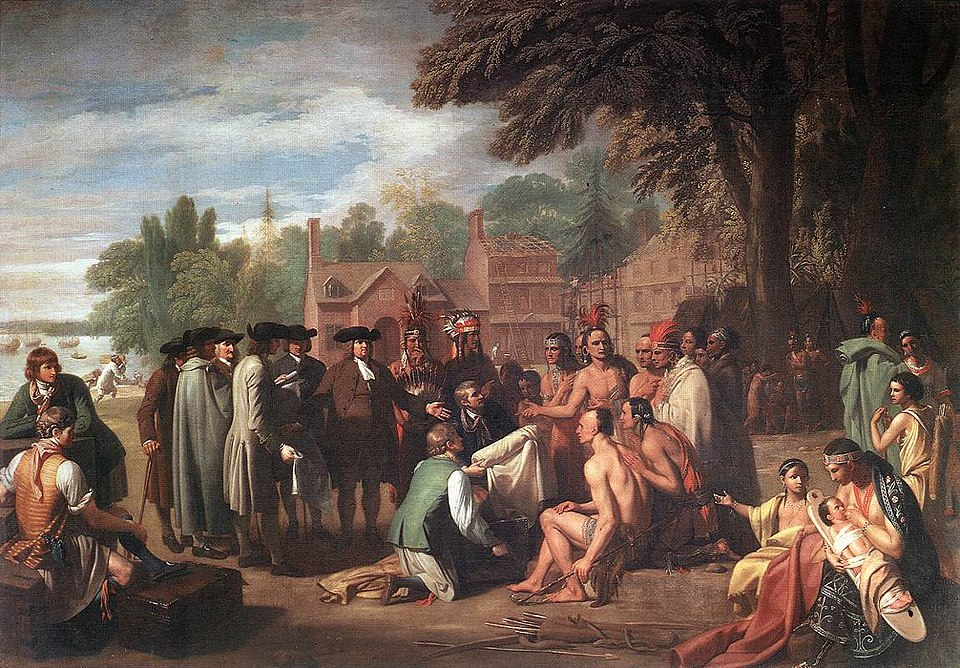
Benjamin West’s painting portrays a treaty meeting between William Penn and Lenape leaders, emphasizing diplomacy, negotiation, and ceremonial exchange. The composition highlights diplomatic resistance as a key strategy Indigenous peoples used to manage expanding colonial settlements. The scene is idealized and dated after Period 1, but it effectively illustrates the broader theme of Native diplomatic efforts to limit encroachment. Source.
Military Resistance and Armed Defense
Diplomacy coexisted with the threat and use of military action. Armed resistance emerged when negotiations failed or when settlers violated agreements.
Coordinated attacks on vulnerable settlements
Defensive fortifications and strategic withdrawals
Use of environmental knowledge to slow European expansion
Some conflicts stemmed from Native efforts to preserve hunting grounds, agricultural land, or the integrity of trade networks. Warfare in this era was not a uniform continental effort but a series of localized, highly strategic responses to specific colonial pressures.
Religion, Worldviews, and the Defense of Belief Systems
Indigenous religious traditions, deeply connected to land and community, were targets for missionary intervention. Attempts by Europeans—most prominently the Spanish and French—to replace Indigenous spiritual practices challenged foundational cultural systems.
Preserving Religious Authority
Missionary activity demanded conversion and behavioral transformation, often dismissing Native spiritual leaders as obstacles to progress. Native resistance included:
Rejecting or selectively adapting Christian teachings
Maintaining spiritual ceremonies in private or protected settings
Supporting leaders who advocated for cultural preservation
Syncretism (the blending of cultural or religious traditions) appeared in some areas, but syncretic practices were frequently part of Indigenous strategies to maintain continuity, not surrender cultural identity.
Gender Relations and Social Structures Under Pressure
European assumptions about gender and family roles clashed sharply with Native social systems. Many Indigenous societies held matrilineal inheritance patterns and recognized women as key political and economic actors. These structures contradicted European patriarchy, prompting colonizers to challenge or undermine Native gender relations.
Defense of Social Order
Native resistance sought to preserve established gender roles, which were essential to governance, agriculture, and religious life.
Upholding women’s political influence in councils
Defending communal land rights tied to female inheritance
Rejecting European efforts to impose patriarchal family structures
Matrilineal: A kinship system in which lineage, inheritance, and social identity are traced through the mother’s line.
Efforts to alter gender relations threatened community stability, prompting many Native peoples to view cultural preservation as inseparable from resistance to land loss.
Diplomacy, Alliance Networks, and Strategic Adaptation
Indigenous nations drew on long-established intertribal alliance traditions to respond flexibly to European threats. Alliances allowed communities to combine military power, control trade routes, and maintain regional influence.
Balancing European Powers
As Spanish, French, and later English and Dutch interests expanded, Indigenous peoples exploited imperial rivalries.
Partnering with one European power to counter another
Retaining leverage by controlling essential trade goods
Using diplomacy to enforce agreed territorial boundaries
These strategies reflected sophisticated geopolitical thinking grounded in centuries of intertribal diplomacy.
Indigenous Resistance as Ongoing Adaptation
Resistance during this period was not a singular event but a continuous process shaped by evolving conditions. Native peoples assessed threats, forged alliances, and adapted to changing technologies and trade patterns. Their efforts to defend sovereignty, prosperity, religious beliefs, and gender relations underscore the complexity and resilience of Indigenous societies confronting European expansion.
FAQ
Indigenous nations had long-established systems of intertribal diplomacy, including councils, negotiated truces, and ceremonial gift exchange. These traditions shaped their initial approaches to Europeans, whom they treated as another group entering existing political networks.
Many Indigenous leaders sought to integrate Europeans into these systems, expecting reciprocal obligations and respectful cooperation. This often conflicted with European assumptions about hierarchy and land ownership, creating misunderstandings that influenced early resistance.
Geography shaped both the vulnerability and resilience of Indigenous communities. River valleys and coastal plains provided fertile land but also easy access points for European ships and settlers.
In contrast, mountainous, forested, or marshy terrain enabled more effective defensive strategies. These environments allowed Indigenous groups to control movement, carry out ambushes, or retreat to temporary refuges when necessary.
Missionaries often sought to influence political life by undermining existing spiritual leaders. Some Indigenous communities responded by strengthening the authority of religious figures who resisted conversion.
Others adopted selective elements of Christianity to maintain stability or reduce conflict, using syncretic practices to preserve core traditions while negotiating coexistence with missionaries.
Indigenous women in many societies held economic, diplomatic, and kinship authority, giving them influence over decisions relating to trade, alliance-making, and land use.
Women often acted as intermediaries in negotiations, controlled agricultural resources that sustained resistance, and shaped diplomatic outcomes through matrilineal inheritance systems. Their roles sometimes contradicted European patriarchal expectations, contributing to cultural tensions.
European arrival altered longstanding alliance patterns by introducing new trade goods, military technologies, and political opportunities.
Some Indigenous nations strengthened existing alliances to counter expanding European influence, while others shifted loyalties to gain access to firearms or trade networks.
Alliances with Europeans were often pragmatic and temporary.
Intertribal diplomacy remained central, as Native nations used alliances to balance power and manage encroachment.
Practice Questions
Question 1 (1–3 marks)
Identify one reason why Indigenous peoples in the period 1491–1607 used diplomatic strategies such as treaty-making when responding to European encroachment.
Mark scheme:
1 mark for identifying a valid reason (e.g., to limit European settlement; to protect land or resources; to maintain sovereignty).
1 additional mark for explaining how diplomacy served Indigenous interests (e.g., treaties could establish boundaries or regulate trade).
1 additional mark for contextual detail linking diplomacy to broader patterns of European expansion (e.g., exploiting rivalries between European powers).
Question 2 (4–6 marks)
Explain how Indigenous peoples used both diplomatic and military methods to defend their sovereignty and social structures against European encroachment in the period 1491–1607.
Mark scheme:
1 mark for describing at least one diplomatic method (e.g., alliance-making, treaty negotiation, gift diplomacy).
1 mark for describing at least one military method (e.g., targeted attacks, defensive withdrawals, strategic use of terrain).
1 mark for linking these strategies to the defence of sovereignty (e.g., maintaining control over land and decision-making structures).
1 mark for linking strategies to the protection of prosperity, religious practices, or gender relations.
1 mark for incorporating accurate contextual details from the period (e.g., missionary pressures, land seizure, competition among European powers).
1 mark for a coherent, well-structured explanation that shows a clear understanding of how these strategies worked together.