AP Syllabus focus:
‘The middle colonies developed a flourishing export economy based on cereal crops and attracted diverse European migrants, creating greater ethnic, religious, and cultural diversity and tolerance.’
The Middle Colonies flourished through grain-based export economies and expanding social diversity, shaping a region distinguished by tolerance, demographic variety, and commercial vitality in early British America.
Economic Foundations of the Middle Colonies
Grain Production and Export Markets
The Middle Colonies—primarily New York, New Jersey, Pennsylvania, and Delaware—became known as the “breadbasket colonies”, a term referring to their substantial production of cereal crops.
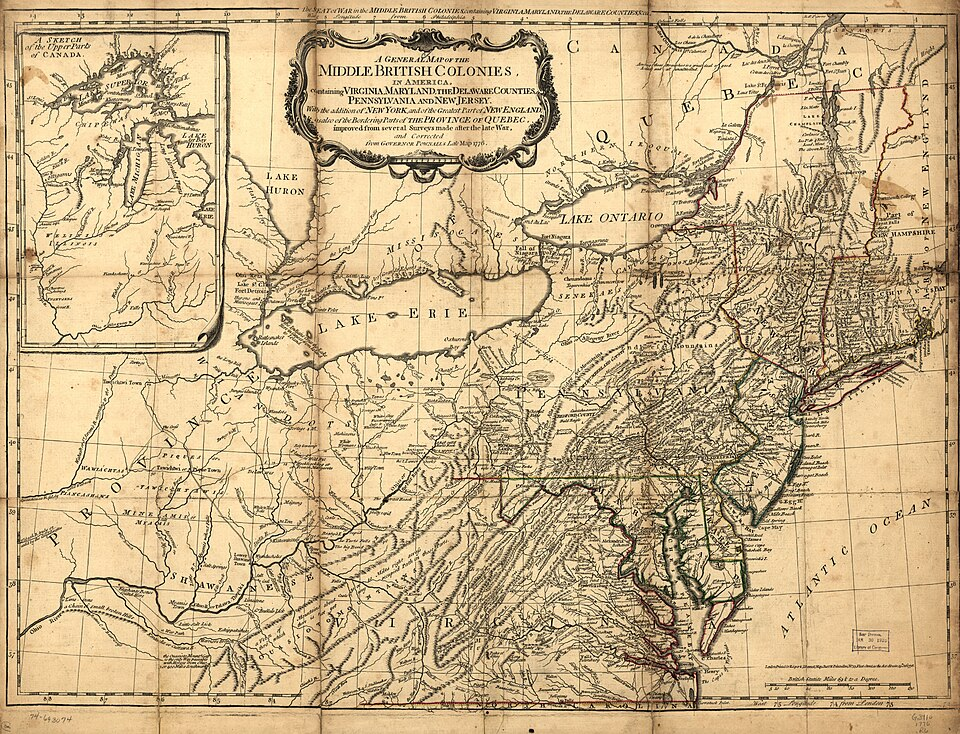
This 1776 map shows the middle British colonies, including Pennsylvania, New Jersey, the Delaware counties, and New York, alongside neighboring regions. Students can see how rivers and Atlantic access enabled agricultural products like grain to move from inland farms to port cities. The map includes surrounding areas not required by the syllabus but offers useful geographic context. Source.
These colonies possessed fertile soils, moderate climates, and reliable growing seasons that supported large harvests of wheat, barley, oats, and rye. The consistent output of these staple crops enabled farmers to supply both local markets and booming Atlantic trade networks.
Large port cities such as Philadelphia and New York City emerged as key export hubs because they linked inland agricultural zones to broader imperial markets. Merchants purchased surplus grain from rural farmers, processed it into flour, and exported it to the West Indies, southern Europe, and other British colonies. This commercial activity fostered greater urbanization and institutional development, including financial services, shipping industries, and artisan labor that supported expanding regional economies.
Mixed Farming and Economic Flexibility
While cereal crops dominated the export economy, the Middle Colonies also practiced mixed agriculture, combining livestock raising, dairy production, and small-scale craft industries. This diversified economy stabilized household incomes and allowed communities to withstand fluctuations in crop yields or market prices. Farmers often shifted between grain cultivation and animal husbandry depending on soil conditions and commercial demand, demonstrating a level of adaptability uncommon in more specialized regions like the Chesapeake or the West Indies.
This economic flexibility encouraged broad participation in market life, drawing families, not just single laborers, into long-term settlement. As a result, the Middle Colonies supported denser populations with balanced gender ratios and stable social structures.
Demographic Change and Migration Patterns
Attracting European Migrants
The promise of fertile land, combined with relative social openness, attracted significant migrant populations from across Europe. Groups such as the Dutch, Germans, Scots-Irish, Swedes, and English Quakers sought opportunity, religious freedom, or escape from conflict. Their arrival transformed the region into one of the most diverse areas in British North America.
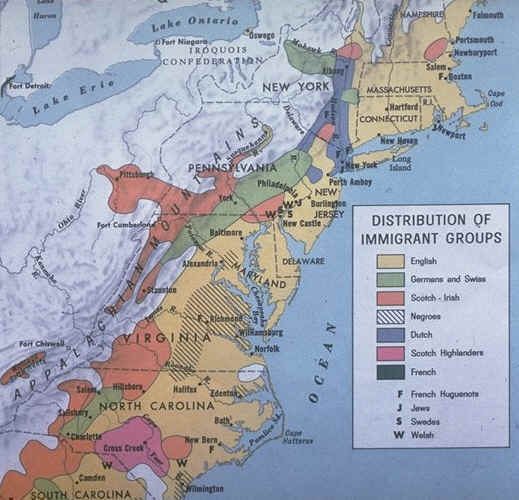
This map illustrates the distribution of European immigrant groups in the British colonies, highlighting dense German and Scots-Irish settlement in Pennsylvania and nearby Middle Colony regions. It reinforces the region’s demographic diversity, showing how varied cultural groups shaped local society. The map includes regions beyond the Middle Colonies, offering broader context for migration patterns. Source.
Several factors contributed to this migration stream:
Affordable farmland, especially in Pennsylvania’s interior valleys
Policies of tolerance, including William Penn’s Quaker principles of equality and peace
Economic opportunity in trade, farming, and craft labor
Established ethnic communities that encouraged chain migration
As more settlers arrived, they formed ethnically distinct towns or mixed settlements connected through trade and shared agricultural markets. This demographic complexity generated vibrant cultural exchange but also required new forms of cooperation and negotiation.
Patterns of Settlement
While some migrants clustered in homogeneous enclaves—such as German communities in Pennsylvania’s backcountry—others integrated into multiethnic towns. Unlike New England’s tightly organized religious villages or the South’s plantation-dominated landscapes, the Middle Colonies exhibited varied settlement patterns shaped by geography, land availability, and cultural preference.
Cultural Diversity and Religious Pluralism
A Region of Unusual Tolerance
Religious diversity became a defining feature of Middle Colony society. The region’s population included Quakers, Lutherans, Presbyterians, Dutch Reformed, Anglicans, Catholics, and Jews. Because no single religious group held overwhelming dominance, communities often developed customs of pragmatic tolerance, allowing different groups to coexist while maintaining distinct identities.
Religious pluralism: The coexistence of multiple religious groups within a society, often accompanied by policies or customs that allow diverse practices and beliefs.
This pluralism encouraged political cooperation and moderated the kind of religious uniformity found in Puritan New England. Assemblies in places like Pennsylvania reflected the influence of Quaker ideals, emphasizing peaceful relations, civic equality, and fair treatment under the law.
A sentence here ensures spacing before the next definition block.
Ethnic diversity: The presence of multiple ethnic groups within a population, each retaining cultural traditions, languages, and social practices.
Cultural Exchange and Social Mobility
Diverse populations brought a wide range of cultural traditions, agricultural techniques, and artisan skills. German settlers introduced efficient farming tools and barn designs; the Dutch brought commercial expertise; and the Scots-Irish contributed frontier settlement techniques.
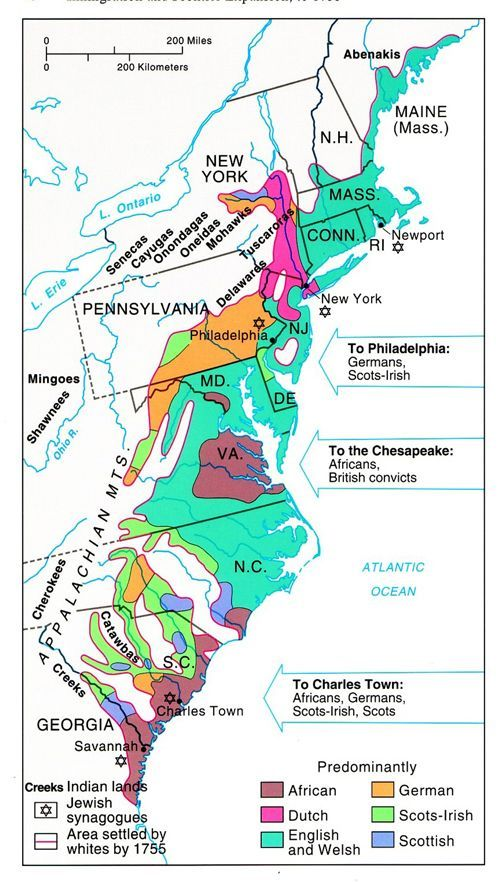
This migration map highlights the movement of Scots and Scots-Irish settlers into Pennsylvania and adjacent backcountry regions. It supports the study of cultural diversity in the Middle Colonies by showing how these groups contributed significantly to frontier communities. The map also includes movements into New England and southern colonies, offering additional context beyond the AP subtopic. Source.
These influences blended into a distinct regional culture emphasizing practicality, cooperation, and economic ambition.
The Middle Colonies also offered relatively high levels of social mobility, as land ownership was accessible to many free settlers. Opportunities in trade, crafts, and farming allowed immigrant families to improve their economic status within a generation.
Urban Growth and Regional Influence
Commercial Cities as Cultural Crossroads
Philadelphia and New York grew into major Atlantic port cities, each serving as commercial and cultural centers. Their bustling docks welcomed ships from Europe and the Caribbean, while marketplaces facilitated the exchange of goods, information, and ideas. Multiethnic neighborhoods, artisan guilds, and newspapers contributed to lively public cultures that reflected the region’s diversity.
Urban environments reinforced the Middle Colonies’ role in connecting agricultural production with imperial trade systems. Financial institutions, insurance companies, and shipping firms developed to support this commerce, laying foundations for future American economic growth.
Connections to the Atlantic World
The Middle Colonies’ grains and finished flour were vital exports in the Atlantic economy, linking them to demand in plantation colonies and European markets. These connections integrated the colonies into British mercantilist frameworks while simultaneously nurturing local economic independence and entrepreneurial spirit.
The combination of agricultural productivity, pluralistic society, and commercial dynamism made the Middle Colonies a distinctive and influential region in early British America.
FAQ
The Middle Colonies benefited from fertile loamy soils, moderate rainfall, and a temperate climate that supported multi-season planting. These conditions produced high yields compared to the rockier soils of New England or the heat-dependent cash crops of the South.
Farmers could cultivate wheat, barley, rye, and oats with relatively low labour demands, enabling more families to manage their own farms rather than rely on large-scale plantation systems.
Port cities created dependable markets for inland farmers by buying surplus grain, processing it into flour, and exporting it abroad.
This encouraged farmers to:
Align crop production with export demands
Invest in wagons, mills, and storage facilities
Participate in regional trade networks that connected rural households to global markets
These connections contributed to rising prosperity and greater social mobility in the countryside.
Quaker beliefs emphasised equality, modesty, and peaceful coexistence, which influenced local governance and community relationships, especially in Pennsylvania.
These ideals encouraged:
Fairer legal treatment across ethnic groups
Reduced social hierarchy compared to other colonies
Greater acceptance of newcomers, contributing to pluralism and intergroup cooperation
While not universally followed, these principles nonetheless set the cultural tone for much of the region.
Most groups preserved identity by establishing institutions that anchored community life.
Common strategies included:
Founding ethnic churches and schools
Publishing newspapers in native languages
Practising traditional farming methods and craftsmanship
These practices enabled groups like Germans, Dutch, and Scots-Irish to retain distinct customs even while participating in shared economic and political systems.
Land in the Middle Colonies was more accessible to ordinary settlers, allowing many newcomers to become independent farmers rather than tenants or labourers.
Additional contributors included:
A diversified rural economy with multiple avenues for work
Growing urban centres offering artisan, shipping, and merchant roles
Fewer entrenched elites than in plantation regions
Together, these factors created a society where economic advancement was achievable for a wide range of free settlers.
Practice Questions
Question 1 (1–3 marks)
Identify and briefly explain one factor that contributed to the Middle Colonies developing a culturally diverse population during the seventeenth and early eighteenth centuries.
Mark scheme:
1 mark for identifying a relevant factor (e.g., policies of religious tolerance, availability of affordable farmland, economic opportunities in trade and agriculture, existing ethnic enclaves encouraging migration).
1 additional mark for explaining how this factor encouraged migration (e.g., Quaker tolerance attracted persecuted groups, land opportunities drew German or Scots-Irish settlers).
1 further mark for developing the explanation with contextual detail (e.g., reference to William Penn’s recruitment efforts, chain migration patterns, or specific groups such as Dutch, Germans, or Scots-Irish).
Question 2 (4–6 marks)
Explain how the economic structure of the Middle Colonies shaped their social and cultural development in the period 1607–1754.
Mark scheme:
Up to 2 marks for describing key features of the economy (e.g., grain exports, mixed agriculture, presence of major port cities such as Philadelphia and New York).
Up to 2 marks for linking economic conditions to social structure (e.g., diverse occupational roles, opportunities for social mobility, family-centred settlement patterns).
Up to 2 marks for explaining how these factors encouraged cultural diversity and pluralism (e.g., demand for labour attracting migrants, coexistence of multiple ethnic and religious groups, development of tolerant political practices).
Answers reaching the top of the band should demonstrate clear, accurate explanation supported by specific evidence about the Middle Colonies’ economy and society.