AP Syllabus focus:
‘The southern Atlantic coast and British West Indies used long growing seasons for plantation economies exporting staple crops and depended on enslaved Africans, who often formed a majority and built cultural autonomy.’
Long growing seasons, expanding plantation systems, and reliance on enslaved Africans shaped the southern Atlantic coast and West Indies, creating profitable export economies and distinct, durable Afro-Caribbean cultural worlds.
Plantation Foundations in the Southern Atlantic Coast and West Indies
Plantation economies in the Carolinas, Georgia, and the British West Indies developed rapidly due to long growing seasons, fertile soil, and access to Atlantic markets. Colonists oriented their economies toward the large-scale production of staple crops, a commercial strategy that shaped demographic patterns, labor systems, and social structures.
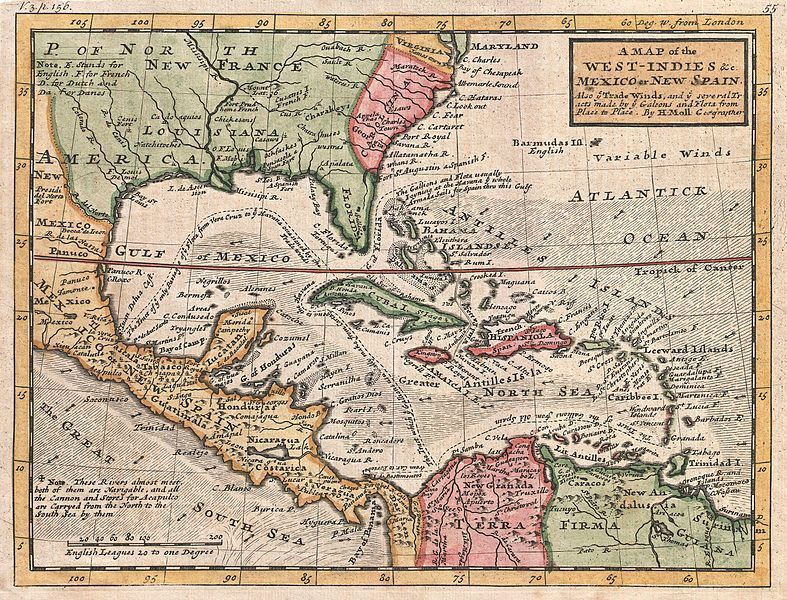
Map of the West Indies and Caribbean showing the proximity of the British West Indies to the Carolina coast, illuminating geographic foundations of plantation-linked regional development. The map includes additional colonial territories not directly covered in the syllabus but serves as an effective visual locator for the region. Source.
Environmental Advantages and Agricultural Specialization
The combination of subtropical climate and coastal geography allowed for intensive cultivation of high-demand commodities.
Rice and indigo became dominant in the Carolinas and Georgia.
Sugar became the centerpiece of West Indian agriculture, especially on Barbados and Jamaica.
Plantations required large tracts of land and continuous labor cycles, reinforcing the shift toward enslaved African labor.
The emphasis on export production created societies oriented toward Atlantic commerce rather than diversified local markets.
Staple Crop Export Economies
The plantation regions of the southern Atlantic coast and West Indies developed highly profitable, globally connected export systems. Merchants, planters, and imperial administrators viewed these colonies as indispensable contributors to British wealth.
Crop Economics and Imperial Priorities
Staple crops—agricultural commodities produced primarily for sale abroad—dominated the regional economy.
Staple crops: High-demand agricultural products grown for export rather than local consumption, such as sugar, rice, tobacco, and indigo.
Planters invested heavily in land, labor, and processing infrastructure to sustain year-round production cycles that maximized yields.
Key features included:
Highly specialized monoculture systems
Capital-intensive preparation of fields, mills, and irrigation
Integration into Atlantic trade networks connecting the colonies to Africa, Britain, and Europe
Sugar, the most lucrative crop in the British Empire, required continuous grinding, boiling, and refining. Even modest plantations operated as industrial complexes, reflecting both economic opportunity and labor coercion.
A normal sentence separates these sections to maintain required formatting.
Growth and Centrality of Enslaved African Labor
The plantation regions depended on enslaved Africans, who provided the agricultural labor necessary for large-scale production. Over time, the enslaved population expanded dramatically, particularly in the West Indies, where enslaved Africans often outnumbered Europeans by wide margins.
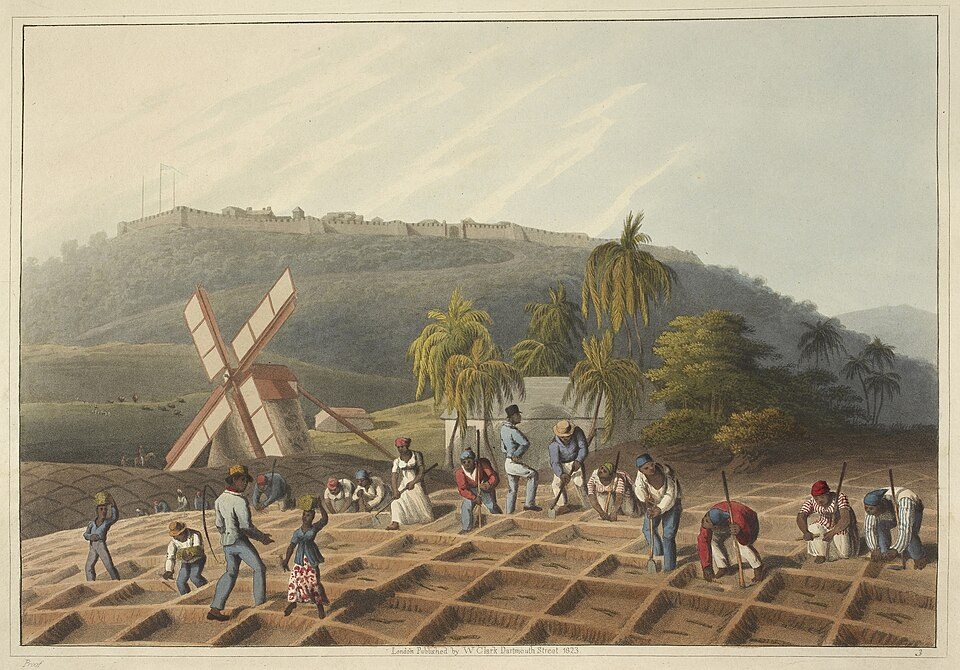
Illustration of enslaved Africans planting sugarcane on an Antigua plantation, showing labor organization and industrial processing central to West Indian sugar estates. Though painted slightly after the AP timeframe, it accurately represents plantation labor systems formed during the 1600s–1700s. Source.
Reasons for Reliance on Enslaved Labor
Several forces drove the rapid adoption of slavery:
High labor demands of rice and sugar cultivation
Low availability of European indentured labor willing to migrate to disease-prone regions
British participation in and profit from the Atlantic slave trade
Long-term cost efficiency for planters investing in enslaved laborers and their descendants
Plantation environments, especially in sugar-producing colonies, were harsh and deadly. Mortality rates remained high, making the constant importation of enslaved Africans essential to maintaining the labor force.
Demographic Patterns and the Emergence of Black Majorities
By the late 17th and early 18th centuries, many plantation colonies contained enslaved majorities, especially Barbados, Jamaica, and South Carolina’s Lowcountry. The scale of African presence reshaped the cultural, linguistic, and social dynamics of the region.
Social Structures in Majority-Enslaved Regions
The presence of Black majorities encouraged the development of:
Distinctive Afro-Caribbean and African American cultural practices, including creole languages, spiritual traditions, and familial networks
Systems of community cohesion maintained despite harsh conditions
New cultural expressions blending African and Christian elements
The demographic imbalance also intensified planter fears of rebellion, leading to increasingly rigid racial hierarchies and slave codes.
A normal sentence is added here before any further definition or equation blocks, ensuring the structure remains compliant.
Cultural Autonomy and Resistance within Plantation Societies
Despite the coercive nature of plantation life, enslaved Africans forged forms of cultural autonomy—maintaining practices that provided identity, resilience, and continuity.
Cultural Persistence and Adaptation
Enslaved communities developed and preserved cultural elements such as:
Gullah/Geechee language forms in the Carolina Lowcountry
African-rooted musical and oral traditions
Distinctive foodways blending African and American ingredients
Rituals and kinship practices that strengthened community bonds
These cultural forms represented both adaptation to new conditions and resistance to the cultural erasure imposed by slavery.
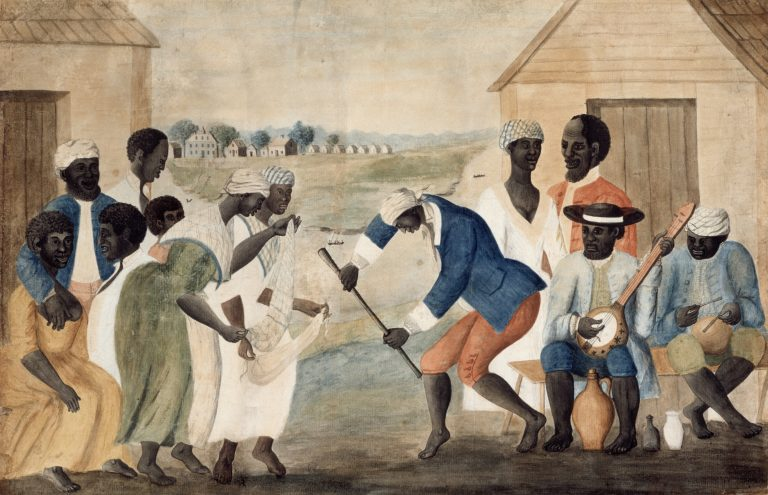
Late eighteenth-century watercolor depicting enslaved people engaged in music and dance on a South Carolina plantation, illustrating cultural autonomy and community life. The image includes additional details of clothing and instruments that extend beyond the AP syllabus but enrich understanding of Afro-Atlantic cultural expression. Source.
Resistance and Survival Strategies
Resistance took many forms, integrating both everyday actions and coordinated efforts:
Covert resistance, including work slowdowns, sabotage, and maintenance of spiritual practices
Overt resistance, such as revolts and escape attempts
Communal support systems that protected vulnerable members of enslaved communities
Collectively, these strategies enabled enslaved Africans to preserve identity and agency even within highly oppressive plantation regimes.
Plantation Governance and Colonial Society
Plantation economies shaped hierarchical social orders dominated by wealthy planters who controlled political and economic life.
Power Structures
The planter elite:
Monopolized land ownership
Dominated colonial assemblies
Influenced imperial policies favoring plantation profitability
This political dominance reinforced the centrality of plantation agriculture and slavery within the southern Atlantic coast and West Indies, anchoring the region’s long-term development around exploitation, export production, and racialized labor systems.
FAQ
Plantations were designed to maximise production efficiency and control over labour. In the West Indies, sugar estates often placed the mill and boiling house centrally so cane could be processed quickly after cutting.
Living quarters for enslaved labourers were usually positioned at the edges of the estate, creating physical and social separation from the planter’s house.
In the Carolinas, rice fields were arranged along tidal rivers to exploit controlled flooding, shaping daily work routines around water management.
Sugar cultivation involved high accident rates due to the machinery used in grinding mills and boiling houses. Workers risked crushing injuries and severe burns during processing.
The grueling pace of harvest and the heat generated in boiling houses also created extreme working conditions.
Harsh discipline and long working hours further increased mortality compared to mainland plantations.
Many enslaved Africans brought expertise in rice cultivation, soil management, and irrigation from African regions with similar ecologies.
In the Carolinas, Africans helped refine tidal rice systems, contributing techniques such as bund construction and water-controlled field divisions.
Their knowledge improved the efficiency and sustainability of plantation agriculture, though this expertise was exploited without compensation.
Planters were often among the wealthiest subjects in the British Empire and used their influence to lobby for policies that protected plantation profits.
They advocated for favourable shipping regulations, military protection from rivals and maroon communities, and restrictions that tightened racial control.
Their economic power gave them disproportionate influence over colonial assemblies and imperial decision-making.
Enslaved people created flexible, resilient kinship systems that extended beyond nuclear families.
They developed “fictive kin” ties, adopting unrelated individuals into family roles to replace members lost to sale, disease, or punishment.
Communal childrearing, shared rituals, and naming traditions helped preserve continuity and cultural identity despite constant disruption.
Practice Questions
Question 1 (1–3 marks)
Identify and briefly explain one reason why plantation economies in the British West Indies and the southern Atlantic coast relied heavily on enslaved African labour during the seventeenth and eighteenth centuries.
Mark scheme:
1 mark for identifying a valid reason (e.g., high labour demands of sugar and rice cultivation; shortage of willing European labour; profitability of enslaved labour; mortality rates requiring constant labour supply).
Up to 2 further marks for a clear explanation of how or why this reason encouraged reliance on enslaved Africans (e.g., sugar cultivation required continuous processing; European indentured servants avoided disease-prone regions; enslaved Africans were considered long-term investments; labour-intensive export economies depended on large workforces).
Question 2 (4–6 marks)
Explain how the demographic patterns of plantation societies in the British West Indies and the southern Atlantic coast shaped the development of African cultural autonomy between 1607 and 1754.
Mark scheme:
1 mark for identifying that enslaved Africans often formed a majority in many plantation regions.
1 mark for describing how majority-enslaved populations enabled the preservation or creation of African-derived cultural practices.
Up to 2 marks for specific examples of cultural autonomy (e.g., development of creole languages such as Gullah, maintenance of African musical and spiritual traditions, communal networks, distinctive foodways).
Up to 2 marks for explaining the connection between demographic conditions and cultural survival (e.g., high numbers of Africans reinforced shared practices; plantation isolation allowed communities to sustain traditions; communal resistance to cultural erasure).