AP Syllabus focus:
‘Pluralism and intellectual exchange were reinforced by the first Great Awakening, which spread evangelical Protestantism and reshaped religious life across many colonies.’
The First Great Awakening marked a profound shift in colonial religious culture, energizing Protestant practice, challenging established authority, and fostering new ideas that reshaped community life, identity, and belief.
Origins and Nature of the First Great Awakening
The First Great Awakening emerged in the 1730s–1740s as ministers across the British colonies preached revitalizing messages emphasizing emotional faith, moral renewal, and personal religious experience. This movement is associated with evangelical Protestantism, a form of Protestant belief that stressed individual conversion, heartfelt devotion, and the conviction that all believers could experience a direct relationship with God.
Evangelical Protestantism: A revival-oriented form of Protestant Christianity emphasizing personal conversion, emotional expression of faith, and the authority of Scripture for individual believers.
These developments unfolded amidst population growth, expanding print culture, and a growing sense that traditional churches no longer met the spiritual needs of many colonists. The movement resonated across regions, though its character varied from New England’s Congregational parishes to the southern backcountry.
Key Figures and Spread of Revivalism
Several influential ministers popularized revival preaching, using dramatic sermons and itinerant travel to reach diverse audiences.
Prominent Leaders
Jonathan Edwards, a New England theologian, delivered powerful sermons such as “Sinners in the Hands of an Angry God,” urging listeners to seek immediate spiritual renewal.
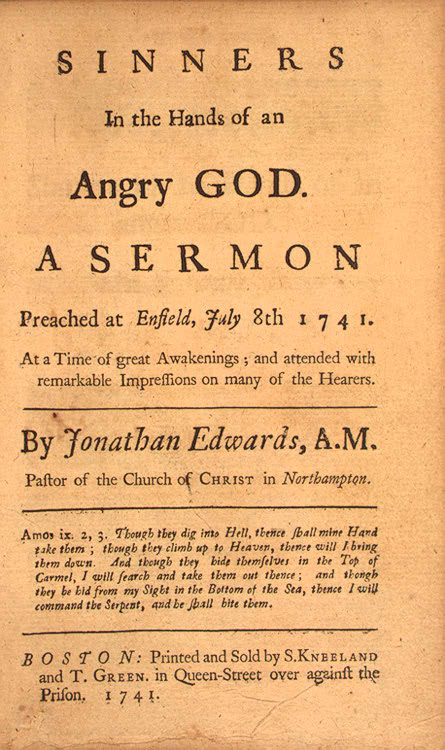
Title page of Jonathan Edwards’s 1741 sermon, illustrating how revival preaching spread widely through colonial print culture. The detailed publication elements go beyond syllabus scope but help demonstrate how evangelical ideas circulated across regions. Source.
George Whitefield, an English evangelical preacher, toured widely in the colonies. His emotional sermons attracted thousands and helped unify revival sentiment across colonial boundaries.
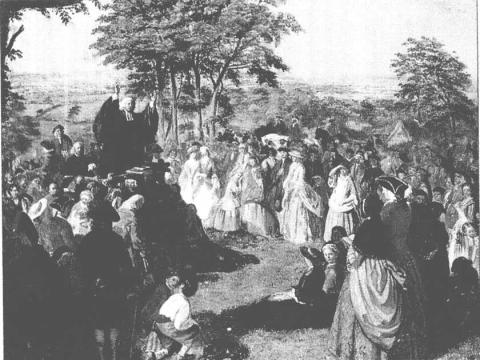
Eighteenth-century woodcut showing George Whitefield preaching outdoors to large crowds, demonstrating the open-air revival meetings characteristic of the First Great Awakening. Some artistic crowd details extend beyond syllabus needs but help visualize the diverse audiences drawn to evangelical preaching. Source.
Factors Promoting Rapid Expansion
Growing networks of transatlantic print culture, which circulated sermons, conversion narratives, and theological debates.
Increased mobility of preachers who traveled outside traditional parish boundaries.
Popular fascination with dramatic conversions and the experiential nature of revivalism.
The spread of revivalism reinforced colonial pluralism by exposing diverse communities to shared religious messages even as it encouraged local experimentation in worship.
Cultural Change and Religious Innovation
The First Great Awakening reshaped religious life by modifying authority structures, stimulating competition among denominations, and promoting new forms of lay participation.
Challenges to Established Churches
Revival preaching questioned the spiritual complacency of established ministers, generating tension within traditional congregational systems.
“New Lights,” who embraced revivalism, often formed separate congregations.
“Old Lights,” who rejected revivalism, criticized emotional preaching and defended traditional authority.
This fragmentation fostered greater religious pluralism, creating space for new denominations such as Baptists and Methodists to expand.
Growth of Lay Participation
The First Great Awakening emphasized that salvation was available to all, regardless of education or social status. As a result:
Laypeople gained new roles as exhorters, organizers, and witnesses to conversion.
Women and marginal groups participated more actively in religious meetings, contributing testimonies and shaping community practice.
Religious authority became more diffuse as personal experience competed with institutional hierarchy.
Social and Regional Impacts
The effects of the movement varied significantly across the colonies, contributing to distinct patterns of cultural change.
New England
Revivalism intensified debates over church membership and moral discipline.
Divisions between New Lights and Old Lights reshaped town life, education, and local governance.
The emphasis on spiritual equality subtly pushed against longstanding deference to social elites.
Middle Colonies
Already religiously diverse, the region saw increased competition among denominations.
Revivalism supported interdenominational cooperation through shared evangelical identity, reinforcing pluralism.
Ideas circulated rapidly due to dense print networks and active urban centers.
Southern Colonies and Backcountry
Baptists and Methodists gained influence among poorer settlers and enslaved Africans.
Revival preaching challenged hierarchical planter dominance by promoting messages of spiritual equality.
Although revival messages sometimes encouraged enslaved people to form religious communities, colonial authorities sought to restrict gatherings they feared might undermine social control.
Intellectual and Political Consequences
The movement encouraged patterns of thought that later shaped colonial resistance and emerging American identity.
Expansion of Intellectual Exchange
Debate over revivalism—published sermons, letters, and pamphlets—connected colonists to broader Atlantic discussions about faith, authority, and individual conscience.
Increasing literacy and print circulation allowed ordinary people to engage with theological and cultural ideas previously reserved for elites.
Ideological Shifts
Revivalism contributed to a broader colonial culture that valued:
Individual judgment, as believers evaluated ministers and doctrines for themselves.
Challenging traditional authority, both religious and, eventually, political.
Community formation around shared ideals, encouraging networks that transcended colony and denomination.
These changes reinforced the specification’s emphasis on how pluralism and intellectual exchange strengthened through the First Great Awakening, reshaping religious life and contributing to the evolving cultural foundations of British North America.
FAQ
The movement encouraged more informal, participatory worship, reducing reliance on structured liturgy. Congregants often met in homes, fields, or temporary gathering spaces rather than traditional church buildings.
It also popularised practices such as public testimonies, spontaneous prayer, and singing, which made religious expression more personal and emotionally driven.
Many elites feared that revivalism undermined social hierarchy by empowering poorer colonists, women, and marginal groups to speak publicly about faith.
They also objected to the challenge revivalists posed to educated clergy, worrying that lay exhorters weakened institutional authority and encouraged social disorder.
Transatlantic ties facilitated the exchange of ideas about theology, philosophy, and religious reform movements, allowing colonists to situate their revivals within broader Protestant currents.
Visitors such as George Whitefield, as well as correspondence between ministers in Britain and America, helped synchronise revival trends across the Atlantic world.
The revival spurred the creation or strengthening of institutions aimed at training evangelical ministers, including colleges founded or reshaped to support revivalist theology.
Some communities also emphasised literacy so individuals could read the Bible and evangelical tracts for themselves, reinforcing the movement’s focus on personal engagement with Scripture.
Revivalism promoted the idea that individuals could challenge established religious leaders, contributing to a broader cultural shift that valued questioning authority.
This language of spiritual equality and personal judgement subtly influenced later political discussions about liberties, civic participation, and resistance to hierarchical control.
Practice Questions
(1–3 marks)
Identify one way in which the First Great Awakening contributed to increased religious pluralism in the British colonies.
Question 1 (1–3 marks)
1 mark: Basic identification of a relevant effect (e.g., creation of new denominations).
2 marks: Clear explanation of how the First Great Awakening created or expanded religious diversity.
3 marks: Specific and accurate detail showing understanding of the mechanism (e.g., conflict between New Lights and Old Lights leading to splits, growth of Baptists and Methodists, or revivalism encouraging competition among sects).
(4–6 marks)
Explain how the First Great Awakening reshaped religious authority in the British colonies. In your answer, refer to specific features of revivalism and their wider cultural impacts.
Question 2 (4–6 marks)
4 marks: Provides a clear explanation of how revivalism challenged traditional religious authority.
5 marks: Uses specific evidence, such as itinerant preachers, George Whitefield, or Jonathan Edwards, and discusses their role in undermining established clergy or structures.
6 marks: Demonstrates detailed understanding of broader cultural consequences, such as the spread of printed sermons, increased emphasis on individual judgement, or decline of hierarchical church control, and connects these directly to shifts in authority.
Answers may refer to:
Itinerant preachers bypassing established parish systems.
Emotional preaching shifting authority toward personal religious experience.
New Lights challenging the legitimacy of traditional clergy.
Expansion of print culture enabling ordinary colonists to evaluate doctrine independently.