AP Syllabus focus:
‘Over time, the British colonies became more Anglicized, building autonomous political communities on English models shaped by commercial ties and Protestant evangelical influences.’
Anglicization transformed British American colonies as shared culture, commerce, and political practices tied them to England, even as autonomous institutions and resistance-oriented identities increasingly took root.
Foundations of Anglicization in British North America
Anglicization refers to the process by which colonial societies adopted English cultural, political, religious, and economic practices to strengthen ties with the mother country.
Anglicization: The process through which British colonists increasingly emulated English cultural norms, political institutions, and social structures.
Throughout the seventeenth and early eighteenth centuries, economic networks, imperial policies, and shared religious traditions created a coherent British Atlantic world.
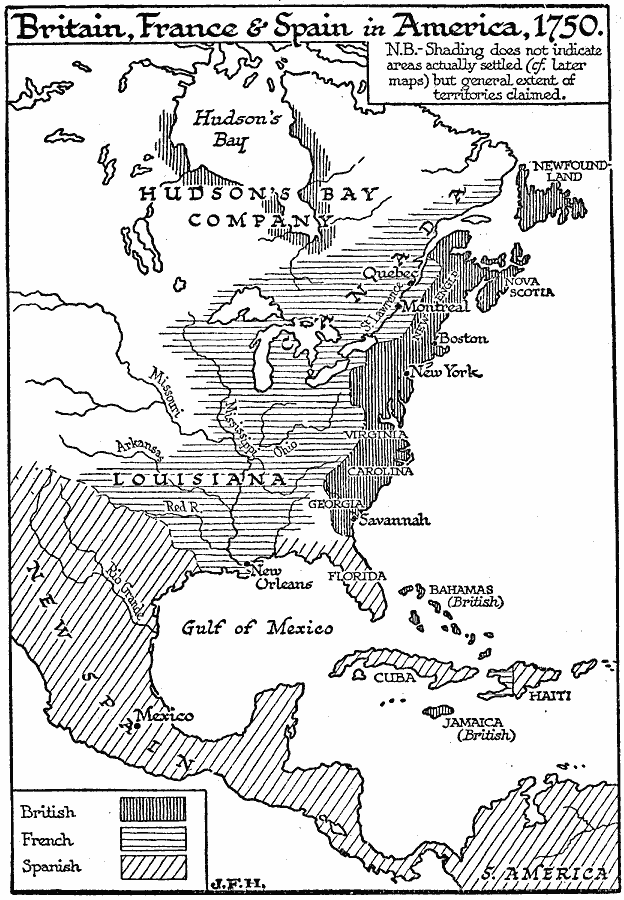
Map of North America in 1750 showing British, French, and Spanish territorial claims. The British colonies along the Atlantic coast appear as part of a larger imperial patchwork, illustrating how colonists were embedded in a wider British Atlantic system. The map also includes Caribbean and Central American territories, which extend beyond the specific focus of the syllabus but help students see the broader imperial context. Source.
Key Drivers of Anglicization
Multiple developments encouraged colonists to model their institutions and behaviors after England.
Commercial integration through transatlantic trade networks carrying manufactured goods, foodstuffs, and raw materials.
Legal and political inheritance from English constitutionalism, common law, and traditions of representative assemblies.
Religious connections, especially the influence of the Protestant evangelical tradition across the empire.
Print culture, fostering shared debates, information exchange, and imperial identity.
The combination of these influences encouraged colonists to replicate English social norms such as hierarchical class structures, property-based political participation, and patriarchal family arrangements.
Economic Ties and Commercial Anglicization
Expanding Atlantic commerce played a central role in orienting colonial life toward Britain.
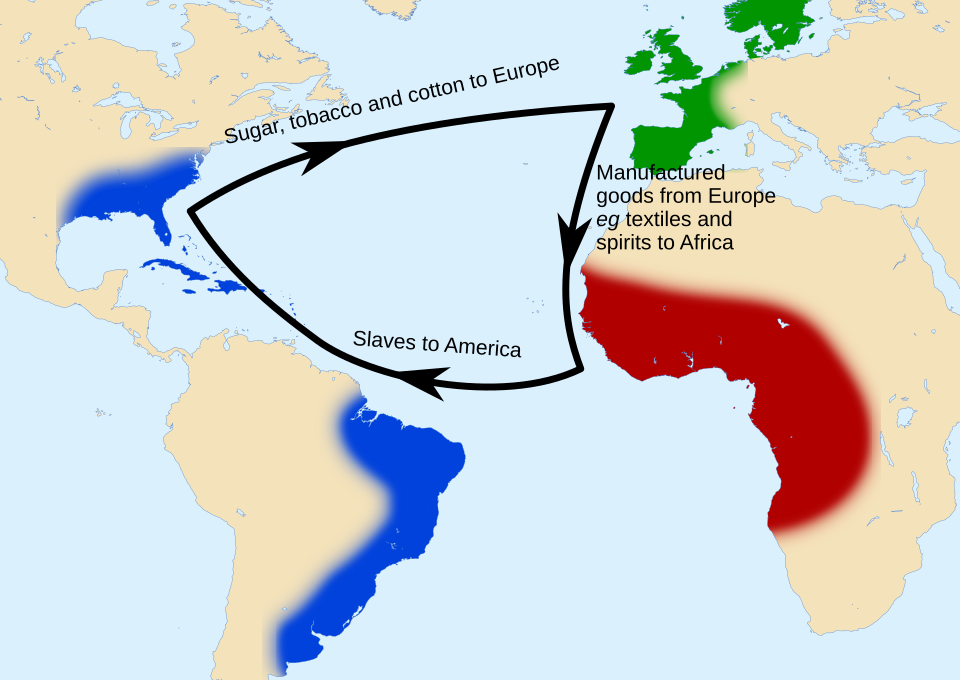
Diagram of the triangular Atlantic trade linking Europe, Africa, and the Americas. Arrows indicate the movement of manufactured goods from Europe, enslaved Africans across the Middle Passage, and colonial raw materials back to Europe. The diagram includes commodities such as sugar and rum, which exceed the exact wording of the syllabus but accurately illustrate the economic system supporting Anglicization. Source.
British merchants exported tools, textiles, and luxury items that reshaped consumer culture in the colonies. Colonial elites purchased tea, porcelain, fine clothing, and books, expressing status through goods associated with English refinement.
The adoption of these commodities helped standardize tastes and linked colonists to British economic patterns. Many communities also shifted their agricultural and commercial production to meet imperial market demands, reinforcing dependence on English trading partners.
Processes Shaping Economic Anglicization
Growing availability of British manufactured goods.
Participation in triangular trade routes.
Consumer behavior that emulated English fashions and material culture.
Merchant networks connecting colonial ports closely to London and Bristol.
These economic bonds strengthened loyalty to Britain but also heightened expectations of the imperial government’s protection and fair regulation.
Political Anglicization and the Rise of Autonomous Institutions
Even as colonists adopted English political traditions, the realities of distance and local conditions pushed them to build autonomous political communities. English models inspired the structure of colonial assemblies, but everyday governance increasingly reflected local needs rather than strict imperial oversight.
English Political Traditions in the Colonies
Commitment to representative government, modeled on Parliament.
Reliance on common law as a foundation for legal systems.
Emphasis on the rights of Englishmen, especially protections of property and limits on arbitrary authority.
Colonial assemblies grew more assertive during the eighteenth century, controlling taxation and legislation.
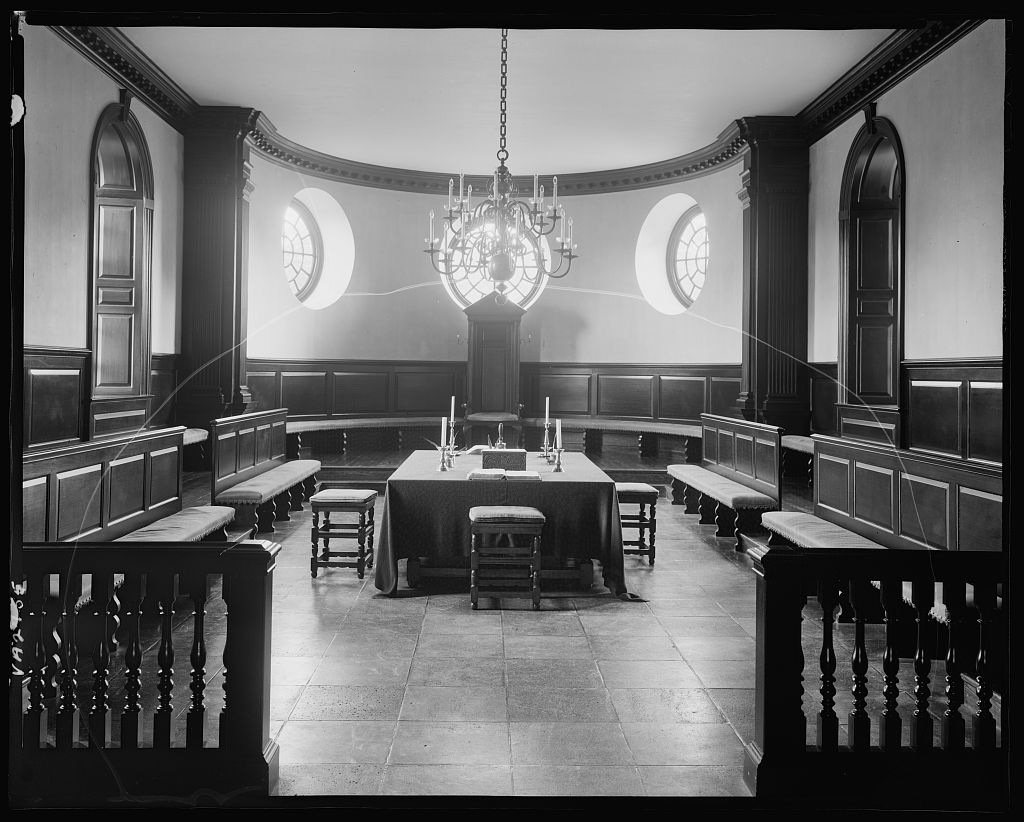
Interior view of the House of Burgesses chamber in the Capitol at Williamsburg, Virginia. The ordered architectural layout echoes English legislative spaces, helping students visualize the political environment in which colonial representatives met. Decorative elements such as chandeliers exceed syllabus requirements but aid understanding of the elite setting of colonial self-government. Source.
Elite planters, merchants, and landowners dominated these bodies, but the existence of elected representatives reflected a shared English political heritage.
Emergence of Colonial Autonomy
The English government’s policy of salutary neglect, in which enforcement of imperial regulations remained inconsistent, encouraged innovation in local governance. Over time, assemblies:
Negotiated with royal governors, often restricting their power.
Formed committees and procedures that paralleled Parliament.
Asserted authority over militia, land policy, and taxation.
This autonomy laid institutional foundations for later resistance to imperial control.
Religious Anglicization and Evangelical Influences
Religion reinforced cultural bonds with Britain. The Church of England held official status in several colonies, while Protestant evangelical currents circulated widely through transatlantic networks of ministers and printed sermons.
Evangelical Protestantism: A movement within Protestant Christianity emphasizing personal conversion, Bible-centered faith, and active preaching.
As evangelical preachers traveled between Britain and the colonies, they promoted shared worship practices and theological ideas. This circulation created a sense of belonging to a broader Protestant Atlantic world.
However, the diversity of colonial denominations also contributed to autonomous religious communities that operated independently of formal English church authority.
Cultural Expressions of Anglicization
Shared literary, philosophical, and artistic influences further integrated colonial culture with Britain. Colonists read English newspapers, political treatises, and novels, absorbing Enlightenment thought alongside English literary style. Architects and builders adopted Georgian designs, creating public buildings and private homes modeled on English aesthetics.
Elements of Cultural Anglicization
Adoption of English print materials and widespread literacy.
Patronage of English-style art, architecture, and education.
Growth of voluntary societies modeled on British organizations, including libraries, scientific clubs, and charitable associations.
These cultural connections encouraged colonists to see themselves as part of a unified British civilization.
Tensions Within an Anglicizing Society
While Anglicization strengthened imperial ties, it also fostered expectations of political participation and rights that sometimes conflicted with British policies. As colonial elites gained confidence through economic prosperity and self-government, they increasingly resisted imperial interference, claiming the liberties of English subjects.
This paradox—greater similarity to England fostering stronger demands for autonomy—shaped the evolving identity of British America and laid groundwork for later political conflict.
FAQ
Colonial elites often embraced English fashions, literature, and architectural styles as markers of refinement. Importing luxury goods signalled both wealth and cultural alignment with Britain.
They also joined or founded clubs and societies modelled on British organisations, using these networks to strengthen their authority and distinguish themselves from lower-status groups.
Not entirely. Coastal towns, especially major ports, experienced stronger Anglicising influences through trade, printed materials, and direct contact with British merchants.
Frontier communities absorbed English practices more slowly and often combined them with local traditions, leading to a more blended cultural environment.
Many colonists adopted English curricula that emphasised classical learning, moral philosophy, and Protestant theology.
Colonial colleges such as Harvard and William and Mary modelled their instructional methods on English institutions, reinforcing shared intellectual foundations.
English common law principles guided courts in matters such as inheritance, property boundaries, and contract enforcement.
Local magistrates used English precedents to resolve conflicts, giving even routine disputes a legal framework that mirrored English judicial practice.
Yes. Some ethnic and religious minorities, such as German Pietists or Scots-Irish Presbyterians, maintained distinct cultural traditions.
Others resisted Anglicisation due to economic marginalisation or mistrust of elite colonial leaders who closely aligned themselves with British norms.
Practice Questions
Question 1 (1–3 marks)
Identify and briefly explain one way in which Anglicisation influenced political development in the British North American colonies during the seventeenth and eighteenth centuries.
1 mark for correctly identifying a feature of political Anglicisation (e.g., representative assemblies, common law traditions, rights of Englishmen).
1 mark for explaining how this feature reflected English political models.
1 mark for explaining how this feature affected colonial political life (e.g., growth of autonomy, assertive assemblies).
Question 2 (4–6 marks)
Explain how economic and cultural connections to Britain contributed to the Anglicisation of colonial society while simultaneously encouraging the development of autonomous colonial communities.
1–2 marks for describing economic connections (e.g., transatlantic trade networks, consumer goods, commercial dependence on Britain).
1–2 marks for describing cultural connections (e.g., print culture, religious ties, adoption of English fashions or architecture).
1–2 marks for explaining how these links fostered colonial autonomy (e.g., expectations of rights, rise of local assemblies, confidence of colonial elites).