AP Syllabus focus:
‘British colonies developed regional differences that reflected environmental, economic, cultural, and demographic factors, producing distinct economies and social systems across North America and the West Indies.’
Colonial regions in British North America evolved along sharply different economic, labor, and social lines, shaped by climate, geography, population patterns, and imperial priorities across the seventeenth and early eighteenth centuries.
Regional Variation in Environment and Settlement Patterns
Distinct environmental conditions—from the cold, rocky soils of New England to the fertile mid-Atlantic valleys and the long growing seasons of the southern and West Indian plantation zones—generated divergent colonial models. Climate, access to waterways, and land fertility all influenced which crops could thrive and how labor systems developed. These natural factors ultimately shaped the everyday lives of colonists and the structures of their emerging societies.
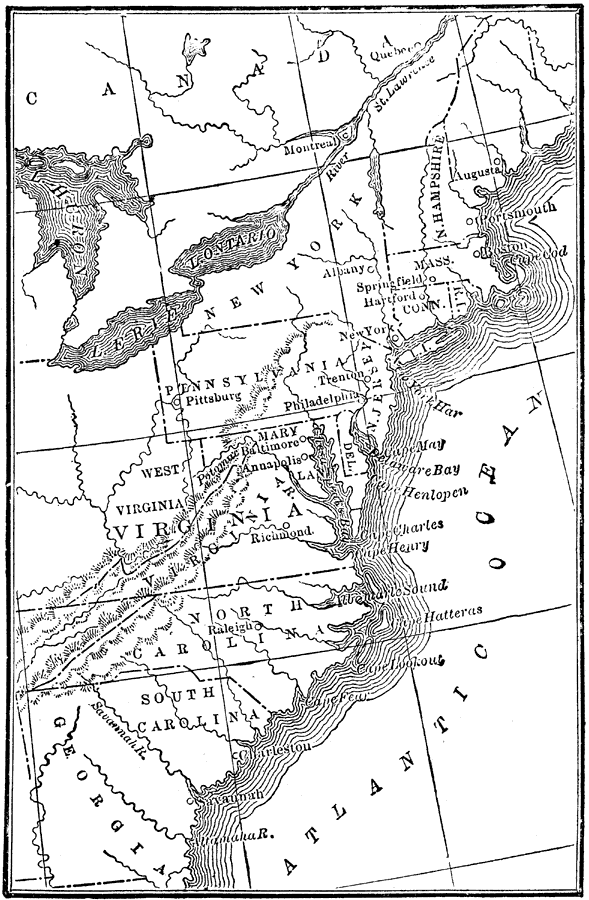
Map of the thirteen British colonies showing major towns, rivers, and coastal geography. This visual helps illustrate regional environmental differences that shaped New England, Middle, and Southern colonial development. The map includes additional geographic detail beyond the syllabus focus, but it effectively situates each region within the broader Atlantic landscape. Source.
Demographic Composition and Migration
Migration patterns reinforced regional difference. New England settlement was dominated by family migration tied to religious motives, while the Chesapeake and lower South saw large flows of single young men driven by the promise of land and agricultural profit. The Middle Colonies attracted diverse European migrants—Germans, Dutch, Scots-Irish—who contributed to pluralistic cultures.
Pluralism: The coexistence of diverse ethnic, religious, and cultural groups within a single society, often accompanied by varying degrees of tolerance.
These contrasting demographic foundations shaped social hierarchies, governance structures, and community cohesion.
Economic Systems Across the Colonies
Economic specialization was the clearest marker of regional identity. Colonists adapted to local conditions, creating export economies that integrated them into the wider Atlantic world.
New England: Mixed Economy and Maritime Trade
New England developed a mixed economy combining subsistence farming, small-scale livestock raising, and vibrant maritime industries.
Key features included:
Limited agricultural output due to climate and soil constraints.
Growth of shipbuilding, fishing, and coastal trade.
Tight-knit towns organized around congregational churches and local commons.
These conditions produced relatively egalitarian property distribution and stable family-centered communities.
Middle Colonies: Grain Production and Cultural Diversity
The Middle Colonies—New York, New Jersey, Pennsylvania, and Delaware—became known as the “bread colonies” for their high-yield cultivation of cereal crops such as wheat and barley.
Additional characteristics included:
Fertile river valleys supporting commercial agriculture.
Large port cities (Philadelphia, New York) facilitating export trade.
Cultural heterogeneity spurred by varied European immigration.
Traditional hierarchies were less rigid than in the South, while religious diversity fostered tolerance and experimentation in governance.
Chesapeake and North Carolina: Tobacco Plantations
Chesapeake settlers relied on tobacco, a labor-intensive cash crop that shaped nearly every aspect of life.
Important components of this tobacco-based system included:
Heavy initial reliance on indentured servants, who worked fixed terms in exchange for passage.
Intensifying transition to enslaved African labor by the late 1600s as tobacco profits demanded a permanent, controllable workforce.
Wide disparities in land ownership creating a pronounced planter elite.
The labor system generated social instability early on, but plantation culture ultimately dominated the region.
Southern Atlantic Coast and West Indies: Plantation Economies and Enslaved Labor
Regions such as South Carolina, Georgia, and the British West Indies developed plantation economies centered on rice, indigo, and especially sugar in the Caribbean.
Core characteristics included:
Long growing seasons enabling large-scale monoculture.
Enslaved Africans forming a majority of the population in many areas.
Development of distinct African diasporic cultures, facilitated by large, relatively autonomous enslaved communities.
High profits for planters coexisted with extreme racial stratification and brutal labor regimes.
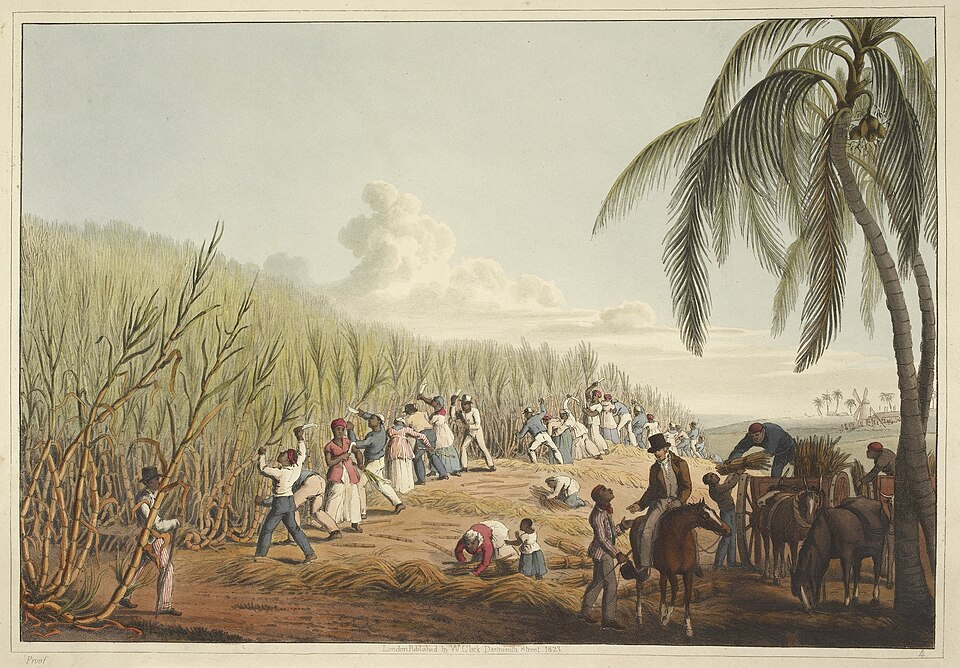
Nineteenth-century illustration of enslaved Africans harvesting sugar cane on a British West Indian plantation, showing field labor, processing structures, and overseer presence. This image reflects the labor-intensive plantation system and demographic realities in the southern Atlantic and Caribbean colonies. The artistic style includes additional detail not required by the syllabus but accurately conveys dependence on enslaved labor. Source.
Labor Systems and the Construction of Regional Societies
Labor shaped society as profoundly as economic specialization. Varied systems of work—family labor in New England, tenant farming in the Middle Colonies, and plantation slavery in the South—structured social hierarchies and political power.
Indentured Servitude and Its Decline
In the seventeenth century, indentured servitude served as the primary workforce for tobacco cultivation. As mortality rates declined and economic prospects shifted, colonists increasingly turned to chattel slavery, which provided lifetime hereditary labor and reinforced emerging racial hierarchies.
A transition away from servitude reshaped Chesapeake society, pushing poorer whites westward and consolidating planter dominance.
Enslaved Labor and Regional Divergence
Enslavement existed in all British colonies, but its scale varied dramatically.
New England and Middle Colony ports held smaller enslaved populations tied to domestic work and artisan trades.
The Chesapeake and Deep South embedded slavery into every aspect of economic life.
The West Indies became the largest hub of enslaved labor in the British Empire.
These differences profoundly affected regional politics, social relations, and cultural development.
Social Structures and Community Life
Each region’s economy and labor system produced its own social patterns. New England’s emphasis on towns fostered participatory local governance such as town meetings. In contrast, plantation regions developed hierarchical societies dominated by elite planters who controlled land, wealth, and legislative assemblies.
Cultural and Religious Distinctions
Religious orientations also varied: Puritan influence shaped New England institutions; Quaker values encouraged tolerance in Pennsylvania; Anglicanism prevailed in the southern colonies. These differing cultural foundations reinforced regional identities.
Collectively, the environmental, economic, cultural, and demographic factors produced three distinct British colonial regions—New England, Middle, and Southern/West Indian—each with its own economy, labor systems, and social dynamics that would influence the later trajectory of American development.
FAQ
New England had relatively dense town-based settlements, while the South and West Indies featured dispersed plantations separated by large tracts of land.
This mattered because:
Higher density supported schools, churches, and local governance.
Dispersed plantations made collective institutions weaker and increased planter dominance.
Urban centres in the Middle Colonies fostered commerce, diversity, and print culture.
The Middle Colonies’ mixed agricultural and commercial economy created multiple pathways to prosperity, preventing wealth from concentrating in the hands of a single planter elite.
Additionally:
Ethnic diversity reduced the dominance of any one group.
Religious pluralism encouraged tolerance and hindered rigid social stratification.
Different regions specialised in distinct exports—grain, fish, timber, tobacco, rice, or sugar—which tied each area into specific Atlantic markets.
As a result:
New England linked strongly to maritime commerce with the Caribbean and Europe.
The Middle Colonies participated in both agricultural and shipping networks.
Southern and West Indian colonies relied heavily on slave-based staple crop exports.
Large tracts of fertile land in the Chesapeake and Lower South attracted single male migrants seeking profit through plantation farming.
In contrast:
New England’s limited arable land encouraged compact settlements and communal development.
The Middle Colonies’ generous farmland and river valleys drew families and diverse European groups.
In the West Indies and Lower South, warm climates and large enslaved majorities allowed the formation of more autonomous African-derived cultural practices.
By contrast:
Smaller enslaved populations in New England and the Middle Colonies meant more assimilation into Euro-American households.
Plantation demography and labour intensity determined opportunities for community building, religious expression, and linguistic continuity.
Practice Questions
Question 1 (1–3 marks)
Identify one significant economic difference between the New England colonies and the Southern Atlantic/West Indian colonies, and briefly explain how this difference shaped regional development.
Mark scheme:
1 mark for identifying a valid economic difference (e.g., mixed economy versus plantation monoculture).
1 mark for linking this difference to labour systems (e.g., limited slavery in New England versus enslaved majorities in plantation regions).
1 mark for explaining a consequence for regional development (e.g., egalitarian town-based society versus hierarchical planter elite).
Question 2 (4–6 marks)
Explain how environmental and demographic factors contributed to the emergence of distinct social structures across the New England, Middle, and Southern British colonies before 1754.
Mark scheme:
1 mark for describing relevant environmental differences (e.g., climate, soil quality, growing seasons).
1 mark for describing relevant demographic patterns (e.g., family migration in New England, diverse immigration in the Middle Colonies, enslaved majorities in the West Indies/South).
1 mark for explaining how environment shaped economic specialisation.
1 mark for linking economic systems to labour patterns (e.g., family labour, tenant farming, plantation slavery).
1 mark for explaining a resulting social structure in at least one region (e.g., town meetings, planter dominance, ethnic pluralism).
1 mark for an additional accurate link between factors and social outcomes across regions (e.g., comparing the relative rigidity or flexibility of hierarchies).