AP Syllabus focus:
‘Compare colonial societies across regions by making a defensible argument and supporting it with specific, relevant evidence that clearly explains the comparison.’
Comparative historical arguments in AP U.S. History require students to evaluate similarities and differences across regions, using specific evidence to support a defensible thesis that explains meaningful relationships rather than listing facts.
Building a Defensible Comparative Argument
A strong comparative argument begins with a clear claim that compares two or more colonial regions directly. A defensible claim is one that can be supported with historical evidence and logically addresses the prompt’s comparative task.
Characteristics of a Defensible Thesis
A thesis must not merely restate the prompt but instead articulate a judgment about the degree, nature, or significance of similarities and differences. Comparative claims should establish a conceptual basis that the rest of the essay will develop.
Defensible Argument: A historically supported claim that directly responds to the prompt, establishes a comparative position, and guides the essay’s direction.
A defensible thesis gains strength when it anticipates the categories that will structure the comparison, such as economic goals, labor systems, religious cultures, or relationships with Indigenous peoples, all of which commonly appear in Period 2 prompts.
Using Specific and Relevant Evidence
Evidence is strongest when it connects directly to the comparative claim rather than simply describing each region separately. Relevant evidence must be specific, accurate, and contextualized, demonstrating how developments in one region relate to or diverge from those in another.
Types of High-Value Evidence
Students can draw on a wide range of developments from Period 2, including:
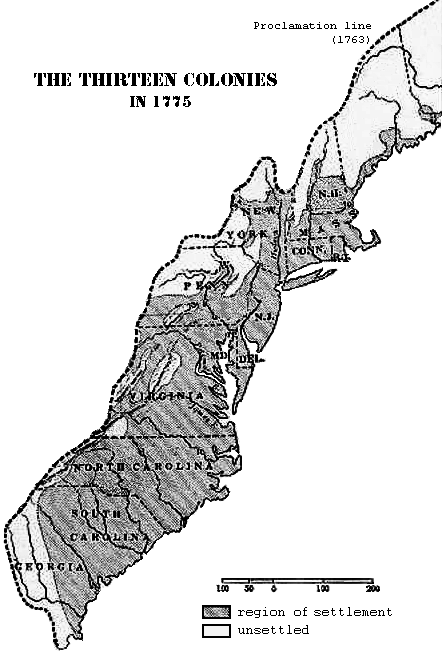
Map of the Thirteen Colonies along the Atlantic coast of North America in 1775, showing regional divisions relevant for comparative analysis. Each colony’s position highlights the geographic framework for comparing New England, Middle, and Southern societies. The map includes colony borders and coastlines, providing spatial context without adding unnecessary information. Source.
Economic systems, such as the Chesapeake’s reliance on tobacco compared with New England’s mixed economy
Labor models, including indentured servitude, enslaved African labor, and family-based farming
Demographic patterns, such as New England’s balanced sex ratios and the Chesapeake’s earlier reliance on young male migrants
Religious structures, including Puritan theocracy versus broader tolerance in the Middle Colonies
Indigenous relations, ranging from French alliance-building to English settler encroachment
When used comparatively, these pieces of evidence illustrate not only what happened in each region but also why differences emerged and how outcomes diverged.
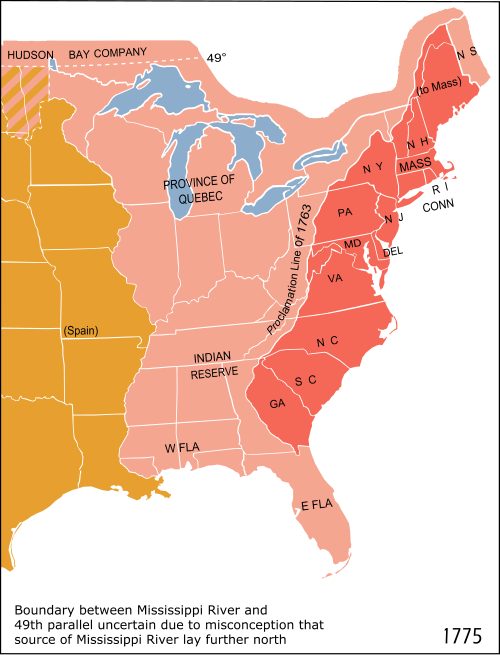
Eastern North America in 1775, showing the Thirteen Colonies, Quebec, and the Indian Reserve created by the Royal Proclamation of 1763. The map situates the coastal colonies within the broader imperial and Indigenous geography essential for contextualizing comparative arguments. It includes additional contextual details such as Quebec and Spanish Florida, which extend understanding of regional dynamics without exceeding syllabus needs. Source.
Integrating Evidence Effectively
To meet AP U.S. History expectations, students should integrate evidence by:
Directly linking facts to the thesis rather than presenting them in isolation
Explaining how an example demonstrates similarity, difference, or degree of contrast
Showing causation or influence when relevant, such as tying economic goals to patterns of settlement or conflict
Evidence is persuasive only when followed by explanation that reinforces the comparative argument.
Structuring Comparative Analysis
A well-organized comparison helps maintain clarity and argumentative coherence. Essays may use either a region-based structure or a theme-based structure, depending on the prompt and the writer’s approach.
Region-Based Approach
This method examines each region separately but consistently ties each section back to the comparative claim.
Useful when the regions have highly distinct characteristics
Helps organize large amounts of specific evidence
Requires careful linking sentences to maintain comparison
Theme-Based Approach
This strategy groups evidence according to analytical categories rather than geographic divisions.
Enables direct, explicit comparison within each paragraph
Strengthens the essay’s analytical precision
Works well when regions share several overlapping traits
Regardless of structure, comparison must be explicit. Implicit contrasts—describing one region without relating it to another—do not meet AP expectations.
Demonstrating Historical Reasoning
AP U.S. History comparative writing requires students to use historical reasoning skills that explain why similarities and differences existed, not just that they did. This involves analyzing contextual forces shaping colonial society.
Key Historical Reasoning Skills for Comparison
Students should apply the following reasoning tools:
Causation, identifying the factors that produced different regional outcomes
Patterns of continuity and change, explaining how certain traits persisted or evolved over time
Contextualization, situating regional differences within broader Atlantic or imperial developments
These reasoning skills elevate a comparative argument from descriptive to analytical.
Historical Reasoning: The use of analytical frameworks—comparison, causation, and patterns of change—to interpret and explain historical developments.
These frameworks help students clarify how dynamics such as empire-building, labor demands, or demographic pressures shaped regional identities.
Crafting Analytical Comparisons
Analytical comparison involves explaining relationships, not listing characteristics. Colonial societies differed for reasons shaped by imperial goals, environmental conditions, and social composition, and a strong argument demonstrates how these factors intersected.
Techniques for Analytical Comparison
Students should practice:
Using qualifying language, such as “to a greater extent” or “more significantly,” to evaluate degrees of similarity or difference
Highlighting interactions among variables, such as the link between climate and cash-crop agriculture
Showing how regional patterns influenced later political, economic, or social developments
These techniques ensure that the comparison is both historically meaningful and clearly articulated.
Synthesizing Comparative Insights
Comparative writing gains depth when students show awareness of broader implications across regions. While the core task is comparison, synthesis strengthens analysis by connecting findings to larger historical processes that shaped early America.
Broader Contextual Connections
Students may connect their comparisons to:
The growth of Atlantic trade networks
The development of British imperial policy
The emergence of distinct colonial identities
Shifting power dynamics among European empires and Indigenous nations
These connections, while concise, demonstrate a sophisticated understanding of Period 2’s complexity and reinforce the significance of comparative conclusions.
FAQ
A thesis is comparative when it directly evaluates the relationship between regions rather than listing traits.
Students can test their thesis by checking whether it:
Makes a clear judgement (e.g., “more significantly,” “to a greater extent”)
Identifies a basis for comparison, such as economy or labour
Avoids summarising each region separately
If the thesis could fit two separate essays without change, it is not truly comparative.
Degree helps transform a simple comparison into analytical evaluation. It shows nuance and demonstrates historical reasoning.
Establishing degree allows students to:
Prioritise which factors matter most
Show how differences or similarities shaped broader developments
Move beyond binary statements like “similar” or “different”
Markers reward essays that weigh evidence rather than treat all factors equally.
Contextualisation frames regional developments within larger Atlantic or imperial trends, helping explain why colonies diverged.
This may include:
Imperial goals shaping migration patterns
Environmental conditions influencing economies
Transatlantic religious and political currents affecting society
Providing context deepens comparisons by connecting local differences to broader forces.
The strongest evidence highlights relationships rather than isolated facts.
Useful evidence types include:
Direct contrasts (e.g., differing labour systems)
Parallel developments (e.g., trade-linked economies)
Causative links (e.g., environment shaping agriculture)
Evidence is most effective when followed by explanation showing how it supports the comparative claim and clarifies regional distinctions.
A comparative argument explicitly analyses similarities and differences, while a descriptive narrative simply recounts events or characteristics without evaluating their relationship.
A strong comparative argument:
Makes direct, explicit comparisons
Uses evidence to show degree or significance
Explains why differences or similarities existed
By contrast, descriptive writing often isolates each region’s details without interlinking them, resulting in weaker analysis.
Practice Questions
Question 1 (1–3 marks)
Identify one way in which a student can strengthen a comparative argument when analysing differences between two British colonial regions in the period 1607–1754. Explain why this strategy improves the quality of the comparison.
Mark scheme
1 mark for identifying a valid strategy (e.g., using specific and relevant evidence, establishing a defensible thesis, applying historical reasoning).
1 mark for explaining how or why the strategy strengthens the comparison.
1 mark for linking the explanation directly to comparative analysis (e.g., clarifying similarities/differences, establishing degree of difference, or improving argument clarity).
Question 2 (4–6 marks)
Using your knowledge of comparative historical writing, evaluate the extent to which economic and social factors shaped distinct regional identities in the British colonies during the period 1607–1754. Your response should make a defensible argument supported by specific and relevant evidence and must clearly explain the comparison.
Mark scheme
1 mark for presenting a defensible comparative thesis that evaluates the extent to which economic and social factors shaped regional identities.
1–2 marks for providing accurate and relevant evidence from at least two British colonial regions (e.g., New England, Chesapeake, Middle Colonies, Southern Atlantic Coast).
1–2 marks for explaining how the evidence supports the comparison, including the degree of similarity or difference.
1 mark for applying historical reasoning (comparison, causation, or continuity and change) to show why differences or similarities existed.