AP Syllabus focus:
‘Competition for resources among European rivals and American Indians encouraged trade and industry but also produced recurring conflict across the Americas.’
Competition for land, labor, and trade shaped interactions across the Americas, as European empires and Indigenous nations pursued strategic advantages, strengthening economic networks while intensifying violent conflict and diplomatic realignments.
Comparing Competition and Conflict in the Americas
European and Indigenous competition in the seventeenth and eighteenth centuries created a dynamic environment defined by shifting alliances, commercial rivalries, and recurring warfare. These pressures generated new economic opportunities while simultaneously destabilizing regions from the St. Lawrence Valley to the Caribbean. The AP focus emphasizes how resource competition encouraged trade and industry yet repeatedly produced conflict, highlighting the interconnectedness of economic and military developments.
Imperial Rivalries and Resource Competition
European powers entered the Americas with distinct imperial goals that often collided as empires expanded into overlapping spheres of influence. Their competition revolved around access to furs, land, mineral wealth, and Indigenous trade partners.
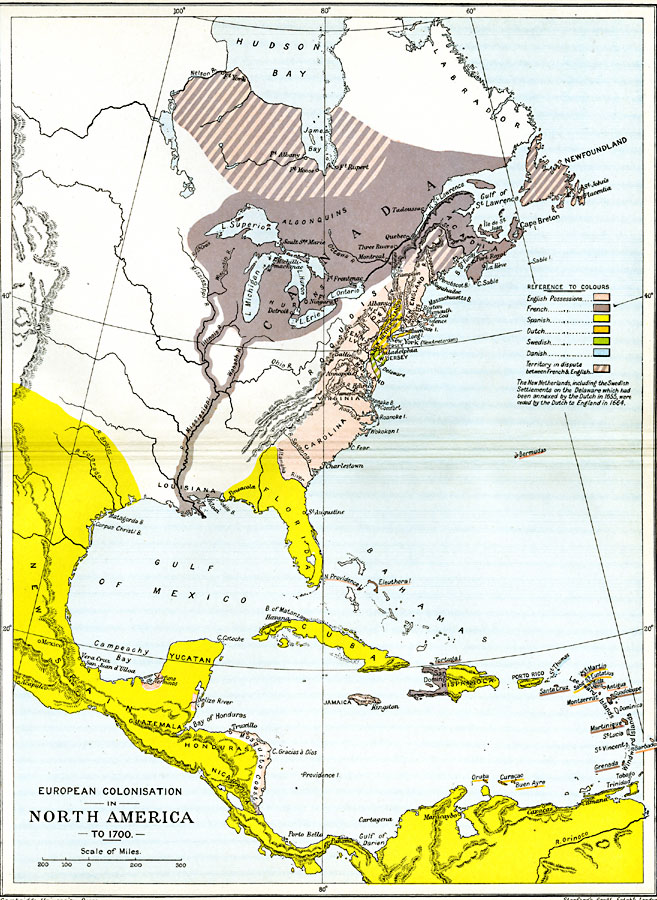
This map illustrates European territorial claims in North America up to 1700, highlighting overlapping zones of competition. It includes Caribbean and Central American regions beyond the syllabus but helps contextualize broader imperial rivalry. Source.
Motives Driving Competition
Territorial expansion into contested borderlands such as the Ohio Valley, Florida, and the Great Lakes.
Control of trade routes vital to the fur trade and Atlantic commerce.
Securing Indigenous alliances to reinforce military capacity and protect imperial claims.
Establishing profitable plantation zones in the Caribbean and southern mainland.
Competition often intensified because the same geographic corridors—river systems, portage routes, and fertile river valleys—were essential to multiple empires.
Indigenous Nations as Strategic Actors
American Indian nations played an essential role in shaping competition. They were not passive participants but active geopolitical agents who negotiated from positions of strategic strength.
Diplomatic and Military Agency
Indigenous polities such as the Iroquois Confederacy, the Huron-Wendat, the Powhatan Confederacy, and the Creek and Choctaw nations brokered alliances to advance their interests.
Alliances frequently shifted as nations sought better economic terms or stronger military backing.
European weaponry and manufactured goods heightened Indigenous leverage but also deepened dependency dynamics.
Alliance System: A structured set of political or military agreements in which participating groups cooperate for mutual benefit, often for defense or trade.
These alliance systems shaped patterns of conflict across colonial North America.
Economic Growth and Intensifying Commercial Rivalries
Competition for resources stimulated the development of trade and industry, especially in regions where European powers relied on Indigenous networks.
Growth in Trade and Industry
The fur trade became a centerpiece of French, Dutch, and English economic activity, intensifying competition for Indigenous partners.
Plantation systems in the Caribbean and southern Atlantic coast expanded due to rising European demand for sugar, rice, and indigo.
Rival empires built fortified trading posts, navies, and commercial infrastructure to secure control over profitable goods.
Economic expansion, however, was inseparable from conflict. As empires strengthened commercial positions, they often undermined Indigenous autonomy and provoked rival European powers.
Recurring Conflict Across the Americas
Violence became a persistent feature of imperial competition, arising from disputes over land, trade access, and alliance commitments. Conflicts varied in scale from localized raids to transatlantic wars carried out on American soil.
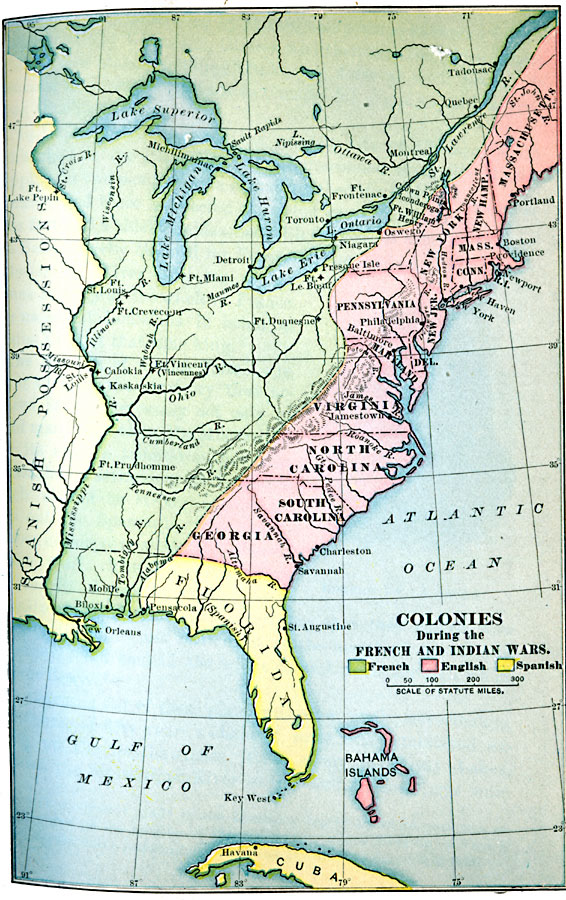
This map shows British, French, and Spanish territorial claims during the French and Indian War. Though slightly later than Period 2, it visually represents longstanding imperial rivalries over land and trade routes that repeatedly generated conflict. Source.
Types of Conflict
Interimperial warfare, such as King William’s War and Queen Anne’s War, which extended European conflicts into the Americas.
Indigenous–European conflicts, driven by territorial encroachment, resource extraction, and violations of diplomatic agreements.
Inter-Indigenous conflicts exacerbated by European weapons and competition for European trade.
Frontier Warfare: Decentralized military conflict occurring in contested borderlands where no single power exerted stable control, often involving irregular tactics and shifting alliances.
These frontier conflicts blurred distinctions between imperial and Indigenous warfare, reflecting the overlapping claims that defined the colonial world.
Regional Variations in Conflict
Different areas of the Americas experienced competition and conflict in distinct ways, shaped by their environmental and demographic contexts.
Northern Borderlands
The Great Lakes and St. Lawrence Valley saw intense competition for the fur trade, involving France, England, and numerous Indigenous nations.
Conflicts such as the Beaver Wars arose from competition over hunting grounds and trade alliances.
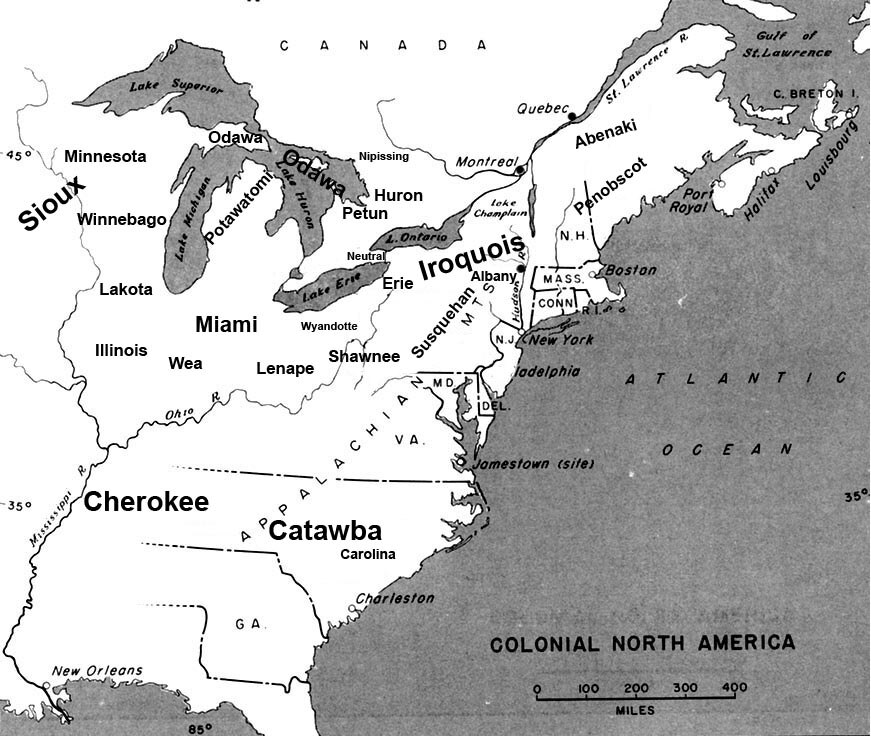
This map indicates the homelands of major Indigenous nations involved in the Beaver Wars, along with nearby colonial settlements. It includes additional tribal detail beyond syllabus requirements but effectively conveys how Indigenous and European spheres overlapped in contested regions. Source.
The Southeast
Spain, France, and England competed through Indigenous alliances, fueling wars among tribes such as the Yamasee War, which reshaped regional power balances.
Access to enslaved Native labor and control of trade networks heightened tensions.
The Caribbean
European powers fought for control of high-value sugar islands.
Enslaved African populations became central to economic competition, with wars often disrupting plantation production and trade.
Consequences of Competition and Conflict
The long-term effects of these dynamics transformed political and economic landscapes across the Americas.
Major Outcomes
Shifts in territorial control, with Britain emerging as the dominant power in North America by the mid-eighteenth century.
Displacement and demographic decline among Indigenous populations due to warfare, disease, and forced migration.
Evolution of colonial economies, as competition stimulated industrial growth, trade specialization, and deeper integration into Atlantic markets.
Increasing militarization, leading colonies to develop fortifications and militias that later shaped revolutionary political culture.
FAQ
Demand for coerced labour, including enslaved Africans and enslaved Native peoples, intensified European competition over coastal access points and trade networks.
Spanish, English, and French raiders sometimes targeted Indigenous settlements to capture labour, provoking retaliatory attacks and escalating frontier violence.
Rival colonies also sought to disrupt one another’s plantation systems and shipping routes, linking labour competition to broader military conflict.
European wars such as the War of the Spanish Succession redirected military priorities and resources, intensifying or easing tensions in colonial borderlands.
These conflicts often created realignments in colonial alliances, prompting governors to strengthen ties with Indigenous nations or reinforce vulnerable forts.
Colonial militias were also affected, as metropolitan powers redirected naval fleets or funding, leaving some colonies under-defended and more prone to localised conflict.
Although overshadowed by larger empires, these powers influenced regional dynamics by providing alternative trading partners for Indigenous nations.
Their presence increased commercial competition, particularly in the mid-Atlantic fur trade, prompting English and French authorities to adopt more aggressive expansionist policies.
Over time, their colonies were absorbed by larger empires, but their early rivalry helped set patterns of contested settlement and trade routes.
Rivers, portage routes, and inland waterways such as the St. Lawrence River were hotspots because they functioned as vital trade arteries.
Mountain ranges and dense forests often acted as natural barriers, funnelling competing groups into narrow corridors where clashes were more likely.
Borderland zones lacking strong imperial control became especially prone to raids, shifting alliances, and frontier warfare.
Indigenous diplomatic customs, such as gift-giving, adoption rituals, and council negotiations, required Europeans to adjust their political expectations.
Failure to follow these protocols often damaged alliances, prompting Indigenous nations to shift support to rival European powers.
These traditions also prolonged negotiations, influencing the timing and nature of military campaigns in contested regions.
Practice Questions
Question 1 (1–3 marks)
Briefly explain one way in which competition for resources contributed to conflict among European powers in the Americas during the seventeenth and early eighteenth centuries.
Mark Scheme
Award up to 3 marks:
1 mark for identifying a specific resource or area of competition (e.g., fur trade, contested river valleys, fertile agricultural land).
1 mark for explaining how this competition heightened tensions or led to conflict (e.g., rival claims, militarised competition for trade routes).
1 mark for providing a concrete historical example (e.g., Anglo-French rivalry in the Great Lakes region).
Question 2 (4–6 marks)
Analyse the extent to which American Indian nations shaped the patterns of competition and conflict among European empires in the Americas in the period 1607–1754.
Mark Scheme
Award up to 6 marks:
1 mark for identifying that Indigenous groups acted as diplomatic and military agents rather than passive participants.
1 mark for describing at least one specific strategy used by Indigenous nations (e.g., alliance-building, shifting loyalties, leveraging trade relationships).
1 mark for explaining how these strategies influenced European rivalries (e.g., competition over Indigenous alliances intensified imperial conflict).
1 mark for a relevant historical example (e.g., the Iroquois Confederacy’s role in the Beaver Wars or Anglo-French relations).
1 mark for analysis of the broader impact on regional power dynamics (e.g., how Indigenous decisions reshaped borderland stability).
1 mark for a clear, well-developed argument addressing the extent of Indigenous influence.