AP Syllabus focus: ‘Song-era innovations included Champa rice, transportation improvements like Grand Canal expansion, iron and steel production, and export textiles and porcelains.’
Song China (c. 1200–1450) strengthened long-distance and regional trade by raising farm output, moving bulk goods more efficiently, and scaling up manufacturing. These practical innovations helped connect interior producers to coastal markets and overseas consumers.
Why Innovation Mattered for Trade in Song China
Song-era trade depended on reliable surpluses, predictable transport, and desirable manufactured exports. Key changes worked together:
Agricultural surplus fed growing cities and freed labor for crafts.
Transportation capacity lowered costs for moving grain, iron, and textiles.
High-output manufacturing supplied both domestic urban markets and foreign demand.
Agricultural Innovation: Champa Rice and Marketable Surpluses
Champa rice (a fast-ripening variety associated with Vietnam’s Champa region) expanded the food supply by shortening growing cycles and improving resilience in some environments.
Champa rice: A quick-maturing rice variety adopted widely in Song China that enabled higher annual yields and more dependable harvests, supporting population growth and commercial crop production.
Higher output supported trade by:
Increasing the amount of tax grain and market grain available for shipment.
Allowing some households to specialise, selling food surplus to buy tools, cloth, and ceramics.
Encouraging cultivation beyond subsistence needs, strengthening urban provisioning and interregional exchange.
Transportation Improvements: Grand Canal Expansion and Internal Trade
Efficient internal movement was essential because many production zones were inland while major commercial hubs clustered along rivers and the coast. Transportation improvements—especially Grand Canal expansion and maintenance—enhanced integration between northern political centres and southern rice-growing regions.
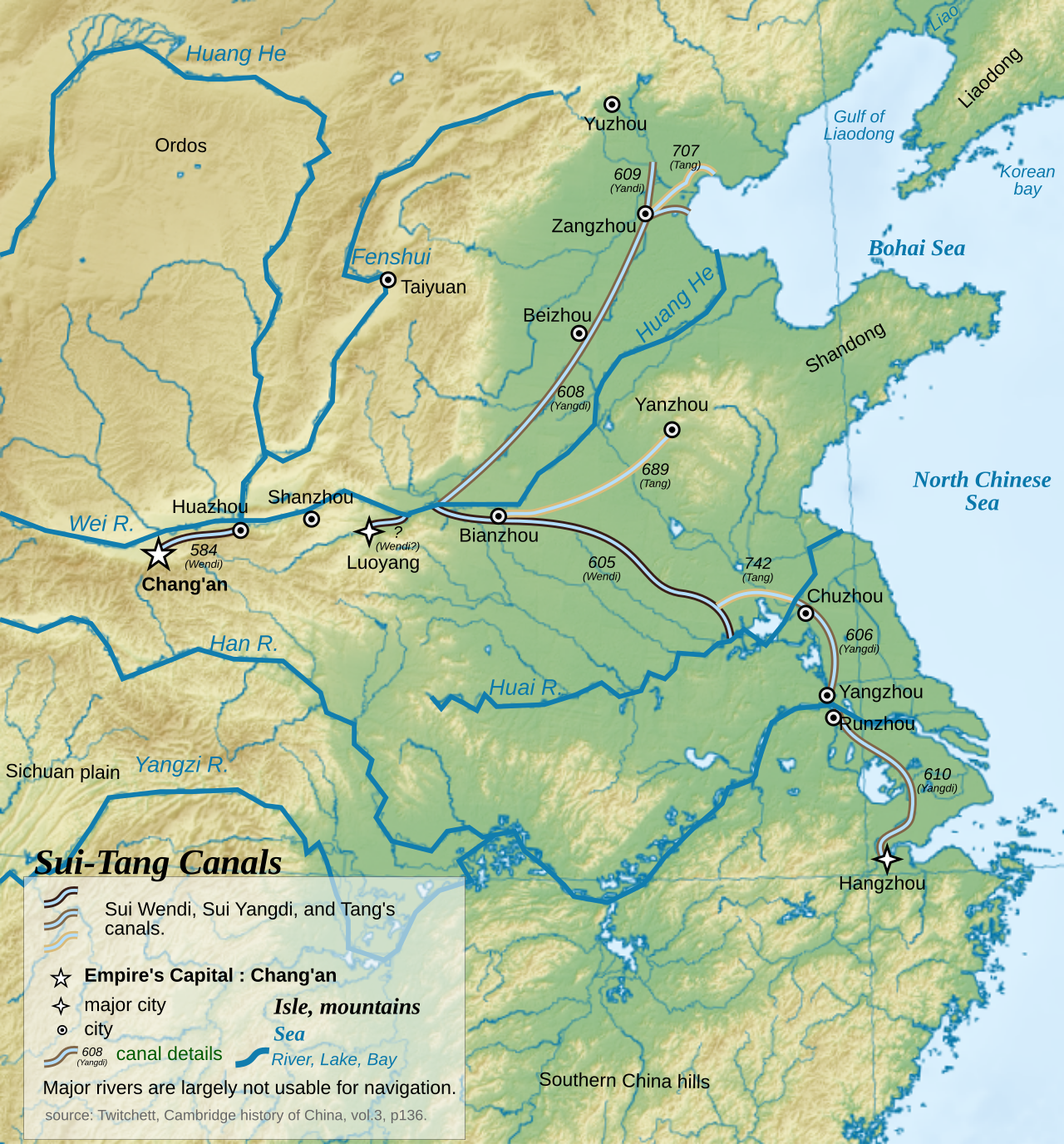
Topographic map highlighting the Grand Canal corridor across eastern China. It helps explain how Song-era canal maintenance and expansion lowered the cost of moving bulk staples like grain by connecting multiple river basins into a single transport network. Seeing the canal’s north–south alignment makes the state’s ability to provision capitals and concentrate goods for trade more concrete. Source
How Canal Transport Supported Commerce
Moved bulky staples (grain) and heavy inputs (iron) more cheaply than overland routes.
Reduced seasonal bottlenecks by improving navigability and linking waterways.
Strengthened commercial corridors between inland craft towns and large consumer markets.
Trade Effects
Encouraged larger-scale shipments, which supported more regular market supply.
Helped merchants coordinate purchasing and resale across regions.
Increased the reach of export industries by making it easier to concentrate goods in port cities for overseas sale.
Industrial Output: Iron and Steel Production for Tools and Markets
Song China’s iron and steel production expanded substantially, reflecting both technical capacity and strong demand.
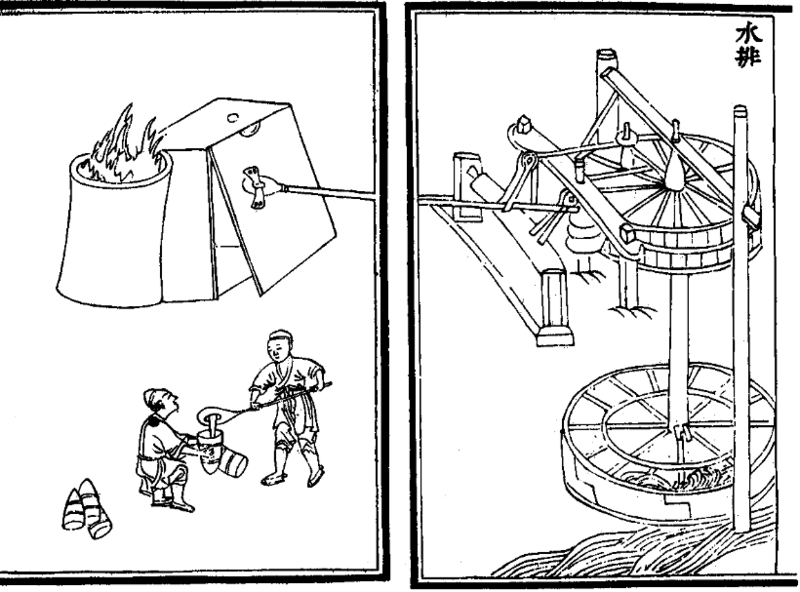
Illustration of a blast-furnace system in which a waterwheel powers bellows to force air into the furnace, raising temperatures for large-scale smelting. This diagram helps students connect Song-era iron output to energy inputs (hydraulic power), labor organization, and the production of standardized metal goods for markets. It also clarifies why heavy industry benefited from waterways: both the machinery and the output were easiest to support where transport was cheap. Source
Iron supported trade indirectly by improving productivity and directly by supplying valuable manufactured goods.
Why Iron and Steel Mattered
More metal tools improved farm efficiency, supporting the surpluses that underwrote commerce.
Metal goods (tools, implements, fittings) circulated widely through regional markets.
Concentrated production encouraged specialised labor and reliable supply chains for fuel, ore, and transport.
Links to Trade Networks
Heavy iron products benefited especially from improved waterways, making canal and river shipping economically significant.
Standardised outputs (common tool types) made exchange easier across diverse regions.
Export Manufacturing: Textiles and Porcelains
Song producers supplied large markets with high-quality goods, notably export textiles and porcelains, which became commercial signatures of Chinese production.
Export Textiles
Textile production supported trade through:
Scalable workshop production that could meet large orders.
Broad consumer appeal, since cloth served both practical and status needs.
Port-focused distribution, where merchants assembled bales for maritime routes.
Porcelain Production
Song porcelains succeeded in long-distance trade because they were:
Durable enough for transport compared with many earthenwares.
Highly valued for refined appearance and consistent quality.
Suitable for bulk export as standardized bowls, dishes, and containers.
Commercial Consequences
Strong overseas demand reinforced investment in specialised kilns and skilled artisans.
Export success encouraged regional manufacturing centres to orient output toward merchant preferences (quality, uniformity, and volume).
Practice Questions
(1–3 marks) Describe one way Grand Canal expansion supported trade in Song China.
1 mark: Identifies a correct link (e.g., “made transport cheaper”).
+1 mark: Develops with how (e.g., “enabled bulk shipment of grain/iron by water instead of overland”).
+1 mark: Adds trade impact (e.g., “integrated north–south markets” or “supplied port cities more reliably”).
(4–6 marks) Explain how ONE agricultural innovation and ONE manufacturing innovation in Song China contributed to the expansion of trade.
1 mark: Correctly identifies Champa rice as the agricultural innovation.
1 mark: Explains how it increased yields/surpluses (e.g., faster ripening, more reliable harvests).
1 mark: Links surplus to trade growth (e.g., more marketable grain, labour specialisation, urban supply).
1 mark: Correctly identifies one manufacturing innovation: iron and steel production OR export textiles OR porcelains.
1 mark: Explains how the chosen manufacturing innovation increased output/quality/availability.
1 mark: Links manufacturing to trade expansion (e.g., wider distribution through canals/ports, increased demand for exports).
FAQ
Often by fitting a shorter growing cycle into local calendars.
Common approaches included:
Planting earlier to reduce famine risk from late-season weather
Using quicker harvests to support additional planting where conditions allowed
Local soil, water access, and labour availability determined adoption speed.
Not only new stretches of canal, but also performance improvements, such as:
Dredging and widening to increase tonnage
Repairing embankments to reduce breaches
Improving junctions between rivers and canal channels
These changes increased reliability for merchants planning shipments.
Iron output depended on steady supplies of ore and fuel.
Constraints typically included:
Securing large quantities of charcoal/other fuels
Coordinating transport of heavy inputs and outputs
Managing seasonal transport disruptions on waterways
Bottlenecks could raise prices and shape where production clustered.
Overseas markets often preferred pieces that balanced aesthetics with transport durability.
Desirable features included:
Consistent shapes for stacking and shipping
Glazes that resisted staining and chipping
Visual styles that signalled prestige in elite dining or ritual settings
Merchant feedback could influence what kilns prioritised.
Export-oriented production tended to emphasise uniformity and scale.
Adjustments could involve:
Standardising lengths and weaves for bulk orders
Using colourfast dyes to reduce losses in transit
Organising labour in more specialised stages (spinning, weaving, finishing)
These shifts reduced transaction costs for long-distance buyers.