AP Syllabus focus: ‘Song China used Confucian traditions and an imperial bureaucracy to maintain and justify rule, illustrating one pathway of state formation.’
Song China offers a clear model of how a state could build durable authority through bureaucratic governance. Its blend of Confucian political ideals and professional administration shaped legitimacy, policy implementation, and social hierarchy.
What “bureaucratic governance” meant in Song China
Song rulers strengthened the idea that an effective state depends on trained officials who administer law, taxes, and public works across a large territory. This contrasted with systems that relied more heavily on personal lordship, hereditary officeholding, or loosely coordinated local power.
Imperial bureaucracy: a hierarchical system of state officials appointed to administer governance (taxation, justice, records, and public works) across an empire, ideally based on merit and loyalty to the dynasty.
This administrative approach helped the Song project authority beyond the capital and made the state’s presence routine in everyday life.
Confucian traditions as political legitimacy
Song governance tied state power to Confucian traditions, which framed rule as moral and paternal rather than merely coercive.
Core Confucian political expectations
The ruler should embody virtue and govern for social harmony.
Officials should model ethical conduct, learning, and disciplined self-cultivation.
Society should be ordered through properly defined relationships, reinforcing hierarchy and duty.

This image tradition (五伦图, “Five Principal Human Relations”) visualizes core Confucian social relationships—linking political order to moral, hierarchical obligations. It helps explain why Confucianism could present obedience and proper conduct as ethical duties rather than mere compliance with force. In state ideology, these relationships reinforced the idea that stable governance depends on well-defined roles for rulers, officials, and families.
############################
How Confucianism “justified” dynastic authority
It portrayed the dynasty as the guardian of proper order, making political obedience a moral expectation.
It elevated educated administrators as the rightful agents of government, delegitimising rivals seen as self-interested or disordering.
The imperial bureaucracy as a tool to “maintain” rule
Song state power depended on consistent administration more than constant military mobilisation. The bureaucracy translated imperial priorities into local enforcement and services.
Recruitment and the civil service ideal
Expansion of civil service examinations promoted the ideal of merit-based appointment.
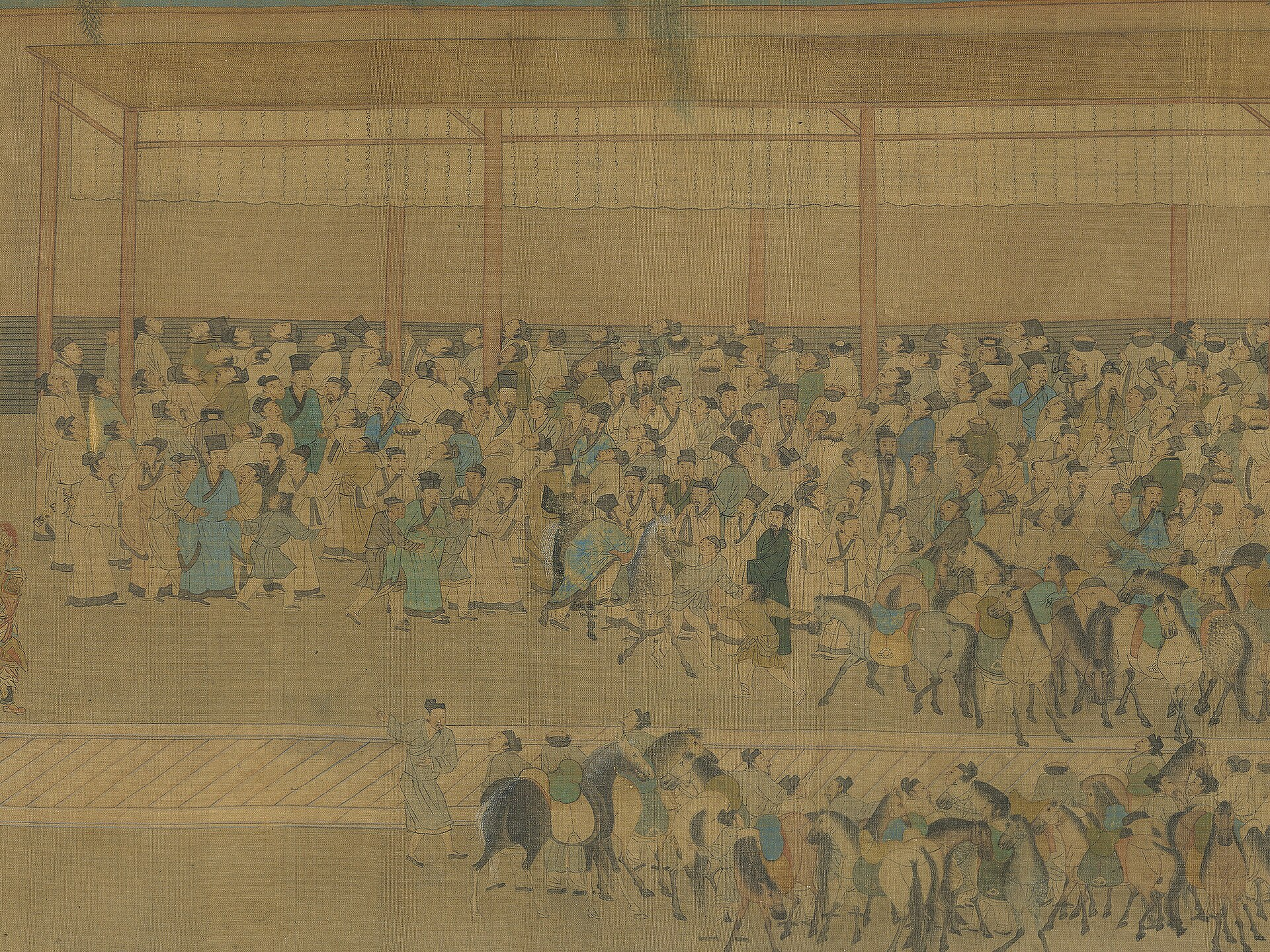
This painting depicts civil service examination candidates gathered to read the posted results, illustrating how exam success publicly translated learning into official status. In Song governance (and later dynasties that retained the system), examinations helped standardize recruitment and tie elite ambition to state institutions. The scene makes visible the social stakes of becoming a scholar-official within an imperial bureaucracy. Source
Successful candidates formed a scholar-official class whose status depended on the state, encouraging loyalty to dynastic institutions.
Officials shared a common political culture rooted in classical learning, creating coordination across regions.
Administrative functions that sustained state capacity
Tax collection and fiscal management: regularised revenue streams to fund the court, administration, and state projects.
Legal administration: standardised procedures and documentation strengthened predictability and compliance.
Record-keeping: routinised reports, registers, and audits increased central oversight and reduced dependence on any single local strongman.
Infrastructure and public works: managed canals, granaries, and transport logistics that supported political stability and economic integration.
Managing elites and local society
Bureaucratic officeholding offered elites prestige through state service, drawing ambition into official channels rather than rebellion.
Local governance linked magistrates and clerks to communities, extending the dynasty’s presence into markets and villages.
Why Song China is a comparative “pathway of state formation”
Within c. 1200–1450 comparisons, Song China demonstrates that states could expand and stabilise by deepening institutions rather than only expanding territory.
Key features of this pathway
Legitimation through ideology: Confucian traditions framed the state as morally necessary.
Institutional continuity: dynastic authority rested on durable offices, routines, and texts, not only on a ruler’s personality.
Scalable governance: bureaucratic layers enabled control across diverse regions through standardised administration.
What to emphasise in comparison
The Song model highlights centralised civil administration as a foundation for authority.
It shows how states can convert cultural values into political legitimacy, reinforcing compliance and elite cooperation.
Practice Questions
Explain one way Confucian traditions helped Song rulers justify dynastic authority. (2 marks)
1 mark: Identifies a relevant Confucian idea (e.g. moral rulership/virtuous governance, hierarchical order, educated officials).
1 mark: Explains how it legitimised rule (e.g. obedience as moral duty; dynasty as guardian of social harmony).
Explain two ways the Song imperial bureaucracy helped maintain rule, and make a comparative claim about why this represents a distinct pathway of state formation. (6 marks)
1–2 marks: First way explained (e.g. taxation/records enabled predictable revenue and oversight).
1–2 marks: Second way explained (e.g. examinations/official culture created loyal scholar-officials and administrative coordination).
1–2 marks: Comparative claim (e.g. contrasts institution-based central administration with reliance on hereditary officeholding or decentralised local power), supported by at least one Song-specific piece of evidence.
FAQ
Quotas could favour certain regions and help the court manage representation.
They limited over-dominance by wealthy educational centres.
They also encouraged provinces to invest in schooling to compete.
Printing made key texts and study materials cheaper and more available, widening preparation for examinations.
It also helped standardise what officials learned, reinforcing shared administrative values.
Common tools included rotation of postings, layers of review, and audit-like reporting.
These measures aimed to prevent long-term local patronage networks from capturing offices.
Song rulers tended to emphasise civil administration to keep policy predictable and restrain independent military power.
This reduced coup risks but could create tension over defence and frontier security.
Routine registers and reports mattered most: tax lists, household records, legal filings, and performance evaluations.
Their standard formats enabled comparison across districts and tighter central supervision.