AP Syllabus focus: ‘Using evidence from Unit 1’s key concepts, students should explain similarities and differences in state formation and make a historically defensible claim.’
Comparative writing in AP World History is about building an argument, not listing facts. You must choose meaningful comparison categories, use specific evidence, and explain how that evidence supports a defensible claim.
What “making a comparative claim” requires
A strong comparison does three things at once:
States a clear claim about similarities and differences
Uses evidence (specific historical facts) to support each part of the claim
Explains reasoning (why the evidence proves the claim)
Core idea: comparison is argument
Comparison is persuasive when you show:
What is similar/different
In what ways (categories like politics, economy, belief, social order)
To what extent (more/less, broader/narrower, more centralised/more local)
Why the patterns make sense (causation, function, or historical conditions)
Building a historically defensible claim
A defensible claim must be accurate, specific, and supportable with real evidence from the time period.
Historically defensible claim: an argument about the past that is specific and credible because it is supported by accurate evidence and a clear line of reasoning, not vague generalisations.
A defensible comparative claim usually takes a structured form:
Both X and Y did (similarity) because (reason)
However, X differed from Y in (difference) due to (reason)
Optionally add extent: “overall,” “more consistently,” “primarily,” “to a greater degree”
Choosing strong comparison categories (what to compare)
To avoid random fact-dumping, compare using consistent categories that fit state formation and governance.
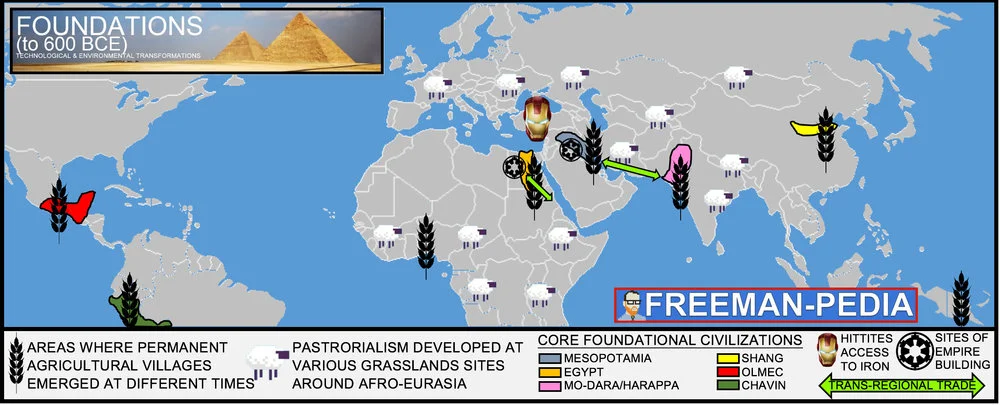
This world map (focused on the period up to about 600 BCE) situates major early civilizations and regions where complex societies developed. Seeing these early state centers geographically helps students choose comparison pairings that make historical sense (e.g., river-valley states vs. pastoralist regions) and then apply consistent categories like administration, extraction, and legitimacy. The visual also reinforces that state formation patterns varied across environments and interconnected zones. Source
High-utility categories include:
Political structure: centralisation, bureaucracy, military organisation, succession
Legitimacy and ideology: religious or philosophical justification, law, ritual, elites
Administration and extraction: taxation/tribute, recordkeeping, local governance
Social organisation: hierarchies, gender roles, status groups, labour systems
Economic foundations: agriculture, trade networks, monetisation, urbanisation
Keep categories symmetrical
Use the same lens for both societies throughout.
Weak: “X had trade; Y had religion” (not comparable categories)
Strong: “Both used ideology for legitimacy, but they relied on different institutions”
Evidence: what counts and how to use it
Evidence should be specific, relevant, and paired across the comparison.
Specific = concrete institutions, policies, practices, or developments (not “they were advanced”)
Relevant = directly supports the similarity/difference you claim
Paired = evidence for X and evidence for Y under the same category
Move from evidence to reasoning
A high-scoring response explains significance, not just details:
Evidence: identify the institution/practice
Reasoning: explain how it demonstrates centralisation, continuity, innovation, or diversity in state formation
Use because and therefore logic to connect proof to claim:
“Because (evidence), the state could (function), therefore it was (comparative judgement).”
Explaining similarity and difference with precision
A defensible comparison avoids extremes (“completely different”) unless evidence supports it. Strong phrasing uses:
Both, similarly, in contrast, whereas
More/less, to a greater extent, primarily, in practice
Add nuance to strengthen credibility
Nuance shows you understand complexity without losing the argument:
Identify internal variation (differences over time or across regions)
Distinguish ideal vs practice (official ideology vs local realities)
Note limits of state power (reach, enforcement, geography)
Common pitfalls to avoid
Laundry lists: many facts, no comparative claim tying them together
One-sided evidence: deep detail for one society, vague statements for the other
Category drift: switching lenses mid-paragraph so comparisons stop matching
Unsupported judgements: “X was stronger” without defining “stronger” and proving it
Presentism: judging with modern standards rather than historical context
Suggested paragraph structure for comparison (DBQ/LEQ-ready)
Topic sentence with comparative claim (similarity + difference)
Evidence for Society X tied to the category
Evidence for Society Y tied to the same category
Reasoning sentence explaining why the comparison matters for state formation
Optional: nuance/extent sentence to qualify the claim responsibly
Practice Questions
(1–3 marks) Identify one similarity and one difference historians could use when comparing state formation in two regions during c. 1200–1450. Mark scheme:
1 mark: valid similarity category (e.g., legitimacy, administration, extraction, social hierarchy).
1 mark: valid difference category or contrast within the same category.
1 mark: both are framed as comparison (not two unrelated facts).
(4–6 marks) Write a comparative claim about state formation in two regions during c. 1200–1450 and support it with evidence and reasoning. Mark scheme:
1 mark: clear comparative claim stating at least one similarity and one difference.
2 marks: two specific pieces of evidence (paired: one for each region, same category).
1 mark: reasoning that links evidence to how states formed/maintained power.
1–2 marks: complexity (extent language, nuance, or addressing limits/variation).
FAQ
Category organisation is usually clearer: each paragraph compares the same lens (e.g., legitimacy). Similarities-first can work, but it often drifts into lists unless each point stays paired and explained.
Name identifiable features: an institution, policy, practice, or ideology, plus what it did. If your evidence could apply to most states (“they had leaders”), it is too vague.
Use controlled qualifiers:
“to a greater extent”
“primarily in urban centres”
“although local elites limited enforcement”
This refines scope while keeping the core claim intact.
Aim for 2–3 strong categories you can support with paired evidence and reasoning. More categories can reduce depth and increase the risk of uneven or unsupported comparison.
Underline your categories and check pairing: for every claim about X, you should have a matched claim about Y in the same category, followed by a sentence explaining why that similarity/difference matters.