AP Syllabus focus: ‘New Hindu and Buddhist states emerged in South and Southeast Asia, showing continuity, innovation, and diversity in state development.’
These comparative notes focus on how Hindu and Buddhist polities formed and governed between c. 1200 and 1450, and how their religious traditions shaped legitimacy, administration, and regional diversity across South and Southeast Asia.
Comparative Frame: What You’re Comparing
AP World comparisons ask how states built power and legitimised rule while balancing older traditions with new political needs.
Continuity, Innovation, Diversity (CID)
Continuity: Use of longstanding religious authority, sacred kingship ideas, and elite-dominated governance
Innovation: New capitals, revived or restructured institutions, and fresh strategies for integrating diverse populations
Diversity: Different blends of Hindu and Buddhist practice, varying degrees of centralisation, and distinct regional political cultures
Common Tools of State Formation in Hindu and Buddhist Contexts
Legitimacy through religious patronage
Rulers supported temples and monasteries to project moral authority and social order
Monumental architecture and ritual patronage linked rulers to divine or karmic legitimacy
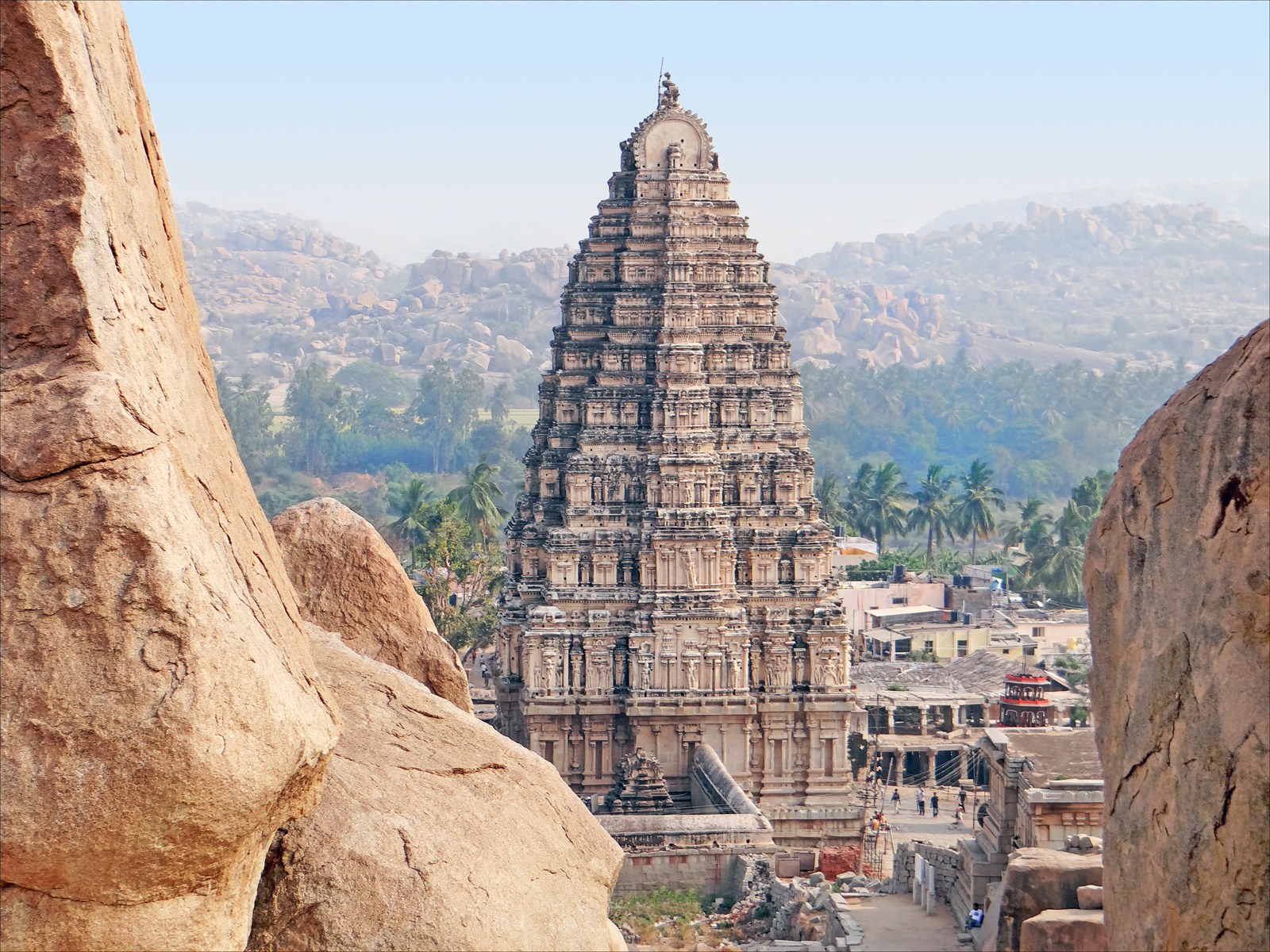
The Virupaksha Temple gopuram at Hampi (the Vijayanagara capital region) exemplifies how monumental temple building made royal power visible in stone. In many Hindu-identified states, rulers reinforced legitimacy by endowing temples, sponsoring ritual, and embedding court authority in sacred landscapes. Source
Court culture (literature, law codes, art) reinforced hierarchy and the ruler’s status
Governance and integration strategies
Reliance on local elites (landholders, nobles, religious leaders) to collect revenue and maintain order
Use of tribute and alliance networks to extend influence beyond the core region, especially where terrain limited direct rule
Mandala model: A flexible political pattern in which power radiates outward from a central court through overlapping circles of influence, alliances, and tribute rather than fixed borders.
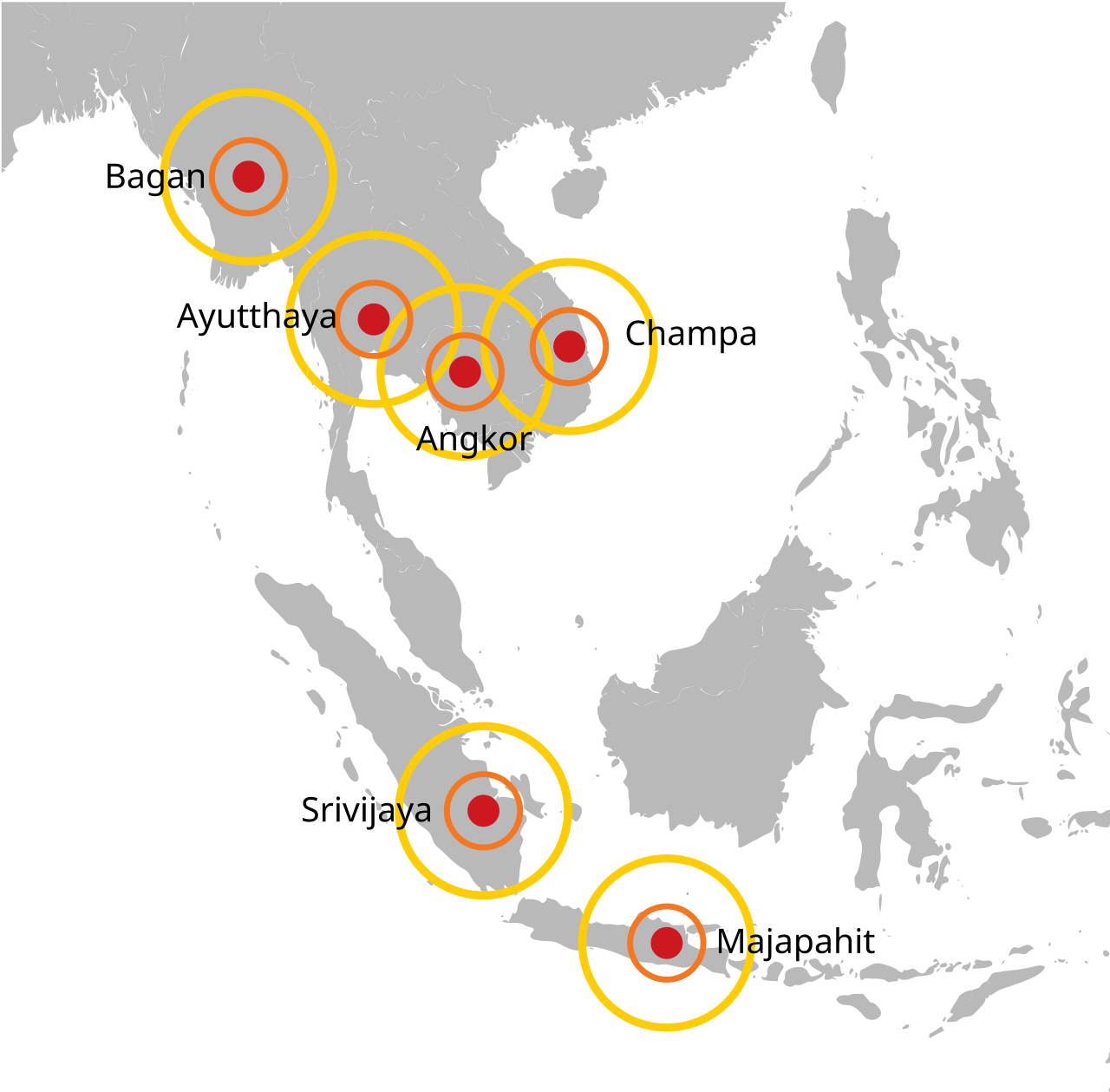
This figure visualizes mandala-style politics as overlapping zones of influence among major centers rather than clean, modern borderlines. It supports the idea that authority was often negotiated through tribute, alliance, and prestige, producing a flexible and layered political geography. Source
Comparative Case Studies: Hindu States
Vijayanagara (South India)
A major example of a Hindu state consolidating power in a region with longstanding religious traditions
Legitimacy strengthened through temple patronage, court ritual, and support for Brahminical learning
Demonstrates innovation in building a durable imperial centre that coordinated elites and resources across a large territory
Rajput kingdoms (North/Western India)
Illustrate diversity in state formation: multiple competing Hindu-identified polities rather than a single empire
Power often rooted in warrior aristocracies, fortifications, and lineage-based authority
Continuity in social hierarchy and the political role of elite families, with shifting alliances as a normal feature of governance
Comparative Case Studies: Buddhist States
Sukhothai (Mainland Southeast Asia)
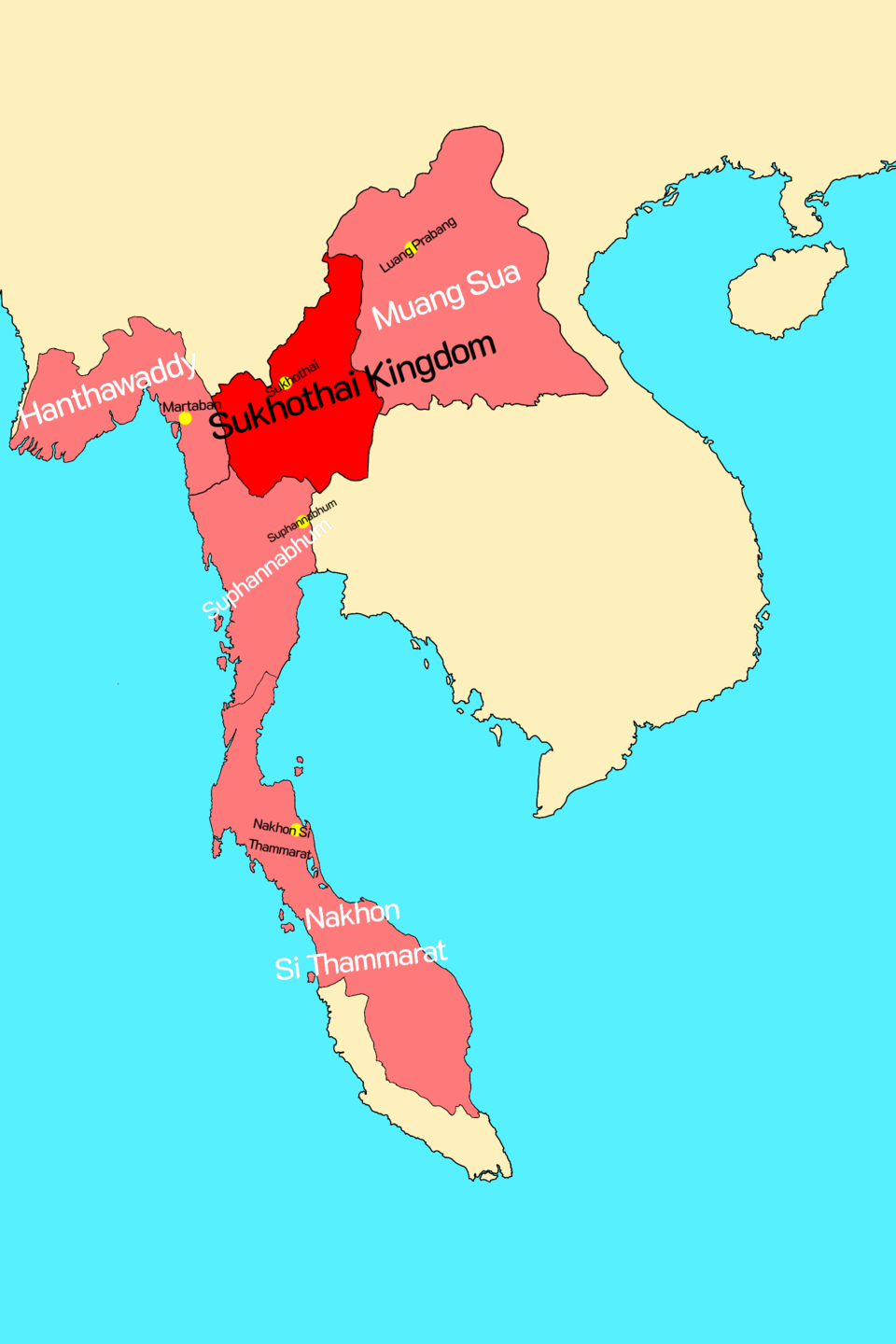
This map depicts the Sukhothai Kingdom at its peak under King Ram Khamhaeng, offering a geographic anchor for claims about state growth and regional influence. Used alongside the notes, it helps connect Theravada Buddhist kingship and patronage to how a relatively new political center could consolidate legitimacy across a wide area. Source
A prominent Theravada Buddhist polity where kingship was framed through merit and righteous rule
Close relationship between ruler and monastic community reinforced social cohesion and public morality
Shows innovation in using Buddhist ideals to unify populations and legitimise relatively new political centres
Sinhala kingdoms (Sri Lanka)
Strong Buddhist identity supported by royal protection of monasteries and sacred sites
State authority tied to guardianship of the island’s religious institutions, reinforcing continuity across political change
Demonstrates how Buddhist patronage could stabilise rule even when dynasties shifted
Hybrid and Blended Traditions: Diversity in Practice
Khmer Empire and Majapahit
Many Southeast Asian states drew on both Hindu and Buddhist traditions over time
Rulers could adopt different religious emphases to broaden legitimacy across diverse subjects
Syncretic court cultures show that “Hindu” vs “Buddhist” is often a spectrum in state practice, not a strict divide
High-Utility Comparisons for AP Writing
Similarities (good for “compare” claims)
Both traditions supported state authority through religious institutions, sacred spaces, and moral ideology
Both often governed through layered authority: central rulers depended on local elites and ritual specialists
Both used public works, patronage, and ceremony to demonstrate capacity and rightful rule
Differences (good for “contrast” claims)
Hindu statecraft frequently emphasised temple-centred legitimacy and social hierarchy linked to Brahminical authority
Theravada Buddhist statecraft often highlighted the king as a moral exemplar and patron of monastic discipline
Political geography mattered: mandala-style influence was especially prominent where direct administration across distance was difficult
Practice Questions
Describe one similarity in how Hindu and Buddhist rulers legitimised their authority in South or Southeast Asia (c. 1200–1450). (2 marks)
1 mark: Identifies a valid similarity (e.g., patronage of temples/monasteries, monumental religious building, use of religious elites).
1 mark: Provides a brief, accurate description linking the similarity to political legitimacy.
Compare the processes of state formation in one Hindu state and one Buddhist state in South/Southeast Asia (c. 1200–1450). Your answer should address continuity and change. (6 marks)
1 mark: Names a relevant Hindu state (e.g., Vijayanagara/Rajput kingdoms).
1 mark: Names a relevant Buddhist state (e.g., Sukhothai/Sinhala kingdoms).
2 marks: Accurate comparison (one similarity + explanation grounded in governance/legitimacy).
2 marks: Accurate contrast (one difference + explanation tied to religious basis of rule and/or political structure), with explicit reference to continuity and/or innovation.
FAQ
They could function as economic hubs by:
Holding land grants and collecting rents
Employing artisans and organising production
Hosting markets and redistributing food during festivals
This anchored royal authority in daily material life, not only belief.
Common sources include:
Stone and copper-plate inscriptions recording donations and titles
Court chronicles and genealogies
Monastic texts describing royal patronage
Temple reliefs and dedicatory art
Each source must be read for political messaging as well as factual detail.
Shifts could reflect:
New dynasties seeking fresh legitimacy
The need to appeal to different regional communities
Competition with rival courts using alternative religious claims
Religious policy often followed political coalition-building.
Stability varied widely. Some polities maintained continuity through clear hereditary norms, while others saw:
Frequent elite power struggles
Competing claims by regional governors
Usurpations justified through religious or genealogical narratives
These patterns affected how centralised administration could become.
Yes. Expansion could rely on:
Marriage alliances among elites
Tribute relationships and recognition of overlordship
Strategic patronage of regional religious centres
Such tools fit mandala-style politics where influence mattered more than fixed frontiers.