

CIE Syllabus focus:
'Candidates should understand accounting concepts underpinning accounts, including business entity, historic cost, money measurement, going concern, prudence, realisation, duality and materiality.'
Accounting concepts are the basic assumptions and principles behind financial accounts. They help accountants record transactions in a logical, consistent way so reported profit and financial position are meaningful.
Why accounting concepts matter
Accounting concepts are accepted principles that guide the preparation of financial accounts. They make accounting information more consistent, comparable, and trustworthy. They also reduce the risk that personal opinion will dominate the records. When an accountant decides whether an item should be recorded, how it should be valued, or when income should be recognized, these concepts provide the foundation. They are therefore essential for producing accounts that users can understand and rely on.
Core accounting concepts
Business entity
The business entity concept means the business is accounted for separately from the people who own it.
Business entity: The business is treated as separate from its owner or owners for accounting purposes.
Only transactions relating to the business are included in the accounts. The owner's personal spending, private assets, and personal debts are excluded unless they affect the business directly. This concept is especially important in sole trader and partnership accounts, where legal ownership and accounting separation can easily be confused. It helps measure profit fairly because business performance is not mixed with private activity, and it also prevents capital and drawings from being misunderstood as ordinary business income or expense.
Historic cost
The historic cost concept states that items are recorded at the original amount paid, or the value of the consideration given, when the transaction takes place.
Historic cost: Assets, expenses, and other items are recorded at their original transaction value.
This gives accounting records an objective starting point because the amount is supported by invoices, receipts, or contracts. Historic cost improves reliability, since original transaction values can usually be checked by evidence. However, it does not necessarily show current market value, especially if prices change over time. The concept therefore emphasizes verifiable cost rather than later opinions about worth, making the accounts more dependable even if they are not always up to date in market terms.
Money measurement
The money measurement concept limits accounting records to items that can be measured reliably in monetary terms.
Money measurement: Only items that can be measured in money are included in the accounting records.
This means factors such as staff loyalty, internally developed reputation, or management skill are normally not included in the accounts unless they can be measured objectively in money terms. The concept improves clarity because it limits accounting records to items with a monetary value. At the same time, it reminds users that accounts do not show every influence on success, since some important qualitative factors cannot be expressed objectively in money terms.
Going concern
The going concern concept assumes that the business will continue operating for the foreseeable future.
Going concern: Financial accounts are prepared on the basis that the business will continue trading and will not close in the near future.
If this assumption applies, assets are not valued as though the business must sell them quickly, and costs can be matched against the periods that benefit from them. The concept supports the normal preparation of financial accounts for an operating business rather than for a business that is closing down. If a business is not expected to continue, many accounting treatments would change because asset values, liabilities, and profit measurement would need a different basis.
Prudence
The prudence concept requires caution when making accounting judgments under conditions of uncertainty.
Prudence: Accountants should exercise caution so that assets and income are not overstated and liabilities and expenses are not understated.
Where there is uncertainty, accountants should avoid overstating assets or income and avoid understating liabilities or expenses. Prudence does not mean being deliberately pessimistic. Instead, it means using careful judgment so that the accounts are not misleadingly optimistic. This is particularly important when estimates are involved. The concept protects users from relying on profits or asset values that may not be realized in practice, while still requiring decisions to be based on evidence rather than bias.
Realization
The realization concept is concerned with the point at which income is regarded as earned and can be recognized.
Realization: Income is recognized when it has been earned, not simply when cash is received or expected.
Under this concept, income is recognized when it has been earned, rather than simply when cash is received or when a possible sale is first discussed. This prevents profit from being recorded too early. It supports fair profit measurement by linking reported revenue to genuine business activity that has taken place. Realization is therefore concerned with the proper timing of income recognition, helping accounts reflect completed performance instead of expectation alone.
Duality
The duality concept recognizes that every transaction has two aspects.
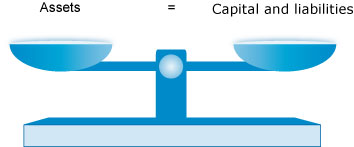
This diagram uses balanced scales to visualize the accounting equation: Assets on one side and Capital plus Liabilities on the other. It illustrates why double entry works—any transaction must keep the two sides equal by creating an equal and opposite effect elsewhere in the accounts. Source
Duality: Every transaction affects at least two items in the accounts.
Every transaction has two aspects, so a change in one part of the accounts causes a corresponding change elsewhere. This idea underpins the whole double entry system and helps keep records logically connected. Because of duality, accounting is not just a list of separate entries; it is a structured system in which assets, liabilities, capital, income, and expenses interact. This makes it possible to build complete accounts from individual transactions.
Materiality
The materiality concept focuses attention on information that is significant enough to affect decisions.
Materiality: An item is material if its omission or misstatement could influence the decisions of users of the accounts.
Materiality depends on the size of the item and sometimes on its nature. This concept allows accountants to focus attention on matters that are significant rather than on trivial detail. It supports efficient and useful reporting, but it also requires judgment, because what is material in a small business may be immaterial in a much larger one. Material items must be treated carefully because incorrect treatment could change the way users interpret the financial accounts.
Applying concepts together
These concepts are linked and are rarely applied in isolation. For example, the going concern assumption supports the use of historic cost for many assets because the business expects to keep using them rather than sell them immediately. Materiality affects how much detail is needed and whether a simpler treatment would still be acceptable. Prudence must be applied carefully alongside realization so that income is neither recorded too early nor suppressed without good reason. In practice, accountants use these concepts as a framework for judgment. They do not remove the need for evidence, but they help ensure that financial accounts are prepared on a logical and consistent basis from one accounting period to the next.
Practice Questions
State two accounting concepts that underpin financial accounts. [2]
1 mark for each correct concept stated, maximum 2.
Accept any two from: business entity, historic cost, money measurement, going concern, prudence, realization/realisation, duality, materiality.
Explain how the going concern, prudence, and materiality concepts help accountants prepare useful financial accounts. [6]
Going concern explained as the assumption that the business will continue operating; therefore accounts are prepared on a normal operating basis. (2)
Prudence explained as caution under uncertainty; assets and income should not be overstated, and liabilities and expenses should not be understated. (2)
Materiality explained as focusing on items significant enough to affect user decisions; important items must be shown accurately and with suitable attention. (2)
1 mark for identification and 1 mark for clear explanation of each concept, maximum 6.
FAQ
Materiality is not based only on size.
A small amount may still be material if its nature is important, for example if it:
changes a profit into a loss
hides fraud or an illegal payment
affects compliance with a contract or regulation
This is why accountants consider both amount and context.
Common warning signs include:
repeated trading losses
serious cash flow problems
inability to repay loans on time
suppliers refusing further credit
loss of a major customer, market, or key supplier
major legal claims
If these problems are severe, the accounts may need extra disclosure or a different basis of preparation.
Historic cost remains reliable because it is based on actual transaction evidence.
However, during inflation:
older asset costs may look very low compared with current values
expenses based on old costs may not reflect present economic conditions
comparisons between old and new assets can become misleading
So historic cost improves objectivity, but it may reduce relevance when prices rise significantly.
Yes. Prudence should mean caution, not deliberate understatement.
If it is applied too aggressively, the accounts may:
understate profit
undervalue assets
overstate liabilities
create an unfairly weak picture of performance
That would reduce neutrality and comparability. Prudence should be based on evidence and reasonable judgment, not systematic pessimism.
Duality supports a balanced accounting system because each transaction should have matching effects.
This helps reveal some mistakes, such as:
recording only one side of a transaction
recording unequal debit and credit amounts
But duality does not catch every error. If both sides are omitted, or both sides are entered incorrectly by the same amount, the records may still appear balanced.
