

CIE Syllabus focus:
'Candidates should understand matching and accruals, objectivity and substance over form as concepts used when preparing financial accounts.'
Financial accounts are most useful when they report the correct period, rely on trustworthy evidence, and reflect the real economic effect of transactions rather than just their legal wording.
Matching and accruals
The matching concept is central to measuring profit fairly.
Matching concept: Revenue for a period should be matched with the expenses incurred to earn that revenue in the same accounting period.
This means profit is not based simply on cash received and cash paid.
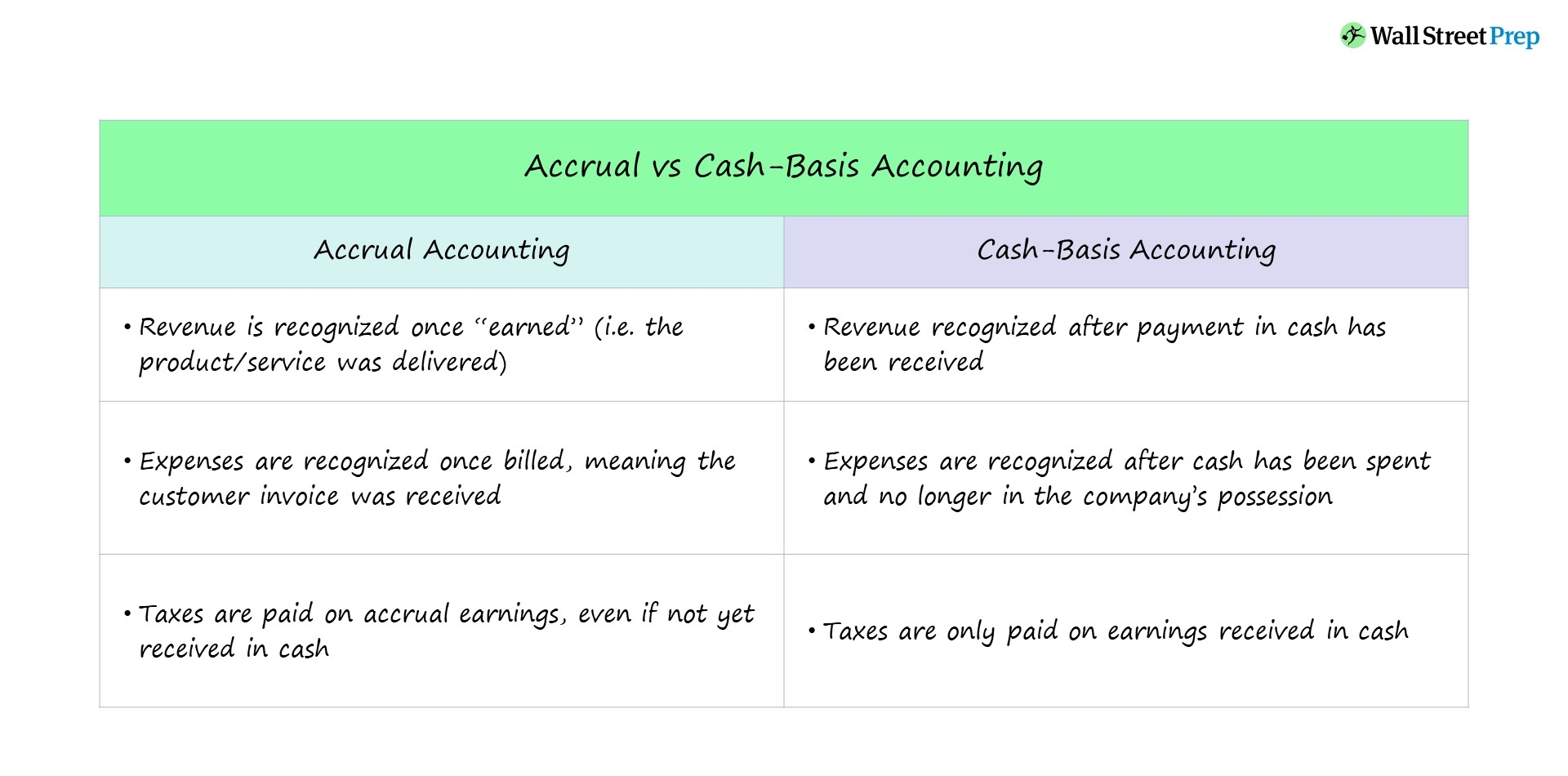
A side-by-side diagram contrasting accrual accounting with cash-basis accounting. It highlights that accrual accounting recognizes revenue when earned and expenses when incurred (often before cash moves), whereas cash-basis accounting records items only when cash is received or paid. Source
It is based on income earned and expenses incurred during the period being reported.
The accruals basis supports this approach.
Accruals basis: Financial transactions are recorded in the accounting period to which they relate, whether or not cash has yet been received or paid.
Under this concept:
revenue is recognized when it is earned
expenses are recognized when they are incurred
amounts relating to other periods are excluded from the current period’s profit figure
A business may use electricity in the year ended December 31 but receive the bill in January. Under accruals, the cost belongs to the year in which the electricity was used. Similarly, if rent is paid in advance, the part relating to a future period should not be treated as an expense of the current year.
The main purpose of matching and accruals is to calculate a more accurate profit or loss for a period. If a business ignored these ideas and recorded only cash movements:
profit could be overstated in one year and understated in the next
assets and liabilities at the end of the period could be misstated
comparisons between accounting periods would be less reliable
Matching and accruals are important because financial statements are prepared for specific time periods. Without them, the timing of payments and receipts could distort reported performance.
Objectivity
When preparing accounts, accountants should rely on evidence rather than personal opinion. This is the idea of objectivity.
Objectivity: Accounting information should be based on verifiable evidence and should not be influenced by personal bias.
Objective evidence may include:
invoices
receipts
bank statements
credit notes
contracts
supplier statements
official correspondence
Objectivity matters because different users of accounts need to trust the information presented. If figures are based only on guesswork or management preference, the accounts become less dependable.
Objectivity does not mean that every number is exact. Some items in accounting require estimation. However, the estimate should still be based on the best available evidence and reasonable judgment. For example, if an expense has to be accrued before the invoice arrives, the amount should be supported by documents such as prior bills, meter readings, or contract terms.
Benefits of objectivity include:
greater reliability of financial statements
reduced risk of deliberate manipulation
improved consistency in accounting records
stronger support for checking and verification
A lack of objectivity can lead to biased asset values, misstated expenses, or profit figures that favor one group of users over another.
Substance over form
Sometimes the legal description of a transaction does not fully show its economic effect.
In these situations, accountants should apply substance over form.
Substance over form: Transactions should be recorded and presented according to their economic reality, not merely their legal form.
This concept is important because users of financial accounts need to understand what a transaction really means for the business.
For example:
if a business controls and uses an asset for most of its useful life, the transaction may in substance be the acquisition of an asset, even if legal ownership is arranged differently
if goods are held on behalf of another business, they should not be treated as inventory of the holder simply because they are physically on the premises
if a sale agreement leaves major risks and rewards with the seller, it may not yet be a true sale in substance
Substance over form prevents accounts from being misleading. A transaction can be designed in a particular legal way, but the accountant must consider its real financial effect on assets, liabilities, income, and expenses.
This concept is especially important where businesses enter into more complex agreements. If accounting followed legal labels only, companies could make their financial position appear stronger or weaker than it really is.
Applying the concepts in financial accounts
These three ideas often operate together when financial accounts are prepared.
If an expense relates to the current year, matching and accruals require it to be included in that year’s profit calculation. Objectivity requires the amount to be supported by evidence. If the transaction has been structured in an unusual way, substance over form requires the accountant to record its real economic effect.
When reviewing transactions, the accountant must decide:
which accounting period the item belongs to
what evidence supports recognition and measurement
whether the amount recorded is free from personal bias
whether the legal wording reflects the true commercial reality
Practice Questions
State what is meant by the accounting concept of objectivity. [2]
1 mark: accounting information is based on verifiable evidence or documentation
1 mark: accounting information is free from personal bias or opinion
Explain why the concept of substance over form is important when preparing financial accounts. Use one example to support your answer. [6]
1 mark: transactions should be recorded according to economic reality
1 mark: not just according to legal form
1 mark: prevents misleading presentation of financial statements
1 mark: improves reliability or usefulness for users
1 mark: valid example given, such as consignment goods or an asset controlled by the business although legal ownership differs
1 mark: example clearly explained in accounting terms
FAQ
Cutoff procedures check whether income and expenses have been recorded in the correct accounting period.
They often involve reviewing goods received notes, delivery notes, supplier statements, and service periods around the year-end.
This helps identify:
expenses incurred before year-end but not yet invoiced
income earned before year-end but not yet received
payments made early that relate to the next period
Without good cutoff procedures, the accruals concept may be applied incorrectly.
A missing invoice does not automatically mean no expense should be recorded.
Useful evidence may include:
a signed contract
supplier statements
time sheets
utility meter readings
purchase orders
correspondence confirming the amount or service period
The stronger and more independent the evidence, the more objective the accrual will be.
Yes, if they are reliable and can be checked.
Digital evidence may include:
scanned invoices
emailed supplier confirmations
online bank records
electronic contracts
system-generated audit trails
What matters is not whether the evidence is paper or digital, but whether it is authentic, complete, and capable of independent verification.
Weak digital controls, however, can reduce confidence in the evidence.
Consignment goods are held by one business on behalf of another.
Even though the goods may be physically on the premises, they should not be included as inventory of the holder if the holder does not own them and does not bear the main risks and rewards.
So the accounting treatment follows the real commercial position:
owner records the inventory
holder may record only any commission receivable
This avoids overstating inventory and profit.
Common warning signs include:
unusual agreements made close to the year-end
transactions with related parties on unclear terms
sales recorded even though major risks remain with the seller
assets kept off the statement of financial position despite long-term control by the business
legal documents that conflict with normal commercial behavior
These situations do not always mean the accounts are wrong, but they should prompt careful review of the true economic effect.
