CIE Syllabus focus:
'Candidates should understand the principles of the double entry system for recording business transactions and the accounting equation.'
Double entry gives accounting its structure. It ensures that every transaction is recorded completely and that the accounting equation remains balanced, allowing financial records to be organized, reliable, and internally consistent.
The basis of double entry
Accounting records are built on the idea that each business transaction has two effects.

A basic T-account (ledger account) format, showing the split between the left-hand debit side and the right-hand credit side. This layout is the core “container” used to record the two equal and opposite effects of each transaction in double entry. Source
A business may receive something and give something, or one item may increase while another decreases. Because of this dual effect, every transaction is entered in at least two accounts. This is why the system is called double entry.
Double entry: A system of accounting in which every transaction is recorded with equal debit and credit entries in the appropriate accounts.
The important point is that debit and credit describe the side of an account used for the entry, not whether the entry is favorable or unfavorable. In double entry, total debits must always equal total credits. If this principle is followed properly, records stay mathematically balanced.
Double entry is essential because it creates a complete record of a transaction. Recording only one side would make the accounts incomplete and would break the balance within the accounting system. This principle also helps accountants trace transactions and check whether records appear internally consistent.
In practice, some transactions involve more than two accounts. Even then, the same rule applies: the total of all debit entries must equal the total of all credit entries. What matters is not the number of accounts involved, but that every aspect of the transaction has been recorded.
Debit and credit rules
To apply double entry correctly, you need to know how different categories of account behave.
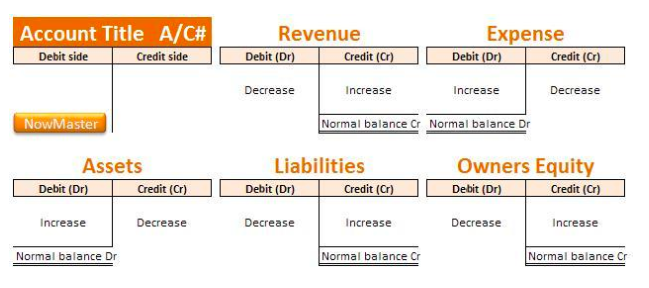
A debit/credit rules chart showing how debits and credits increase or decrease each major account type (Assets, Liabilities, Owners’ Equity, Revenue, and Expenses), including their normal balances. This kind of summary supports fast, accurate application of double entry when deciding which side of each account to use. Source
Assets usually increase with a debit entry and decrease with a credit entry.
Liabilities usually increase with a credit entry and decrease with a debit entry.
Capital usually increases with a credit entry and decreases with a debit entry.
Income increases capital, so it is normally recorded on the credit side.
Expenses reduce profit and therefore reduce capital, so they are normally recorded on the debit side.
Drawings reduce the owner’s claim on the business, so they are treated as a debit entry.
These rules reflect the way each transaction keeps the accounting system in balance. Learning the pattern of increases and decreases is a key part of understanding double entry.
The accounting equation
The accounting equation expresses the relationship between what a business owns, what it owes, and the owner’s interest in the business.
Accounting equation: The statement that the assets of a business are financed by capital and liabilities.
This relationship is the foundation of all financial accounting. It shows that the business’s resources must come from either the owner or outside parties. Capital is therefore the residual interest of the owner after liabilities have been considered.
= resources owned or controlled by the business
= the owner's claim on the business
= amounts owed by the business to external parties
The equation must remain balanced after every valid transaction.
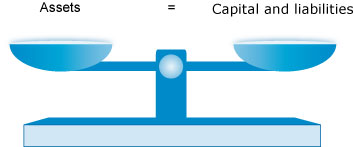
A balance-scale illustration of the accounting equation: Assets on one side must equal the combined claims of Capital and Liabilities on the other. It provides a memorable visual model for why every transaction must preserve equality in the statement of financial position. Source
If assets increase, there must be a matching increase in capital, a matching increase in liabilities, or a decrease in another asset. If assets decrease, there must be a corresponding decrease elsewhere in the equation. This is why the accounting equation and double entry are closely linked: the equation explains why two equal entries are needed.
How transactions affect the equation
Different transactions affect the accounting equation in different ways.
An owner introducing cash increases assets and increases capital.
Buying an asset for cash changes the form of assets: one asset increases and another asset decreases.
Buying goods or equipment on credit increases assets and increases liabilities.
Paying a supplier or other payable reduces assets and reduces liabilities.
Taking out a loan increases assets and increases liabilities.
Drawings reduce assets and reduce capital.
Profit also affects the equation through capital. Income increases profit, which increases capital if retained in the business. Expenses reduce profit, which reduces capital. So although income and expenses are recorded separately in the accounts, their overall effect is through the owner’s interest in the business.
Why the system must balance
A balanced accounting equation shows that the resources of the business have been matched with the claims against those resources. Double entry makes this possible by requiring both sides of every transaction to be recorded.
When the correct debit and credit entries are made:
the record is complete
the equation remains balanced
transactions can be followed logically through the accounts
accounting information becomes easier to check for internal consistency
However, balance alone does not prove that all entries are correct. Two incorrect entries of the same amount may still keep the records balanced. Double entry is therefore a strong control, but it must still be applied carefully and accurately.
Common points to remember
Debit does not always mean increase; it depends on the type of account.
Credit does not always mean decrease; it also depends on the type of account.
A transaction can affect capital indirectly through income, expenses, or drawings.
The accounting equation applies to the business, not to the owner’s personal affairs.
Every transaction recorded under double entry must preserve equality between total debits and total credits.
Practice Questions
State two principles of the double entry system. (2 marks)
1 mark for stating that each transaction has two aspects or is recorded in two accounts.
1 mark for stating that total debits equal total credits.
For each of the following transactions, state the account to be debited and the account to be credited.
(a) The owner introduces cash into the business as capital.
(b) Inventory is bought on credit from a supplier.
(c) Rent is paid by bank.
(d) Equipment is purchased for cash.
(e) A bank loan is received.
(5 marks)
(a) Debit cash or bank, credit capital. 1 mark
(b) Debit inventory or purchases, credit trade payables or supplier. 1 mark
(c) Debit rent, credit bank. 1 mark
(d) Debit equipment or non-current asset, credit cash or bank. 1 mark
(e) Debit bank or cash, credit bank loan. 1 mark
FAQ
A credit purchase means the business receives goods or services now and pays later.
A credit entry is simply an entry made on the right-hand side of an account. A credit purchase can involve both a debit entry and a credit entry, so the words do not mean the same thing.
Drawings are amounts taken by the owner for personal use. They are not a cost of earning business revenue.
Because of that, drawings reduce capital directly rather than being treated as an expense in profit measurement. Expenses relate to running the business; drawings relate to the owner taking value out of it.
Owner investment is not earned from trading. It is money or other assets introduced by the owner.
Income arises from business operations, such as sales or fees earned. Capital introduced by the owner increases the owner’s claim on the business, so it is recorded as capital, not as income.
Yes. Some errors still leave the equation balanced.
For example:
the same wrong amount may be entered on both sides
the correct amount may be posted to the wrong account on each side
one asset may be confused with another asset
So balance is important, but it does not prove the records are fully accurate.
The statement of financial position is a formal presentation of the accounting equation at a specific date.
It shows:
assets
liabilities
capital or equity
So the accounting equation is the underlying principle, while the statement of financial position is the financial statement built from that principle.