CIE Syllabus focus:
'Candidates should understand the need to reconcile and verify ledger accounts using internal and external documentation.'
Accurate accounting records depend on checking ledger balances against evidence. Reconciliation and verification help a business confirm that entries are complete, reliable, and suitable for preparing financial statements and supporting sound decisions.
What reconciliation and verification mean
Reconciliation and verification are checking procedures used to test the reliability of ledger accounts. They are related, but they do not mean exactly the same thing.
Reconciliation: The process of comparing two sets of accounting information and investigating any differences so that the records can be brought into agreement.
Reconciliation is concerned with whether balances or records agree with each other.
Verification: The process of checking that a ledger entry or balance is supported by valid documentary evidence and has been recorded accurately.
Verification is concerned with whether the entry itself is genuine, accurate, and supported by evidence.
Ledger accounts and documentary support
A ledger account records the monetary effect of transactions relating to one item, such as cash, receivables, payables, purchases, or sales. Because ledger accounts are based on source evidence, they should always be capable of being checked back to documents.
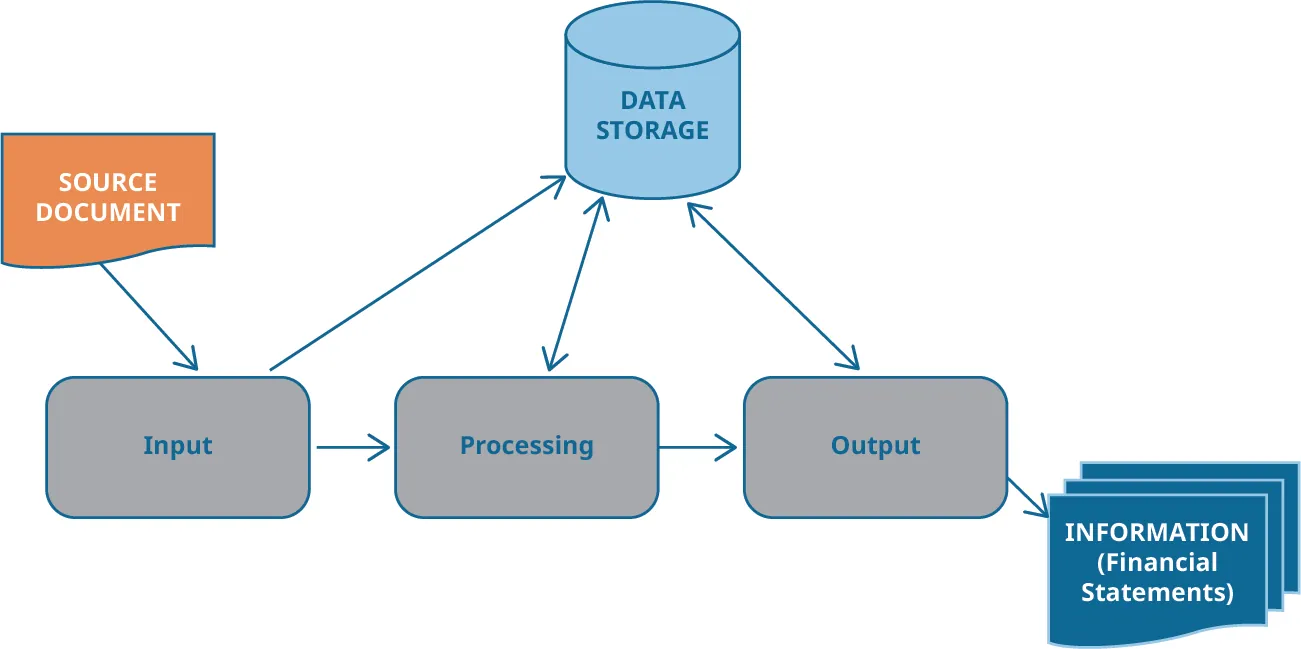
Diagram of an accounting information system showing how source documents enter the system (input), are transformed (processing), and produce reports (output), with data storage supporting all stages. It reinforces the idea of an audit trail: entries in the ledger should be traceable back to originating documents for verification. Source
Internal documentation: Documents produced within the business, such as invoice copies, credit note copies, journal vouchers, goods received records, and till rolls.
Internal documents show what the business has recorded and help staff trace how transactions were entered and posted to the ledger.
External documentation: Documents received from outside the business, such as supplier statements, bank statements, and invoices from suppliers.
External documents provide independent evidence and are useful when checking whether internal records are complete and accurate.
Why reconciliation is necessary
Ledger accounts are prepared by people and systems, so mistakes can occur. Transactions may be omitted, duplicated, posted to the wrong account, or recorded for the wrong amount. Reconciliation is needed to identify these problems before the records are used.
The main purposes of reconciliation are to:
check accuracy of recorded transactions and balances
identify differences between records that should agree
prompt investigation into errors, omissions, or timing differences
support corrections before information is used by managers or other users
A difference does not always mean fraud or a serious mistake. It may exist because one record has been updated and another has not. Even so, the difference must be investigated so that the true balance is known.
Reconciliation matters because ledger balances are used to prepare financial statements. If they are not checked, profit, assets, liabilities, or capital may be misstated.
Why verification is necessary
Even when totals agree, the underlying entries may still be wrong. An amount may be posted correctly but based on weak evidence, or it may come from an unauthorized document. Verification is therefore needed as well as reconciliation.
Verification helps a business to confirm:
existence of the transaction
correct amount and date
correct classification in the ledger
proper authorization, where approval is required
This matters because accounting records should be based on evidence, not assumption. A ledger entry without documentary support is less reliable and reduces confidence in the accounts.
Using internal and external documentation together
Internal and external documents are strongest when used together. Internal evidence shows how the business recorded a transaction, while external evidence shows whether another party reports the same transaction or balance.
Using both types of documentation helps with:
cross-checking, because one source can be compared with the other
completeness, because an external document may reveal an unrecorded item
accuracy, because an internal document may explain the detail behind an outside figure
independence, because external evidence adds extra reliability
For a ledger balance to be trusted, it should not simply be accepted at face value. It should be capable of support from records inside the business and, where available, evidence from outside the business.
Importance for control and accountability
Reconciliation and verification are also important internal control procedures. They reduce the risk that errors remain undetected and make it harder for fraud or unauthorized transactions to go unnoticed.
They promote accountability because:
staff know entries may be checked against evidence
unusual items are more likely to be investigated
missing documents can be followed up quickly
corrections can be made while records are still current
These procedures are especially important in businesses with many transactions, several accounting staff, or a computerized accounting system. Speed of recording does not remove the need for checking.
Effect on the quality of accounting information
Reliable accounting information should be accurate, complete, and supported by evidence. Reconciliation and verification improve these qualities and make ledger accounts more dependable for preparing financial statements, monitoring operations, and demonstrating proper stewardship of resources.
Where these checks are not carried out regularly, balances may remain inaccurate for long periods. This can lead to poor decisions, disputes with suppliers or customers, and loss of confidence in the accounting records.
Practice Questions
State two purposes of reconciling ledger accounts.
[2 marks]
1 mark for each valid purpose stated, up to 2 marks.
Accept answers such as:
checking accuracy of balances
identifying differences between records
finding errors or omissions
supporting corrections
improving reliability of accounting records
Explain why a business should use both internal and external documentation when verifying ledger accounts.
[6 marks]
Award 1 mark for each valid explained point, up to 6 marks.
Possible answers:
internal documentation shows how the business recorded the transaction
external documentation provides independent evidence from outside the business
comparing both sources helps identify errors
comparing both sources helps identify omissions
agreement between the two increases confidence in the ledger balance
differences show that further investigation is needed
using both makes fraud or unauthorized entries harder to hide
verified balances are more reliable for preparing financial statements
FAQ
The frequency depends on the volume of transactions and the risk of error.
Cash and bank-related records often need very frequent checking.
Receivables and payables are commonly reviewed monthly.
Major ledger balances should always be checked before financial statements are prepared.
The business should not ignore the item.
It can:
use available internal evidence temporarily
follow up with the outside party for the missing document
note that the balance is still awaiting confirmation
avoid treating the balance as fully verified until support is obtained
Yes. Electronic documents can be valid evidence if they are reliable and accessible.
Good digital evidence should:
be complete and readable
show dates and key details clearly
come from a trustworthy source
be protected from unauthorized alteration
be stored so it can be retrieved later
Ideally, the person checking should not be the same person who originally recorded the transaction.
This separation reduces the risk of:
unnoticed mistakes
deliberate alteration of records
over-reliance on one employee
In a small business, where full separation is difficult, owner review can provide an extra check.
No. Two records may match and still both be wrong.
For example:
the same wrong amount could be copied into two places
a transaction could be recorded in the wrong account but still agree in value
a document might be invalid even though the amount matches
That is why matching figures should be supported by proper verification, not accepted automatically.