

CIE Syllabus focus:
'Candidates should understand the effect on financial statements when errors are corrected.'
Correcting accounting errors is not just a bookkeeping task. Each correction can change profit, asset values, liabilities, and capital, so you must identify exactly which financial statement figures were previously wrong.
Why the effect of correction matters
When an error is corrected, the aim is to restore the financial statements to the amounts that should have been reported originally. The important issue is not only the correcting entry, but also whether the error caused an overstatement or understatement of profit, assets, liabilities, or capital.
Error correction: The process of amending accounting records so that income, expenses, assets, liabilities, and capital or equity are shown at their correct amounts.
In exam questions, the focus is often on the effect of the correction rather than the mechanics of the journal entry. This means you need to trace how the original mistake flowed through to the statement of profit or loss and the statement of financial position.
Main financial statement areas affected
Statement of profit or loss
A correction affects profit for the year only when the error involves income or expenses.
If income was understated, correcting the error will increase profit.
If income was overstated, correcting the error will decrease profit.
If expenses were understated, correcting the error will decrease profit.
If expenses were overstated, correcting the error will increase profit.
This is a key rule: profit changes only when the correction changes the amount of revenue or expense recognized for the period. If the error does not involve revenue or expense, profit may stay the same.
Statement of financial position
A correction may also change the amounts of assets, liabilities, and capital/equity.
An understated asset becomes higher when corrected.
An overstated asset becomes lower when corrected.
An understated liability becomes higher when corrected.
An overstated liability becomes lower when corrected.
Some corrections affect only one side of the statement of financial position. Others affect both the statement of financial position and profit at the same time. You should always decide which balances were wrong before the correction and then state the direction of the change clearly.
Capital and equity
If profit has been affected by an error, then capital or equity will also be affected because profit for the year is transferred into the owner’s interest in the business.
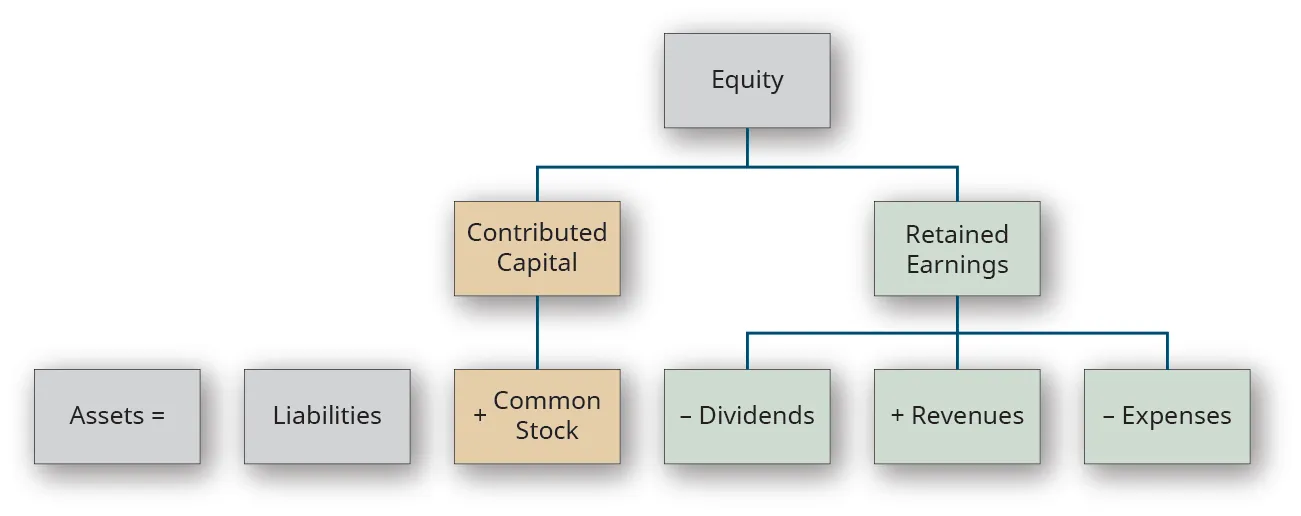
Expanded accounting equation diagram showing that equity can be broken down into contributed capital and retained earnings, and that retained earnings is affected by revenues, expenses, and dividends. This is the key structure behind exam explanations such as “profit increases, so equity (retained earnings/capital) increases.” Source
If corrected profit increases, capital/equity will also increase.
If corrected profit decreases, capital/equity will also decrease.
In a sole trader or partnership, this will usually affect capital or related equity balances. In a company, the effect is reflected in retained earnings as part of equity.
Common patterns in corrected errors
Errors affecting income or expenses
These have the most direct effect on financial statements.
If revenue was omitted or recorded too low:
revenue increases when corrected
profit increases
an asset such as cash or trade receivables may also increase
If an expense was omitted or recorded too low:
expenses increase when corrected
profit decreases
a liability such as a payable may increase, or an asset may decrease
If an expense was recorded twice or too high:
expenses decrease when corrected
profit increases
any related asset or liability is restored to the correct amount
Errors affecting only financial position items
Some errors do not change profit at all. Instead, they change only the classification or amount of items in the statement of financial position.
Examples of effects include:
one asset balance decreasing while another asset balance increases
a liability being reduced and capital increased
a balance being transferred from the wrong class of account to the correct one
In these cases, the correction is still important because the financial statements were presenting the wrong position even though total profit may have been correct.
Errors affecting both profit and financial position
Many errors create a combined effect. For example, if a credit sale was omitted, both revenue and trade receivables were understated. Correcting the error increases revenue, increases receivables, and increases profit, which then increases capital/equity.
If a credit expense was omitted, the correction increases the expense and increases the related payable. Profit falls, and capital/equity falls as a result.
This is why you should think in two stages:
first, identify the immediate accounts affected
second, trace the impact on profit and then on capital/equity
Judging the effect in exam questions
A reliable way to judge the effect of correcting an error is to ask these questions:
What figure was originally too high or too low?
Is that figure an income, expense, asset, liability, or capital/equity item?
If income or expense changes, what happens to profit?
Once profit changes, what happens to capital/equity?
Does the correction change a total, or does it only change the classification of balances?
Use precise language in answers.
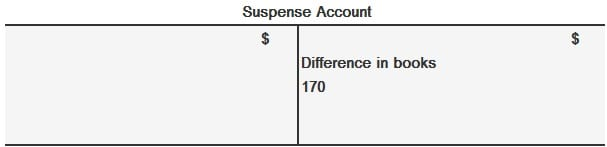
Worked example of a suspense account (T-account) used to temporarily balance a trial balance difference, illustrating which side the difference is posted to. This supports error-correction questions where one side of the double entry is missing or misstated and the suspense account is used until the error is found. Source
Strong exam responses say:
profit overstated
trade receivables understated
liabilities increase on correction
capital decreases by the same amount as the reduction in profit
When the timing of discovery matters
The timing of the discovery can affect how the correction appears in financial statements. If the error is found before the financial statements are finalized, the corrected figures are included in the current statements. If the error is found later, the effect may appear through amended figures, revised comparatives, or adjustments to opening equity balances.
For CIE questions, the most important skill is to identify the final effect after correction. Always state clearly whether the correction increases, decreases, or leaves unchanged each relevant item in the financial statements.
Practice Questions
An error caused rent expense to be overstated. State two effects on the financial statements when this error is corrected. (2 marks)
Rent expense decreases / is reduced. (1)
Profit for the year increases / had been understated before correction. (1)
Before preparing the financial statements, a business discovers that:
credit sales of 1,500 had been entered twice
State the effect of correcting these errors on: (a) revenue (b) insurance expense (c) profit for the year (d) trade receivables (e) capital/equity
(5 marks)
(a) Revenue increases by 1,500. (1)
(c) Profit for the year increases by 6,000. (1)
(e) Capital/equity increases by $7,500. Accept retained earnings or owner’s capital. (1)
FAQ
A trial balance only checks whether total debits equal total credits.
An error can still leave the trial balance balanced if the wrong amount was entered on both sides, the wrong account was used on the correct side, or a transaction was omitted completely. In those cases, the arithmetic balance looks correct, but profit or financial position may still be misstated.
A compensating effect happens when one error increases a figure and another error decreases it.
For example, one mistake may overstate profit while another understates it. The final profit may appear close to correct, but individual balances are still wrong. This is dangerous because users may trust the overall total without noticing that important statement items need correction.
An error may affect one year’s closing figures and then carry forward into the next year as an opening balance.
That means trend analysis can be distorted twice:
once in the original year
again in the following year
Even if the business later corrects the records, the comparison between years may be misleading unless the earlier figures are also reconsidered.
This usually depends on whether the error is material.
If the error is significant enough to influence decisions by owners, lenders, or investors, revised statements may be needed. The business may also need to explain what changed and why. If the error is very small, it may be adjusted in the next accounting cycle without major external action.
Materiality affects how important the correction is to users.
A small correction may change a figure but not change any decision. A material correction can alter judgments about:
profitability
financial strength
management performance
So accountants do not look only at whether a number changes. They also consider whether the size or nature of the correction is important enough to affect how the financial statements are interpreted.
