CIE Syllabus focus:
'Candidates should understand entries in sales ledger and purchases ledger control accounts and reconciliation statements between control account and ledger balances.'
Control accounts summarize total receivables and total payables in one place.
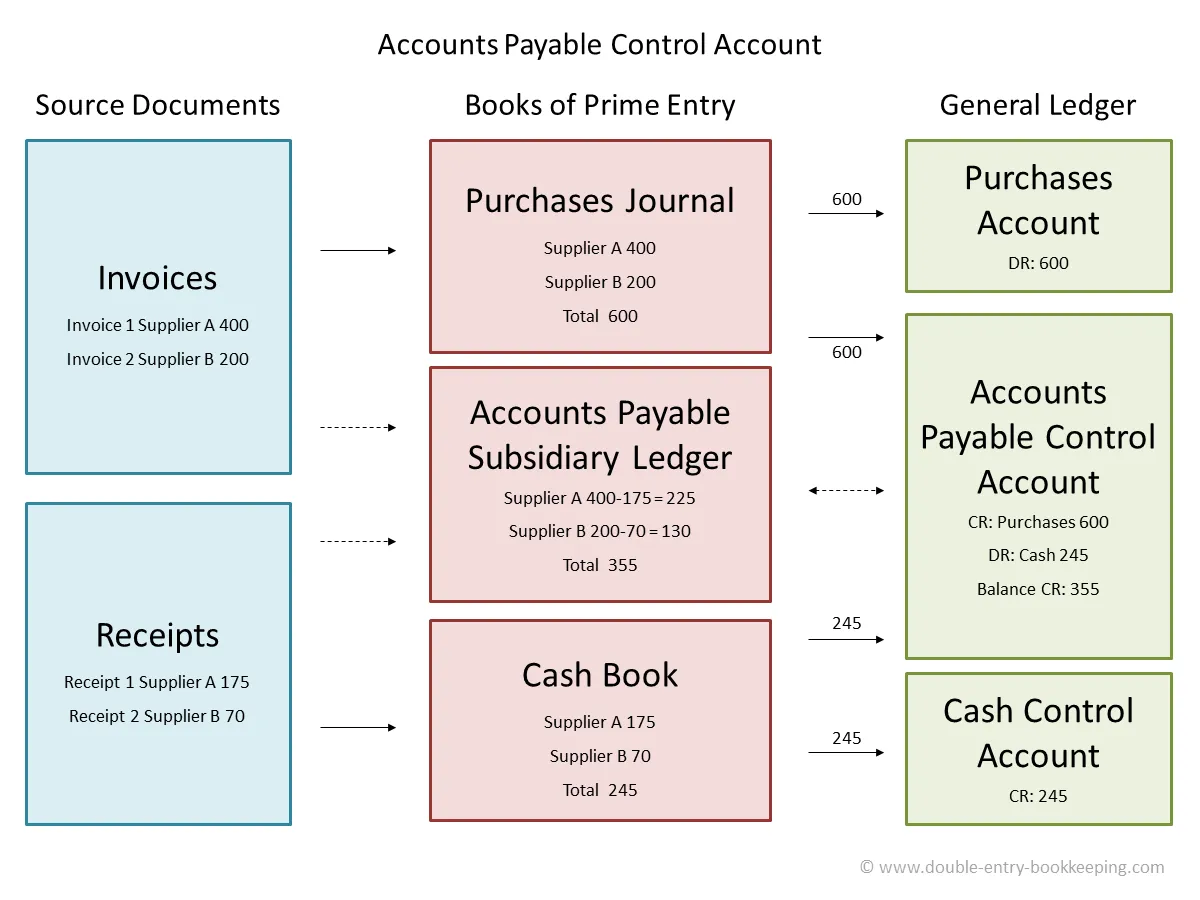
Flow diagram showing how transactions move from source documents (invoices/receipts) into books of prime entry (purchases journal, cash book), then into the general ledger as summary postings to the accounts payable (purchases ledger) control account. It also shows the link to the subsidiary ledger totals, reinforcing the idea that the control account balance should agree with the total of individual supplier balances after posting. Source
They are used to check the accuracy of personal ledgers and to support the preparation of reliable accounting records.
What are control accounts?
A control account is kept in the general ledger and contains the combined total of balances and transactions from a subsidiary ledger. In this topic, the important control accounts are the sales ledger control account and the purchases ledger control account.
Control account: A summary account in the general ledger that records the total of transactions and balances from a subsidiary ledger.
The sales ledger control account shows the total amount due from credit customers. The purchases ledger control account shows the total amount owed to credit suppliers.
These accounts do not replace the individual customer and supplier accounts. Instead, they act as an independent check on them. If the balance on a control account does not agree with the total of the balances in the related ledger, a difference exists and must be investigated.
A sales ledger control account will normally end with a debit balance, because receivables are assets. A purchases ledger control account will normally end with a credit balance, because payables are liabilities.
Entries in the sales ledger control account
Main entries
The sales ledger control account records all transactions affecting the total owed by credit customers.
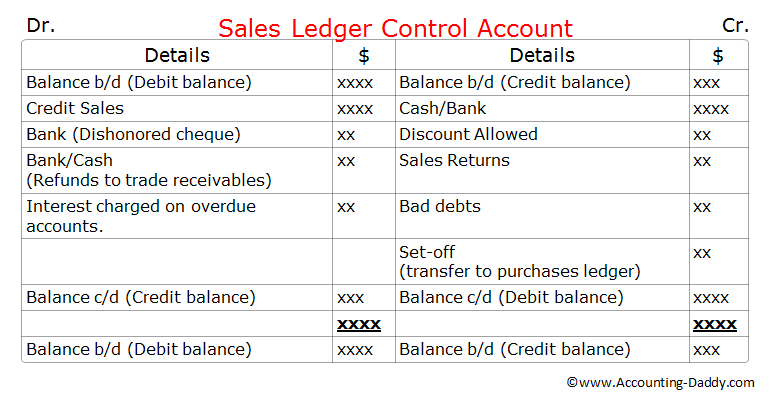
Format/layout of a sales ledger control account (total trade receivables) shown as a T-account. It highlights the typical postings on each side—items that increase receivables on the debit side (e.g., credit sales) and items that reduce receivables on the credit side (e.g., cash received, sales returns, discounts allowed, bad debts). Source
Common debit entries are:
opening balance of trade receivables
credit sales
dishonored checks from customers
any other adjustment that increases the amount due from customers
Common credit entries are:
cash received from credit customers
sales returns
discounts allowed
irrecoverable debts written off
contra entries against amounts the customer is also owed as a supplier
any other adjustment that reduces the amount due from customers
The closing balance is the total amount still due from customers at the end of the period.
What to remember
The control account must reflect the total effect of entries made in individual customer accounts. If a transaction affects receivables overall, it should appear in the sales ledger control account. This is why entries are often taken from total figures rather than from one customer account at a time.
Accuracy matters in two ways:
the entry must be on the correct side of the control account
the amount posted must agree with the related total in the personal ledger
Entries in the purchases ledger control account
Main entries
The purchases ledger control account records all transactions affecting the total owed to credit suppliers.
Common credit entries are:
opening balance of trade payables
credit purchases
any other adjustment that increases the amount owed to suppliers
Common debit entries are:
cash paid to credit suppliers
purchase returns
discounts received
contra entries against amounts due from the same business as a customer
any other adjustment that reduces the amount owed to suppliers
The closing balance is the total amount still owed to suppliers at the end of the period.
Key point
The purchases ledger control account is the opposite of the sales ledger control account in its usual balance. This is because payables are normally credit balances in the ledger. Students should be careful not to reverse the normal debit and credit treatment.
Reconciliation statements
After preparing a control account, the balance should be compared with the total of the individual balances in the related ledger. If they are not equal, a reconciliation statement is prepared.
Reconciliation statement: A statement used to explain and adjust differences between the balance on a control account and the total of the balances in the related ledger.
A reconciliation statement is not the same as the control account itself. The control account records transactions. The reconciliation statement explains why two totals differ.
Reasons for disagreement
Differences between a control account balance and a ledger total may arise because:
an entry was made in the control account but omitted from an individual account
an entry was made in an individual account but omitted from the control account
an amount was entered incorrectly in one place
an item was posted to the wrong side of an account
a balance was left out when listing the individual ledger balances
the list of balances was added incorrectly
a contra entry was recorded in one ledger but not reflected in the control account
These are checking differences between the summary record and the detailed records.
Preparing a reconciliation statement
When preparing a reconciliation statement:
begin with either the control account balance or the total of the balances in the sales or purchases ledger
identify each item causing the difference
add items that should increase the starting figure
subtract items that should reduce the starting figure
show a final adjusted balance that agrees with the other record
The direction of the adjustment depends on the figure you start with. For example, if you begin with the control account balance, each item in the reconciliation must explain how that balance is converted into the total of the ledger balances.
Clear labeling is essential. Each adjustment should state whether it relates to:
omission
incorrect posting
balance omitted from the list
arithmetic error in the listing of balances
Good practice in exams
In examination questions, read carefully whether you are reconciling:
sales ledger control account to sales ledger balances, or
purchases ledger control account to purchases ledger balances
Also check whether the question gives:
a prepared control account balance
a list of personal ledger balances
extra information about errors or omissions
Marks are often lost by adjusting in the wrong direction. A sensible check is to ask whether the item would make the starting balance larger or smaller. If the logic is correct, the reconciliation is more likely to be accurate.
Practice Questions
State two items that may appear on the credit side of a sales ledger control account. (2 marks)
1 mark for any correct item, up to 2 marks.
Acceptable answers include:
cash received from credit customers
sales returns
discounts allowed
irrecoverable debts written off
contra entries
At the end of the year, the balance on the sales ledger control account was 49,380. The total of the balances in the sales ledger was 48,920.
The following were discovered:
discounts allowed of 600 had been entered in the sales ledger control account only
a customer balance of 450 had been omitted from the list of sales ledger balances
sales returns of 310 had been entered in the customer’s account but not in the sales ledger control account
Prepare a reconciliation statement starting with the balance on the sales ledger control account. (5 marks)
1 mark: correct opening balance of 49,380
1 mark: subtract 600 for discounts allowed entered in control account only
1 mark: subtract 450 for balance omitted from list of sales ledger balances
1 mark: subtract 310 for sales returns omitted from control account
1 mark: correct reconciled balance of 48,020
FAQ
Yes. This is unusual, but it can happen if a customer has overpaid, returned goods after paying, or has been given a credit note not yet used against future purchases.
In that case:
the customer’s personal account shows a credit balance
the sales ledger control account includes that credit as part of the total
It is still included in the control account because the control account must match the total of all customer balances, even unusual ones.
A dishonored check means a payment previously received from a customer has failed. The amount must therefore be added back to what the customer owes.
This is usually recorded:
as a debit in the sales ledger control account
as a debit in the customer’s personal account
If it is posted in only one place, the control account balance and the total of the ledger balances will disagree.
A contra entry is used when the same business is both a customer and a supplier. The amount due from one side is set off against the amount due on the other.
These entries can cause differences because:
one side may be updated and the other forgotten
the amount may be posted to the wrong control account
the individual personal accounts may be adjusted without updating the control account totals
Because contra entries affect both receivables and payables, they require careful double checking.
Normally, no. A zero balance does not affect the total of the ledger balances, so it is not necessary for the reconciliation total itself.
However, accounts with zero balances may still be kept open temporarily for administrative reasons, such as awaiting confirmation of a return, credit note, or final settlement.
The important point is consistency:
all non-zero balances must be included
balances should be taken from the same date as the control account
This is possible. Agreement does not guarantee complete accuracy.
For example:
the same error may have been made in both the control account and the personal account
a transaction may have been omitted from both records
an amount may have been entered incorrectly in both places
So, matching balances are useful, but they are only one check within the accounting system. Other checking procedures are still needed.