CIE Syllabus focus:
'Candidates should understand updating cash books, preparing bank reconciliation statements and the benefits and limitations of bank reconciliations.'
Bank reconciliations compare a business’s cash book with the bank statement to explain differences, correct omissions, and improve control over cash. This helps ensure bank balances are reliable for recording, reporting, and decision-making.
Nature and purpose of a bank reconciliation
A business records bank transactions in its cash book, while the bank records the same account in the bank statement. Because these records are prepared independently and may be updated at different times, the balances often differ on the same date.
Bank reconciliation statement: A statement prepared to explain the difference between the balance in the updated cash book and the balance on the bank statement at a particular date.
A bank reconciliation is therefore a checking process. It identifies whether the difference is caused by items missing from the cash book, timing differences, or bank errors. In examination questions, the bank statement is usually treated as an important external source of evidence, but it must still be checked carefully because banks can also make mistakes.
The reconciliation must always compare balances at the same date. If the dates differ, the comparison is misleading and the resulting statement will not be valid.
Updating the cash book
The cash book is updated first.
This is because some transactions may already appear on the bank statement even though the business has not yet entered them in its own records.
Common items that may need to be entered in the cash book are:
bank charges
bank interest
direct debits
standing orders
credit transfers or receipts paid directly into the bank
dishonored checks
corrections of cash book errors
These items affect the accounting records of the business, so they must be recorded before the reconciliation statement is prepared.
Updated cash book: The cash book after all items shown by the bank statement that were missing from the business records have been entered and any cash book errors have been corrected.
A business may not know about these items until the bank statement is received. For example, a direct debit may have been paid automatically by the bank, or a customer’s check may have been dishonored and removed from the account by the bank. Such items change the true bank balance of the business and must not be left out of the cash book.
Timing differences after updating
Once the cash book has been updated, the remaining differences are usually timing differences. These are not entered in the cash book again because they have already been recorded by the business.
The most common timing differences are:
unpresented checks: checks issued by the business but not yet presented to the bank for payment
outstanding deposits: amounts paid into the bank and entered in the cash book, but not yet credited by the bank
bank errors: mistakes made by the bank, such as entering another customer’s transaction in the wrong account
These items explain why the updated cash book balance and the bank statement balance are still different. Their presence does not necessarily mean the business has made a bookkeeping mistake.
Preparing a bank reconciliation statement
A bank reconciliation statement should be clearly dated and should show how one balance is adjusted to arrive at the other. In many questions, the starting point is the updated cash book balance.
A useful method is:
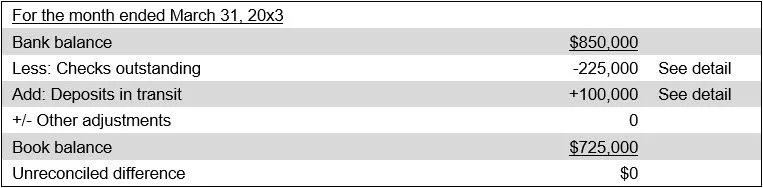
Sample bank reconciliation statement layout for a period, showing how the bank balance is adjusted for timing differences (checks outstanding and deposits in transit) to arrive at the book balance. This is a useful visual template for structuring exam answers where you reconcile one balance to the other in a consistent add/less format. Source
start with the balance as per updated cash book
compare the entries in the updated cash book with those in the bank statement
identify items that have been entered by the business but not yet by the bank
add items that make the bank statement balance higher than the updated cash book balance
deduct items that make the bank statement balance lower than the updated cash book balance
calculate the balance as per bank statement
Some questions begin with the bank statement balance and reconcile to the updated cash book balance instead. This is equally acceptable if the treatment of additions and deductions is consistent.
Care is needed where the business has a bank overdraft. In that case, the balance is adverse, so students must think carefully about whether an item increases or reduces the amount owed to the bank. It is safer to reason from the effect of each item than to memorize one fixed pattern.
The bank reconciliation statement itself is not a ledger account. The entries made to update the cash book affect the double entry records. The outstanding items listed in the bank reconciliation statement do not require further entries at that stage.
Good practice in reconciliation
A sound reconciliation process includes:
matching and ticking off entries that appear in both records
updating the cash book for omitted bank statement items
correcting any cash book errors
listing timing differences clearly and separately
checking that the final reconciled figure agrees exactly with the bank statement balance
keeping supporting documents such as bank statements, deposit evidence, and check records
Regular reconciliation improves confidence in the business’s cash records and helps ensure that errors are identified promptly rather than being carried forward.
Benefits of bank reconciliations
Bank reconciliations are useful because they:
improve the accuracy of the cash book
reveal omitted transactions such as charges, interest, and direct debits
help identify errors made in the cash book or by the bank
strengthen internal control over cash
make financial statement figures more reliable
help detect unusual, duplicate, or unauthorized transactions more quickly
Limitations of bank reconciliations
Bank reconciliations also have limitations:
they only show agreement between two records at one date
they do not prove that every transaction has been recorded correctly
they may not detect fraud if records have been deliberately manipulated
they depend on the accuracy of both the cash book and the bank statement
they do not automatically resolve old outstanding items that continue from one period to the next
Practice Questions
State two items shown on a bank statement that should be entered in the cash book before preparing a bank reconciliation statement. (2 marks)
1 mark for each correct item stated, up to 2 marks.
Accept any two of:
bank charges
bank interest
direct debits
standing orders
credit transfers
dishonored checks
correction of a cash book error revealed by the bank statement
At 31 August, the bank column of Rao’s updated cash book showed a debit balance of 4,860.
The following items were identified:
checks issued totaling 730 had not yet been presented for payment
a deposit of 1,240 had not yet been credited by the bank
the bank had wrongly debited Rao’s account with 95
Prepare the bank reconciliation statement as at 31 August.
(5 marks)
balance as per updated cash book 4,860: 1 mark
add unpresented checks 730: 1 mark
deduct outstanding deposit 1,240: 1 mark
deduct bank error 95: 1 mark
balance as per bank statement 4,255: 1 mark
Alternative layout acceptable if treatment is consistent and final balance is correct.
FAQ
There is no single rule for every business.
A business with many daily transactions may reconcile every day or every week, while a smaller business may do it monthly. At minimum, reconciliation should usually be done whenever a bank statement is received and at each reporting date.
More frequent reconciliation is useful when:
cash movements are high
fraud risk is higher
management needs close control over liquidity
A long-outstanding check should be investigated, not simply carried forward forever.
Possible reasons include:
the check was lost
the payee never presented it
the amount was recorded incorrectly
the check was canceled but not adjusted in the records
The business should check the original payment record, contact the payee if necessary, and follow its policy for canceling or reissuing old checks.
Yes. A reconciliation is prepared for each individual bank account.
This includes separate current accounts, savings accounts, payroll accounts, and foreign currency accounts. Combining them would hide differences and make errors harder to trace.
If money is transferred between two bank accounts, the transfer may appear in one account before the other. That timing difference should be handled within the separate reconciliation for each account.
Processing cut-off times matter.
A deposit made late in the day, on a weekend, or on the last day of a month may be recorded immediately in the cash book but not credited by the bank until the next business day. The same can happen with electronic payments.
This does not automatically mean an error has occurred. It often means the transaction is a valid timing difference linked to bank processing schedules.
Useful supporting documents include:
the full bank statement page
deposit slips or deposit confirmations
check counterfoils or check images
bank debit and credit advices
direct debit notices
electronic transfer confirmations
the previous period’s reconciliation
Using documents from both the business and the bank helps identify whether the problem is an omission, a timing issue, or an error by one side.