

Edexcel Syllabus focus:
'Know the differences between monosaccharides, disaccharides and polysaccharides, including glycogen, starch, amylose and amylopectin.'
Carbohydrates are grouped by the number of sugar units they contain. Understanding these groups helps you compare their size, structure, and properties, and distinguish clearly between starch, amylose, amylopectin, and glycogen.
Classifying carbohydrates
Carbohydrates are organic molecules built from sugar units. In this part of the course, the main difference between the three groups is how many sugar molecules are linked together.
Monosaccharides
A monosaccharide is the simplest type of carbohydrate.
Monosaccharide: A carbohydrate made of a single sugar unit.
Common examples include glucose, fructose, and galactose. These molecules are small and usually dissolve readily in water. Many monosaccharides taste sweet, which is a typical feature of small sugars.
In A-Level Biology, glucose is the key example to remember. It is often shown as a ring structure, although it can also exist in other forms in solution. Monosaccharides are the building blocks from which larger carbohydrates are formed.
Disaccharides
A disaccharide contains two monosaccharides joined together.
Disaccharide: A carbohydrate made of two monosaccharides linked together.
Disaccharides are still relatively small molecules, and many are soluble in water. Like monosaccharides, they often taste sweet, but they are larger and more complex than a single sugar unit.
Important examples are:
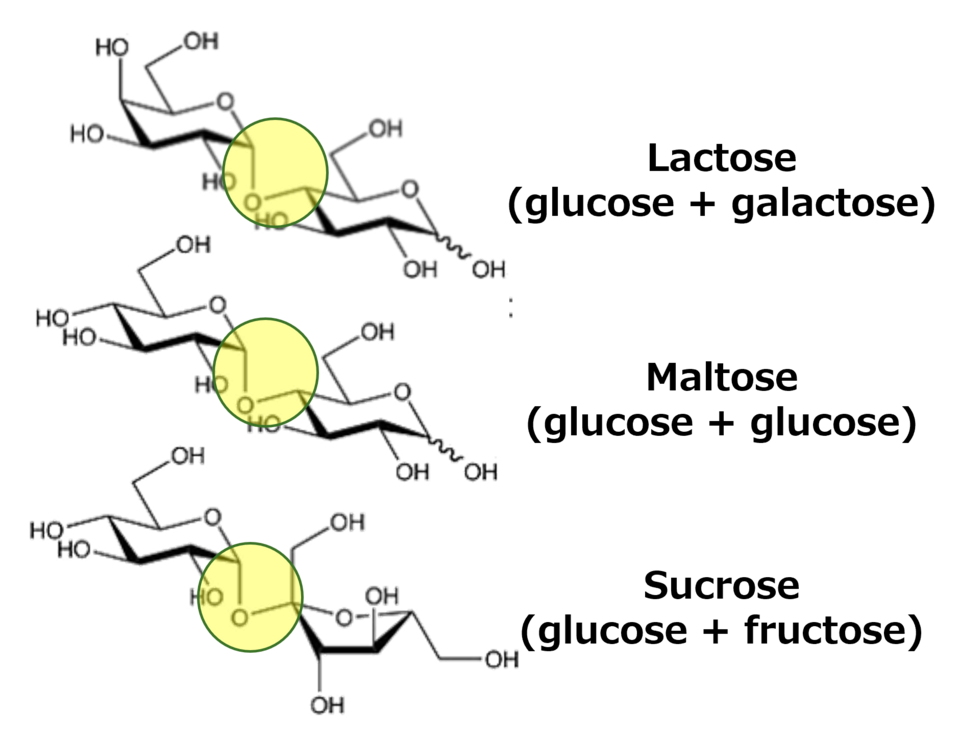
Structural formulas of the three key A‑Level disaccharides: maltose, lactose, and sucrose. The diagram highlights which monosaccharides combine in each case and where the glycosidic linkage is formed, making it easier to compare their compositions at a glance. Source
maltose = glucose + glucose
sucrose = glucose + fructose
lactose = glucose + galactose
These examples show that different monosaccharides can combine to produce different disaccharides. When comparing carbohydrate groups, remember that a disaccharide is not just a bigger sugar in a general sense; it has exactly two sugar units.
Polysaccharides
A polysaccharide is a much larger carbohydrate molecule made from many monosaccharides.
Polysaccharide: A carbohydrate made of many monosaccharide units joined in long chains.
Because they contain many sugar units, polysaccharides are macromolecules. Their chains may be unbranched or branched, and their exact length can vary. This means a polysaccharide does not usually have one fixed molecular size in the same way as a monosaccharide.
Compared with monosaccharides and disaccharides, polysaccharides are:
much larger
usually not sweet
usually insoluble or far less soluble in water
These differences are important because they help you recognize a carbohydrate from its properties as well as its structure.
The named polysaccharides in this topic
The specification requires you to know starch, amylose, amylopectin, and glycogen. These are related, but they are not all the same thing.
Starch
Starch is a polysaccharide made from alpha-glucose. A key point is that starch is not one single type of chain. Instead, it is a mixture of two polysaccharides:
amylose
amylopectin
This is a common source of confusion. Starch is the overall name, while amylose and amylopectin are its two components.
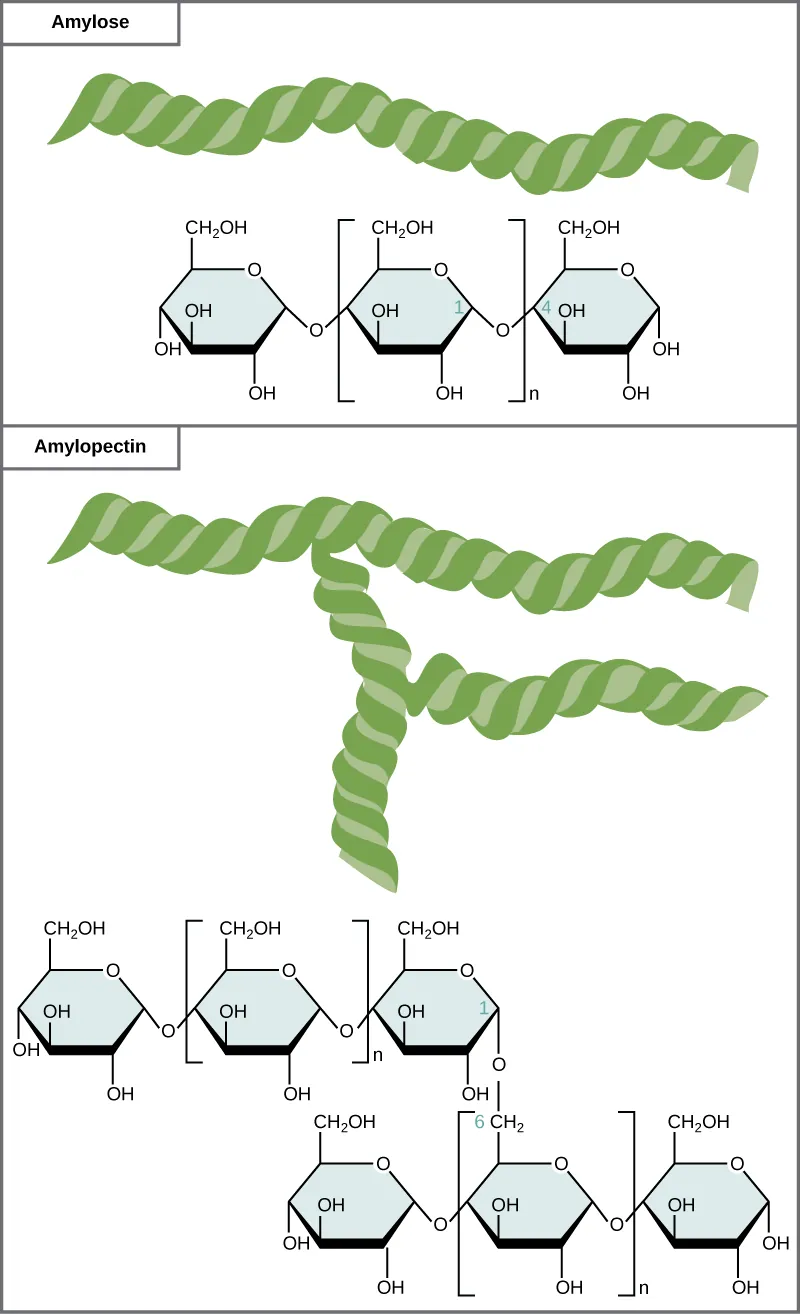
Diagram comparing amylose and amylopectin as two structural forms found within starch. Amylose is shown as an unbranched chain of glucose (α-1,4 linkages), while amylopectin includes branch points (α-1,6 linkages), visually linking “branching” to overall molecular architecture. Source
Amylose
Amylose is the unbranched component of starch. It is made of a long chain of alpha-glucose molecules and tends to form a coiled shape.
Its lack of branching makes it structurally different from amylopectin and glycogen. If you see a question asking for the straight-chain component of starch, the answer is amylose.
Amylopectin
Amylopectin is the branched component of starch. It is also made from alpha-glucose, but unlike amylose, it has side branches coming off the main chain.
This branching means amylopectin has a different overall shape from amylose. It is still part of starch, but it is not identical to the whole starch molecule by itself.
Glycogen
Glycogen is another polysaccharide made from alpha-glucose. It resembles amylopectin because it is branched, but it has more frequent branching than amylopectin.
This makes glycogen:
very compact
more highly branched than starch
structurally distinct from both amylose and amylopectin
A useful comparison is:
amylose = unbranched
amylopectin = branched
glycogen = very highly branched
Key differences to remember
When comparing the three carbohydrate groups, focus first on the number of sugar units:
monosaccharides contain one
disaccharides contain two
polysaccharides contain many
You should also compare their general properties:
monosaccharides and disaccharides are usually small and soluble
polysaccharides are large and usually insoluble
monosaccharides and disaccharides are often sweet
polysaccharides are usually not sweet
For the named polysaccharides, the most important structural distinctions are:
starch is made of amylose + amylopectin
amylose is unbranched
amylopectin is branched
glycogen is more highly branched than amylopectin
A strong exam answer uses these terms precisely. Do not write that starch and amylose are the same, and do not describe glycogen as identical to starch. They are related carbohydrates, but they differ in organization and degree of branching.
Practice Questions
State two differences between a monosaccharide and a polysaccharide. (2 marks)
1 mark for stating that a monosaccharide has one sugar unit and a polysaccharide has many sugar units.
1 mark for one other valid difference, such as:
monosaccharides are small, polysaccharides are large
monosaccharides are usually soluble, polysaccharides are usually insoluble
monosaccharides are often sweet, polysaccharides are usually not sweet
Starch and glycogen are both carbohydrates made from alpha-glucose. Describe the structure of starch and explain how glycogen differs from it. (5 marks)
1 mark for stating that starch is a polysaccharide
1 mark for stating that starch is made of amylose and amylopectin
1 mark for stating that amylose is unbranched
1 mark for stating that amylopectin is branched
1 mark for stating that glycogen is more highly branched than amylopectin or more highly branched than starch
Credit compactness of glycogen as an alternative valid point if not already credited
FAQ
Starch is called a mixture because natural starch contains two different alpha-glucose polymers: amylose and amylopectin.
The proportion of these two components can vary between plant species and even between different tissues in the same plant. That means one starch sample is not always identical to another, even though both are called starch.
No. A monosaccharide is defined by having one sugar unit, not by having a fixed number of carbon atoms.
Examples include:
trioses with 3 carbons
pentoses with 5 carbons
hexoses with 6 carbons
Glucose is a hexose monosaccharide, but not all monosaccharides are hexoses.
Branching means that side chains extend from the main carbohydrate chain instead of the molecule being one continuous straight chain.
A branched polysaccharide has:
a main chain
additional shorter chains attached at certain points
This gives the molecule a more compact shape and creates more ends on the structure than an unbranched chain would have.
When glucose forms a ring, the arrangement around one carbon atom can differ slightly. This produces different forms, such as alpha-glucose and beta-glucose.
They have the same atoms and molecular formula, but the atoms are arranged differently in space. That small structural difference matters because it affects which larger carbohydrates can be built from the glucose molecules.
A glucose molecule always has the same number of atoms, so its molecular mass is fixed. A polysaccharide is different because its chain length can vary.
For example, two amylose molecules are both amylose, but one may contain many more glucose units than the other. As a result, polysaccharides are often described as having a range of molecular masses rather than one exact value.

.png)