

Edexcel Syllabus focus:
'Relate the structures of monosaccharides, disaccharides and polysaccharides to their roles in providing and storing energy.'
Carbohydrates differ in size, shape, and solubility, and these structural differences explain why some are used for immediate energy while others are better suited to storing energy reserves.
Carbohydrates and energy
Carbohydrates are organic molecules containing carbon, hydrogen, and oxygen. Their importance in biology comes from the fact that they can be used in respiration to release energy for cell processes. The main carbohydrate groups differ in the number of sugar units they contain, and this affects how they behave in cells and body fluids.
A key idea for this topic is that small, soluble carbohydrates are useful when energy is needed quickly, whereas large, insoluble carbohydrates are more suitable for storage.
Monosaccharides: rapid energy supply
The simplest carbohydrate type is the monosaccharide.
Monosaccharide — a single sugar unit, which is the simplest form of carbohydrate.
A major example is glucose, which is the main respiratory substrate in many cells.
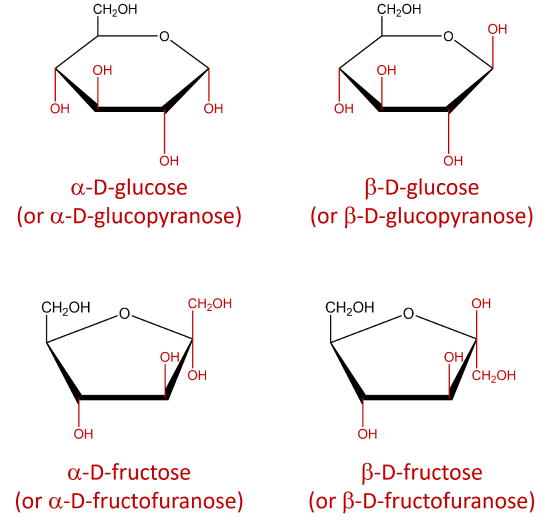
Haworth projections showing the cyclic (ring) structures of glucose and fructose, with each monosaccharide clearly named. This helps you visualize what a monosaccharide looks like structurally, which is useful when connecting small sugar structure to rapid transport and use in respiration. Source
Monosaccharides are well suited to providing energy quickly because they are:
small, so they can move easily into cells
soluble in water, so they can be transported in blood plasma and tissue fluid
readily used in respiration, so energy can be released without first breaking down a large molecule
easily accessed by enzymes because of their simple structure
This makes monosaccharides especially important in tissues with high metabolic activity, where a rapid energy supply is needed.
However, monosaccharides are poor storage molecules. If a cell stored large amounts of glucose, the glucose would contribute to the cell's solute concentration. This would lower the water potential of the cell and could cause water to enter by osmosis. As a result, cells usually convert glucose into larger carbohydrate molecules for storage.
Disaccharides: small but less osmotically active
A disaccharide contains two monosaccharides joined together.
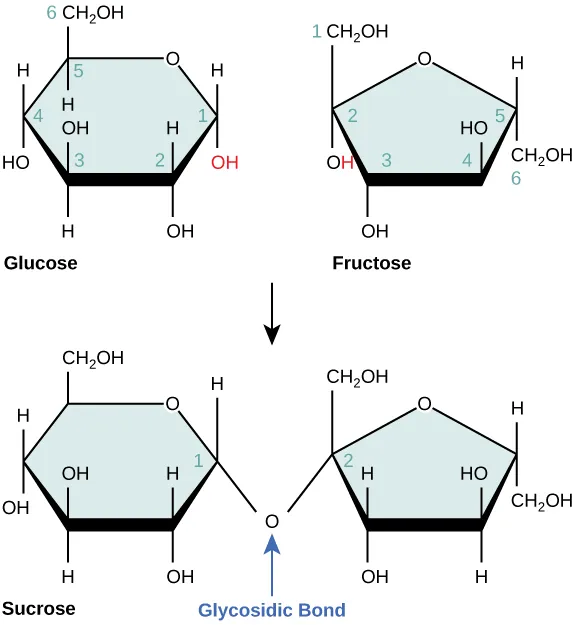
Reaction-style diagram showing sucrose formation from two monosaccharides via a dehydration (condensation) reaction, producing a glycosidic bond and releasing water. This illustrates the structural basis of disaccharides as ‘two sugars linked together’ and why hydrolysis can later split them back into monosaccharides. Source
Disaccharide — a carbohydrate made from two monosaccharides linked together.
Disaccharides are still relatively small and soluble, so they can also play an energy role. They are useful because they can be split into monosaccharides and then used in respiration.
Compared with separate monosaccharides, disaccharides have some advantages:
they still dissolve in water and can be transported in solution
they store more energy per molecule than a single monosaccharide
they have a lower osmotic effect than the same number of separate monosaccharide molecules
This means they are a useful intermediate form: still suitable for energy supply, but slightly less disruptive to water potential than storing the same sugars as free monosaccharides. Even so, they are not ideal for long-term storage because they remain soluble.
Polysaccharides: efficient energy stores
The largest carbohydrate group is the polysaccharide.
Polysaccharide — a large carbohydrate made from many monosaccharides linked together.
Polysaccharides are much better suited to energy storage than mono- or disaccharides. Important examples are starch in plants and glycogen in animals.
Their structure makes them effective storage molecules because they are:
insoluble, so they do not significantly affect water potential
unable to diffuse out of cells easily because they are large
compact, so lots of energy can be stored in a small volume
made of many glucose units, so one molecule contains a large energy reserve
Because polysaccharides are insoluble, they can be stored inside cells without drawing in large amounts of water. This is a major advantage over storing large amounts of free glucose.
In plants, energy is stored mainly as starch.
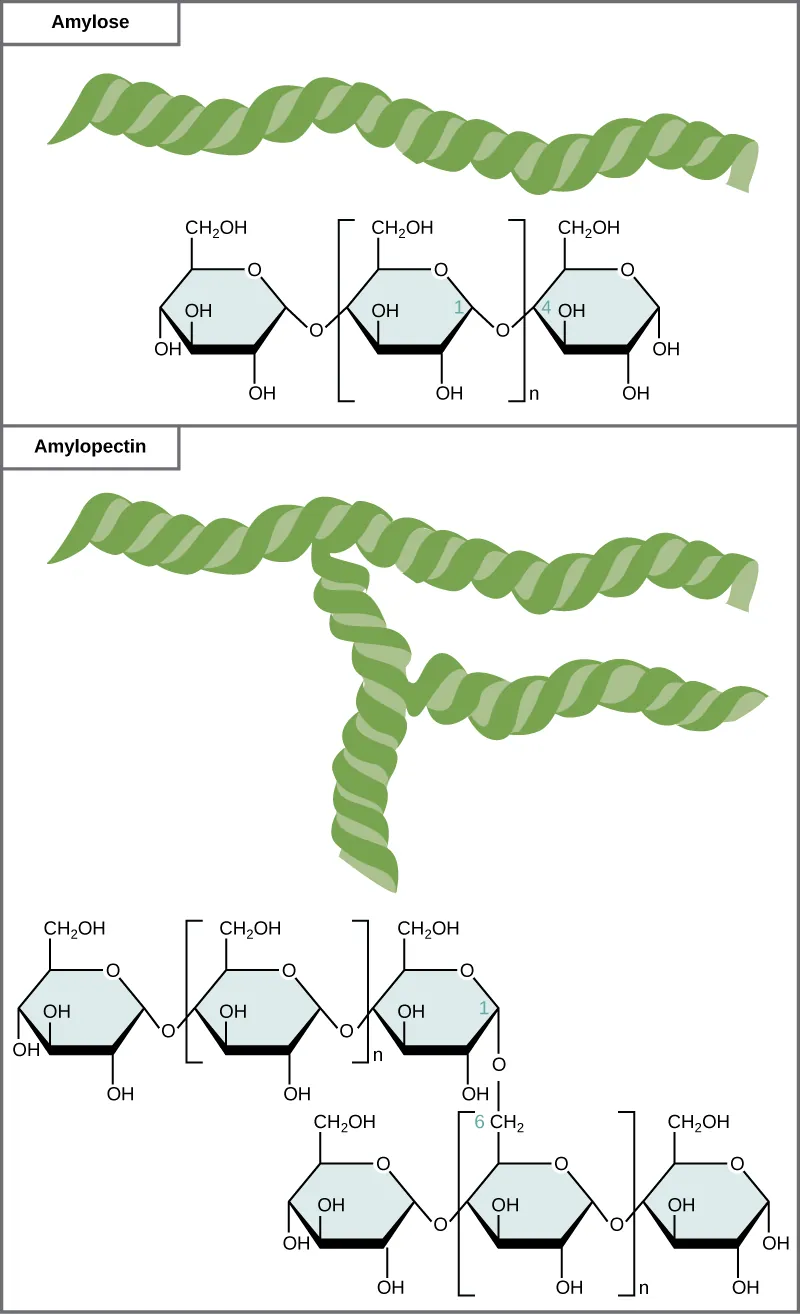
Diagram comparing amylose (unbranched) and amylopectin (branched), with the glycosidic linkages labeled (α-1,4 in the main chain and α-1,6 at branch points). It visually explains why branching increases the number of chain ends available for enzyme action, enabling faster glucose release when required. Source
Starch contains:
amylose, which is long and unbranched and coils into a compact helical shape
amylopectin, which is branched
The coiled structure of amylose helps make starch compact. The branched structure of amylopectin provides more ends where enzymes can act, so glucose can be released more rapidly when needed.
In animals, energy is stored mainly as glycogen. Glycogen is similar to amylopectin, but it is more highly branched. This means there are even more ends available for enzyme action, allowing very fast glucose release. This is useful because animals often have rapid and changing energy demands, especially in muscles.
How structure determines role
For providing energy
Monosaccharides and disaccharides are suitable for energy supply because they are:
small
soluble
quickly available to enzymes
able to support respiration without the delay of breaking down a very large molecule first
This makes them appropriate for immediate or short-term energy needs.
For storing energy
Polysaccharides are suitable for energy storage because they are:
insoluble, so they do not create osmotic problems
large, so they stay inside cells
compact, so a lot can be stored in little space
often branched, allowing relatively rapid glucose release when required
A useful comparison is that many separate glucose molecules would each contribute to osmotic effects, but a single polysaccharide molecule made from many glucose units greatly reduces that problem. This is why storage carbohydrates are polymers rather than free sugars.
Key relationships to remember
Monosaccharides: immediate energy because they are small and soluble
Disaccharides: still soluble and useful for energy supply after splitting into monosaccharides
Polysaccharides: storage molecules because they are insoluble, compact, and contain many glucose units
Amylose: compact storage because of its coiled shape
Amylopectin and glycogen: faster glucose release because branching provides many sites for enzyme action
Practice Questions
State two features of a monosaccharide that make it suitable for providing energy quickly in cells. (2 marks)
Any two from:
small molecule / can move easily into cells
soluble in water / can be transported in solution
can be used directly in respiration
readily acted on by enzymes
Explain how the structure of starch and glycogen makes them suitable for energy storage. (5 marks)
both are made from many glucose units / store a large amount of energy
insoluble / do not significantly affect water potential
do not cause large water uptake by osmosis
large molecules / do not diffuse out of cells easily
compact / can store much energy in a small volume
branching allows rapid enzyme action / rapid glucose release
glycogen is more highly branched than starch / amylopectin, so glucose can be released especially quickly
max 5 marks
FAQ
Animals often have sudden changes in energy demand, especially during movement. A more highly branched molecule has more ends available for enzymes to act on at the same time.
This means glycogen can release glucose faster than starch, which is useful in tissues such as muscle.
Granules keep many glucose units packed together in one place, which makes storage more organized and efficient.
They also help localize the carbohydrate reserve near the enzymes involved in adding or removing glucose units, allowing better control of energy storage and release.
No. The way glucose units are arranged matters as much as the fact that glucose is present.
Polymers made from $\alpha$-glucose, such as starch and glycogen, are well suited to storage.
Polymers made from $\beta$-glucose, such as cellulose, form strong straight fibers and are much less suitable for rapid energy release in humans.
The rate of energy release depends on how quickly the carbohydrate can be digested and absorbed.
small sugars are absorbed quickly
long chains usually take longer to digest
less branched molecules are often broken down more slowly
fiber, fat, and protein in the same meal can slow digestion further
So two foods with similar carbohydrate content may not provide energy at the same speed.
Liver glycogen helps maintain blood glucose levels between meals. When blood glucose falls, the liver can release glucose into the bloodstream.
Muscle glycogen is mainly a local energy store. Muscle cells use it for their own respiration during contraction rather than exporting large amounts of glucose to other tissues.

.png)