

Edexcel Syllabus focus:
'Core Practical 2: Investigate the vitamin C content of food and drink.'
This practical measures vitamin C in foods and drinks by using a dye that changes color when reduced, allowing careful comparison of unknown samples with a known standard solution.
Principle of the practical
Vitamin C, also called ascorbic acid, is a reducing agent. In this practical it reacts with DCPIP (2,6-dichlorophenolindophenol), a blue dye. When DCPIP is reduced by vitamin C, it becomes colorless.

Reaction scheme showing the reduction of DCPIP during the vitamin C test. It links the chemical redox change to the practical observation that the blue dye is decolourised when reduced by ascorbic acid. Source
This visible change makes it possible to estimate how much vitamin C is present in a sample.
A fixed amount of DCPIP is used in each trial. The amount of sample needed to remove the blue color shows how much vitamin C the sample contains. A sample with a high vitamin C concentration will need a smaller volume to reach the color change than a weaker sample.
The reaction is judged by the point where the blue color just disappears and does not return after mixing.
Endpoint: The point in a test at which a visible color change shows that the reaction being used for measurement has just been completed.
Because the endpoint depends on observing color, the method works best when the sample is not very dark or cloudy.
Method overview
A common school or college method uses a standard vitamin C solution and one or more food or drink samples.
Place a measured volume of DCPIP solution into a test tube, conical flask, or spotting tile well.
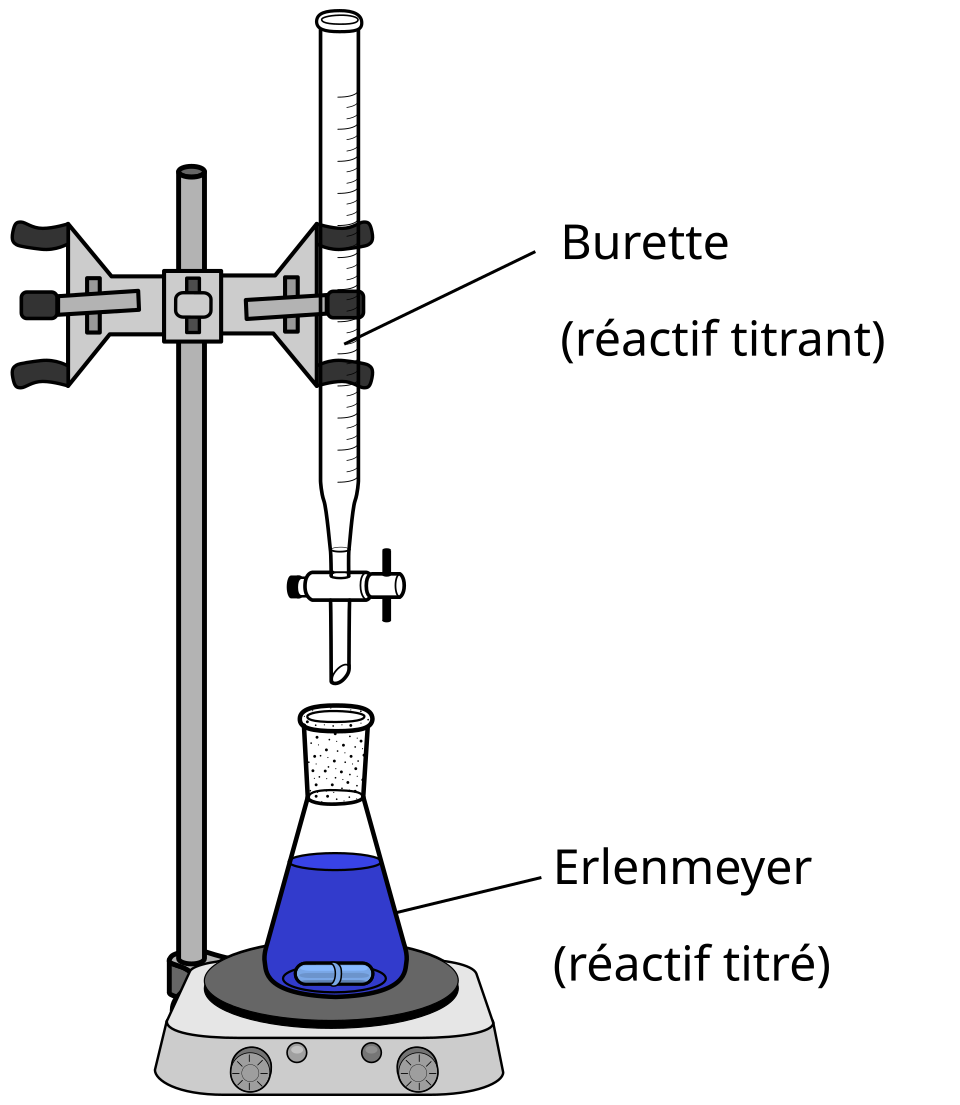
Labelled diagram of a standard titration apparatus setup (burette clamped above a conical flask, typically used over a contrasting background/white tile). This is the same physical arrangement used when adding vitamin C solution dropwise to DCPIP to detect the endpoint by a colour change. Source
Fill a burette, syringe, or pipette with a known concentration of vitamin C solution.
Add the vitamin C solution gradually to the DCPIP while mixing.
Stop when the blue color disappears at the endpoint.
Record the volume of vitamin C solution used.
Repeat the test several times and calculate a mean from similar results.
Carry out the same procedure using the food or drink sample.
Compare the volume of sample needed with the volume of the standard solution.
If a food sample is solid, it is usually crushed, blended, or filtered to obtain a liquid extract. Drinks may need dilution if they contain a lot of vitamin C, because very small volumes are harder to measure accurately. Samples should be tested quickly after preparation because vitamin C is easily oxidized by air.
The practical can be done in two main ways:
Direct comparison of unknown samples by seeing which needs the smallest volume to decolorize the same amount of DCPIP
Standardization, where a known vitamin C solution is first used so that the vitamin C concentration of an unknown sample can be estimated more accurately
Using the same apparatus throughout helps reduce variation caused by equipment differences.
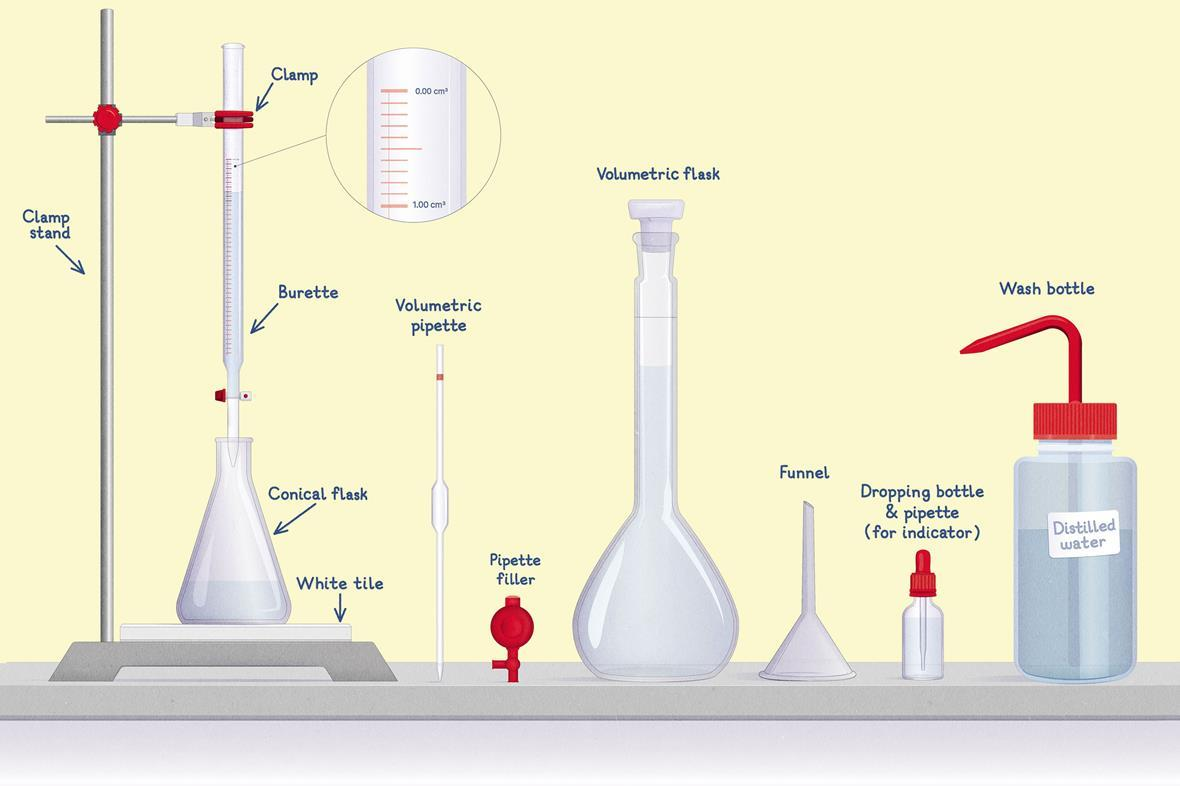
Poster-style diagram identifying the key pieces of titration apparatus and their roles (e.g., burette for precise delivery, conical flask for swirling/mixing, and white tile to make the endpoint colour change easier to see). This reinforces why consistent equipment and careful handling improve accuracy and reliability in the DCPIP vitamin C practical. Source
Making results quantitative
To make the investigation quantitative, the known vitamin C solution is treated as a standard. If a certain volume of the standard decolorizes the fixed DCPIP volume, then that volume contains the amount of vitamin C needed to reach the endpoint.
The food or drink sample is then tested against the same DCPIP volume. The amount of vitamin C in the unknown sample can be found by comparing how much of it is needed relative to the standard.
Important points when processing results include:
A smaller volume of sample to reach the endpoint means a higher vitamin C concentration
A larger volume of sample means a lower vitamin C concentration
If the sample was diluted before testing, the final answer must be adjusted for the dilution factor
Results are often expressed per unit volume of drink or per mass of food extract, depending on how the sample was prepared
This is a comparison method, so consistency is essential. Any change in the DCPIP volume or concentration would affect the result.
Variables and controls
In this practical, the independent variable is usually the food or drink sample being tested. The dependent variable is the volume of sample required to reach the endpoint.
Important control variables include:
volume of DCPIP used each time
concentration of DCPIP
temperature
mixing method
time between sample preparation and testing
same observer deciding the endpoint
same lighting conditions
Controlling these variables makes the comparison fair. For example, testing one sample immediately but leaving another exposed to air for a long time could cause false differences because vitamin C breaks down over time.
Accuracy, reliability, and sources of error
This practical can produce useful data, but several factors affect quality.
To improve accuracy:
use a pipette or burette with fine graduations
read the meniscus at eye level
add the sample slowly near the endpoint
place the tube or flask against a white background to see the color change more clearly
filter pulpy samples so liquid can be measured more precisely
To improve reliability:
repeat each test at least three times
reject clearly anomalous results
use close results to calculate a mean
prepare fresh DCPIP and fresh vitamin C standard when possible
Common sources of error include:
judging the endpoint differently between trials
oxidation of vitamin C before testing
colored fruit juices masking the endpoint
incomplete mixing
contamination from unwashed apparatus
inaccurate dilution of concentrated samples
Reliability is especially important because the endpoint can be subjective. If repeat values are close together, confidence in the result is higher.
Safety and practical considerations
Although this is a low-risk practical, standard laboratory care is still needed.
Wear eye protection when handling DCPIP and glassware.
Avoid skin contact and wash off spills promptly.
Take care with sharp glassware, especially pipettes and burettes.
Do not eat or drink any laboratory samples, even if they are food products.
Dispose of chemicals and food extracts as instructed.
Good practical technique matters as much as the chemistry. Fresh samples, careful measurement, and consistent endpoint judgment are what make the investigation a valid test of vitamin C content.
Practice Questions
State the color change seen when DCPIP reacts with vitamin C and explain what this shows.
[2 marks]
1 mark: DCPIP changes from blue to colorless
1 mark: this shows that vitamin C has reduced the DCPIP / the endpoint has been reached
A student wants to compare the vitamin C content of two fruit juices using DCPIP. Describe how the student should carry out the investigation to obtain valid and reliable results.
[5 marks]
1 mark: place the same measured volume of DCPIP into each tube / flask / well
1 mark: add each juice from a measuring device such as a pipette or burette until the blue color just disappears
1 mark: record the volume of juice needed to reach the endpoint
1 mark: repeat trials and calculate a mean from similar results
1 mark: control relevant variables, such as DCPIP concentration, temperature, lighting, or time after sample preparation
FAQ
Labels are usually based on manufacturer testing across batches, not on a single sample from one container.
They can also differ because:
labels may report values per serving or per 100 mL
vitamin C decreases during storage
legal labeling rules allow some variation
the lab sample may have been stored differently before testing
So a measured result is not always expected to match the printed value exactly.
Vitamin C is water-soluble and also sensitive to heat, so cooking method matters a lot.
Boiling often causes the largest loss because vitamin C can dissolve into the cooking water.
Steaming usually preserves more because less water is involved.
Microwaving can also retain more if cooking time is short.
Long cooking times and repeated reheating usually lower the final amount further.
This is why cooked samples often give lower values than raw ones.
Natural variation is a major reason.
Vitamin C content can change with:
variety of orange
ripeness
growing conditions such as light, temperature, and soil
time spent in storage after harvest
which part of the fruit was sampled
So even a well-run practical may show real biological differences between apparently similar fruits.
Packaging changes how much light and oxygen reach the drink.
Opaque cartons and well-sealed containers usually protect vitamin C better than clear bottles that allow light through.
Once opened, oxygen enters the container and vitamin C can decline faster. Large bottles may lose vitamin C more quickly after opening simply because they are opened repeatedly over several days.
Some drinks are fortified, meaning extra ascorbic acid is added during production.
Manufacturers may do this:
to replace vitamin C lost during processing
to improve the nutritional value on the label
to maintain a target level until the end of shelf life
A practical test measures the total vitamin C present, whether it came naturally from the fruit or was added during manufacture.


