

Edexcel Syllabus focus:
'Know how monosaccharides form disaccharides and polysaccharides by condensation reactions forming glycosidic bonds, and how hydrolysis splits them.'
Carbohydrates can be built up from small sugar units or broken down again. Understanding condensation, glycosidic bonds, and hydrolysis is essential for explaining how larger carbohydrate molecules are formed and split.
Forming larger carbohydrate molecules
A condensation reaction is the reaction that joins monosaccharides together.
Condensation reaction: A reaction in which two molecules join together and a molecule of water is produced.
When two monosaccharides react in a condensation reaction, they become linked and form a disaccharide.
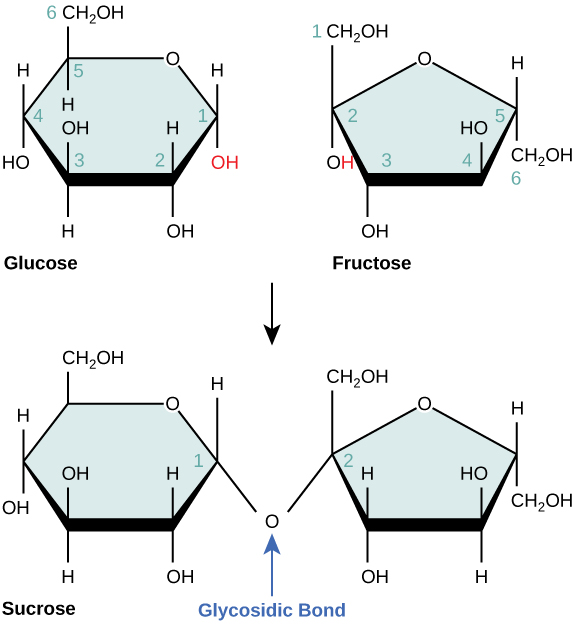
Two monosaccharides (glucose and fructose) are shown joining to form the disaccharide sucrose, with the new covalent linkage labeled as the glycosidic bond. This diagram makes the “two small sugars become one larger sugar” step explicit and anchors the idea that the bond forms between specific numbered carbons. Source
During this process, one molecule of water is released.
This happens because:
one monosaccharide contributes a hydrogen atom
the other contributes a hydroxyl group
these combine to form water
the remaining parts of the two monosaccharides become joined
For example, two monosaccharides can join to make one disaccharide and water. The key idea is not the exact sugar names, but that small sugar units are linked together by removing water.
Condensation reactions are also used repeatedly to build polysaccharides.
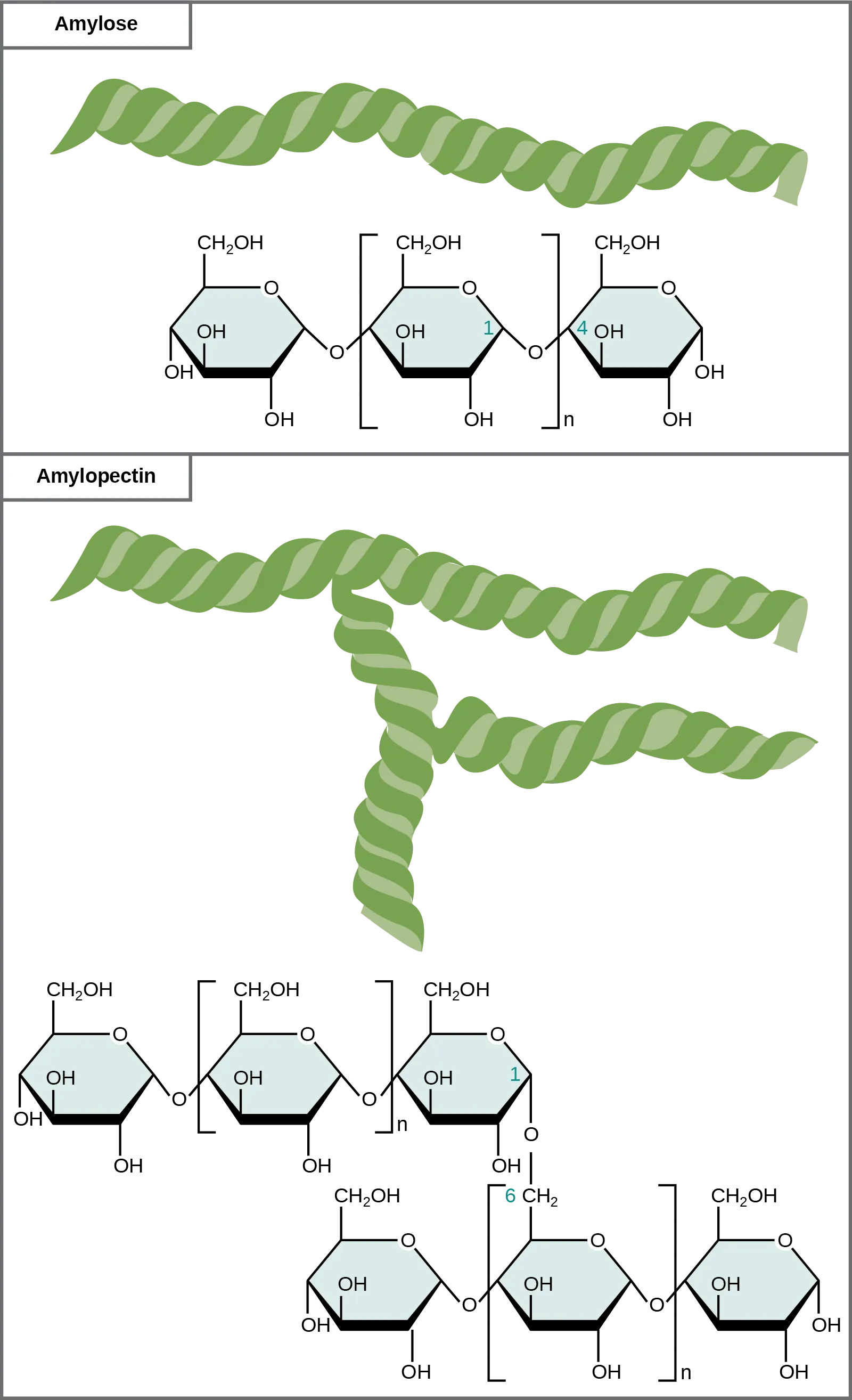
Amylose is shown as a largely unbranched chain of glucose, while amylopectin is shown with branch points—highlighting how polysaccharides can be linear or branched. This helps connect repeated glycosidic bond formation to large-scale carbohydrate structure (and why different linkages/branching patterns change overall shape). Source
A polysaccharide is made when many monosaccharides are joined in a chain or branched structure by many repeated condensation reactions.
Glycosidic bonds
The link formed between monosaccharides is called a glycosidic bond.
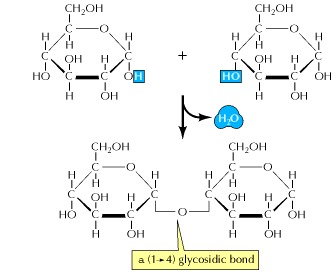
This figure illustrates two glucose molecules being linked by a dehydration (condensation) reaction to form a glycosidic bond (example shown as an linkage). The drawing emphasizes that water is removed during bond formation and that the linkage is a specific covalent bond between defined carbon atoms. Source
Glycosidic bond: A covalent bond formed between monosaccharides during a condensation reaction.
A glycosidic bond is important because it holds the sugar units together in a stable way. Since it is a covalent bond, it is strong and does not break spontaneously under normal cellular conditions.
Each time a glycosidic bond forms:
two monosaccharides become chemically linked
one molecule of water is released
the product becomes a larger carbohydrate molecule
If only one glycosidic bond is formed, the result is a disaccharide. If many glycosidic bonds are formed one after another, the result is a polysaccharide.
A useful rule is that every new glycosidic bond formed means one water molecule has been removed. This helps explain how long carbohydrate chains can be assembled step by step from many individual monosaccharides.
Different carbohydrates can have different glycosidic bonds, depending on which carbon atoms are involved in the joining. This affects the final shape of the molecule, but for this topic the main point is that glycosidic bonds are the bonds produced by condensation between sugar molecules.
From monosaccharides to polysaccharides
The process of building larger carbohydrates can be thought of as a sequence.
Making a disaccharide
start with two monosaccharides
a condensation reaction occurs
one glycosidic bond forms
one molecule of water is released
the product is a disaccharide
Making a polysaccharide
start with many monosaccharides
repeated condensation reactions occur
many glycosidic bonds form
a water molecule is released each time a bond forms
the product is a polysaccharide
This means that polysaccharide formation is simply multiple condensation reactions repeated many times.
It is important to remember that the monosaccharides are not just mixed together physically. They are chemically bonded together. That is why a polysaccharide behaves as one large molecule rather than as many separate sugar molecules.
Breaking carbohydrate molecules apart
The reverse of condensation is hydrolysis.
Hydrolysis: A reaction in which a molecule is split into smaller molecules by the addition of water.
In hydrolysis, water is used to break a glycosidic bond. This means that:
a larger carbohydrate is split into smaller units
the bond between sugar molecules is broken
water is a reactant, not a product
Hydrolysis can split:
a disaccharide into two monosaccharides
a polysaccharide into shorter polysaccharides, disaccharides, or monosaccharides
If only one glycosidic bond in a long polysaccharide is broken, only part of the chain is separated. Complete hydrolysis would require many glycosidic bonds to be broken.
In living organisms, hydrolysis reactions are usually catalyzed by enzymes. These enzymes are specific, so different enzymes act on different carbohydrate molecules or different types of glycosidic bond. This allows carbohydrate breakdown to be controlled and efficient.
Condensation and hydrolysis as opposite processes
Condensation and hydrolysis are opposites:
condensation builds larger carbohydrates from smaller ones
hydrolysis breaks larger carbohydrates into smaller ones
condensation releases water
hydrolysis uses water
condensation forms glycosidic bonds
hydrolysis breaks glycosidic bonds
Common misunderstandings
Students often confuse what happens to water in each reaction:
in condensation, water is produced
in hydrolysis, water is added
Another common error is to say that hydrolysis always produces monosaccharides immediately. In fact, a polysaccharide may first be split into shorter chains before being fully broken down.
You should also be precise with terminology:
monosaccharides are the single sugar units
disaccharides contain two monosaccharides joined by one glycosidic bond
polysaccharides contain many monosaccharides joined by many glycosidic bonds
For Edexcel A-Level Biology, the key link is simple: monosaccharides join by condensation to form glycosidic bonds, producing disaccharides and polysaccharides, and hydrolysis reverses this by using water to split those bonds.
Practice Questions
State what happens during a condensation reaction between two monosaccharides. (2 marks)
one mark for stating that the monosaccharides join together / form a disaccharide
one mark for stating that water is released / removed
one mark for stating that a glycosidic bond forms
Explain how condensation and hydrolysis are involved in the formation and breakdown of polysaccharides. (5 marks)
condensation joins monosaccharides together
a glycosidic bond is formed between monosaccharides
one molecule of water is released for each bond formed
repeated condensation reactions produce a polysaccharide
hydrolysis is the reverse process
water is used to break a glycosidic bond
hydrolysis of a polysaccharide forms smaller carbohydrates / disaccharides / monosaccharides
Max 5 marks.
FAQ
It is called dehydration synthesis because water is removed as the larger molecule is built.
“Dehydration” refers to the removal of water
“synthesis” means building a larger molecule from smaller ones
In carbohydrate chemistry, the term means that monosaccharides are joined together while a water molecule is produced.
A single glycosidic bond forms when two sugar molecules react at one joining point.
At that point:
one molecule provides a hydrogen
the other provides a hydroxyl group
these combine to make one water molecule
So each bond-forming event releases one water molecule. If many bonds form, many water molecules are produced.
Enzymes are specific because their active sites have particular shapes.
This means:
one enzyme may bind only a certain disaccharide
another may act only on a certain polysaccharide
some enzymes recognize the position of the glycosidic bond as well as the sugar involved
This specificity helps cells control which carbohydrates are broken down and when.
Although hydrolysis uses water, water alone is usually not enough to make the reaction happen quickly.
Glycosidic bonds are stable, so hydrolysis often needs:
an enzyme to lower activation energy
the correct molecular orientation
suitable conditions such as pH
Without catalysis, the reaction may be extremely slow.
Yes. Hydrolysis does not have to break every glycosidic bond in a carbohydrate.
For a polysaccharide, partial hydrolysis can produce:
shorter polysaccharide chains
disaccharides
a mixture of different-sized fragments
Complete hydrolysis happens only when all relevant glycosidic bonds have been broken, leaving monosaccharides.
